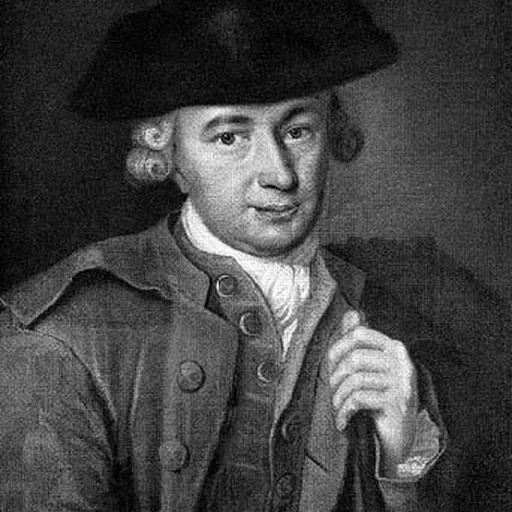
About Johann Georg Hamann
Lived 1730 – 1788 (aged 57). Johann Georg Hamann was a German philosopher, writer, lutenist, theologian and art historian.
Early life
Hamann was born on 27 August 1730 in Königsberg (now Kaliningrad, Russia). Initially he studied theology at the University of Königsberg, but became a clerk in a mercantile house and afterward held many small public offices, devoting his leisure to reading philosophy. He wrote under the pen name of "the Magus of the North" .
His translation of David Hume into German is considered by most scholars to be the one that Hamann's friend Immanuel Kant, also from Königsberg, credited with awakening him from his "dogmatic slumber". Hamann and Kant held each other in mutual respect, although Hamann once declined an invitation by Kant to co-write a physics textbook for children. Hamann also introduced Kant to the work of Rousseau.
Music Hamann was a lutenist, having studied this instrument with Timofiy Bilohradsky (a student of Sylvius Leopold Weiss), a Ukrainian virtuoso then living in Königsberg.
Philosophical views His distrust of autonomous, disembodied reason and the Enlightenment ("I look upon the finest logical demonstration the way a sensible girl regards a love letter" was one of his many witticisms) led him to conclude that faith in God was the only solution to the vexing problems of philosophy.
One of Kant's biographers compared him with Hamann:
In Hamann's own terms Kant was a "Platonist" about reason, believing it disembodied, and Hamann an "Aristotelian" who believed it was embodied. Hamann was greatly influenced by Hume. This is most evident in Hamann's conviction that faith and belief, rather than knowledge, determine human actions.
Hamann famously used the image of Socrates, who often proclaimed to know nothing, in his Socratic Memorabilia, an essay in which Hamann critiques the Enlightenment's dependence on reason. In Aesthetica in nuce, Hamann counters the Enlightenment by emphasizing the importance of aesthetic experience and the role of genius in intuiting nature.
Editions Fragments of his writings were published by Cramer, under the title of Sibyllinische Blätter des Magus aus Norden (1819), and a complete edition by Roth (7 vols., 1821–25, with a volume of additions and explanations by Wiener, 1843). Hamann's des Magus in Norden Leben und Schriften, edited by Gildemeister, was published in 5 vols., 1857–68, and a new edition of his Schriften und Briefen, edited by Petri, in 4 vols., 1872–74.
God Hamann argued that the communicatio idiomatum, namely, the communication of divine messages through material embodiments, applies not just to Christ, but should be generalised to cover all human action: "This communicatio of divine and human idiomatum is a fundamental law and the master-key of all our knowledge and of the whole visible economy." Hamann believed all of creation were signs from God for us to interpret.
Reason is language His most notable contributions to philosophy were his thoughts on language, which have often been considered as a forerunner to the linguistic turn in analytic philosophy such as Wittgenstein's. He famously said that "Reason is language" ("Vernunft ist Sprache"). Hamann thought the bridge between Kant's noumenal and phenomenal realms was language, with its noumenal meaning and phenomenal letters.
Legacy and evaluation Hamann was one of the precipitating forces for the Counter-Enlightenment. He was, moreover, a mentor to Herder and an admired influence on Goethe, Jacobi, Hegel, Kierkegaard, Lessing, and Mendelssohn. Roman Catholic theologian Hans Urs von Balthasar devoted a chapter to Hamann in his volume, Studies in Theological Styles: Lay Styles (Volume III in the English language translation of The Glory of the Lord series). Most recently, Hamann's influence can be found in the work of the theologians Oswald Bayer (Lutheran), John Milbank (Anglican), and David Bentley Hart (Eastern Orthodox). Finally, in Charles Taylor's important summative work, The Language Animal: The Full Shape of the Human Linguistic Capacity (Taylor, 2016), Hamann is given credit, along with Wilhelm von Humboldt and Herder, for inspiring Taylor's "HHH" (Hamann, Herder, and Humboldt) approach to the philosophy of language, emphasizing the creative power and cultural specificity of language.
Historian of ideas Isaiah Berlin writes that Hamann "struck the most violent blow against the Enlightenment" and was "the first person to declare war upon the Enlightenment in the most open, violent and complete fashion." While describing Hamann as one of "the few wholly original critics of modern times", Berlin also asserts that the German philosopher was "the pioneer of anti-rationalism in every sphere." However, according to John Betz, "modern Hamann scholarship has come to see that he was, in some sense, radically progressive – in fact, as Oswald Bayer has put it, a 'radical Enlightener.'" Bayer views him as less the proto-Romantic that Herder presented, and more a premodern-postmodern thinker who brought the consequences of Lutheran theology to bear upon the burgeoning Enlightenment and especially in reaction to Kant.
Don’t just read it —
keep it.
Full-length biographies made to live with: read them, listen on the way to work, watch them tonight.
- E-book
- Audio
- Video
Instant download · yours to keep · every purchase keeps this site free
Important facts
People in Johann Georg Hamann's life
Named in this biography and alive at the same time
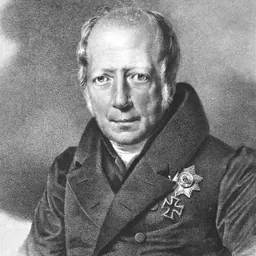




Related people
Same field, nearest in time

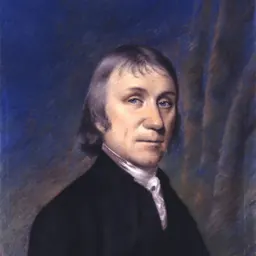


Contemporaries
People whose lives overlapped Johann Georg Hamann's



Frequently asked questions
Who was Johann Georg Hamann?
German philosopher (1730-1788)
When was Johann Georg Hamann born?
Johann Georg Hamann was born on 27 August 1730 in Königsberg.
When did Johann Georg Hamann die?
Johann Georg Hamann died on 21 June 1788 in Münster.
What was Johann Georg Hamann's occupation?
Johann Georg Hamann was a philosopher, writer, lutenist, theologian and art historian.
What nationality was Johann Georg Hamann?
Johann Georg Hamann was German.
Sources & further reading
· Wikipedia: Johann Georg Hamann
· DBpedia: Johann Georg Hamann
Cite this page
APA: Biography.guide. (2026). Johann Georg Hamann. https://biography.guide/johann-georg-hamann/
MLA: "Johann Georg Hamann." Biography.guide, https://biography.guide/johann-georg-hamann/.
Chicago: "Johann Georg Hamann." Biography.guide. https://biography.guide/johann-georg-hamann/.
Data last updated: 2026-09-23 · Spot an error? Report a correction.
Portrait: Wikimedia Commons · author & licence
Page generated 2026-09-27 05:06 UTC