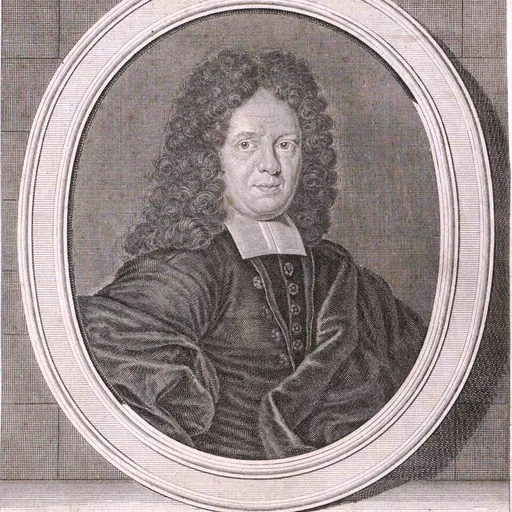
About Johann Franz Buddeus
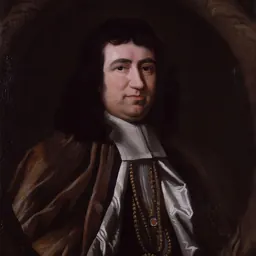
Lived 1667 – 1729 (aged 62). Johann Franz Buddeus was a German theologian, university teacher and philosopher.
Johann Franz Buddeus or Budde (sometimes Johannes Franciscus Buddeus; 25 June 1667, Anklam – 19 November 1729, Gotha) was a German Lutheran theologian and philosopher.
Early life and education Buddeus was a descendant of the French scholar Guillaume Budé, also known by the Latinized name Budaeus; the Huguenots family fled France after the St. Bartholomew's Day Massacre, and those who emigrated to Pomerania Germanized their name as Budde, the Latin equivalent of which was Buddeus.
He was born at Anklam, Swedish Pomerania, where his father was pastor. He early received a thorough education in classical and Oriental languages, and had read the Bible through in the original before he went to the University of Wittenberg in 1685. He was appointed adjunct professor of philosophy there soon after taking his master's degree in 1687, and in 1689 exchanged this for a similar position at Jena, where he also paid much attention to the study of history.
Career In 1692, he went to Coburg as professor of Greek and Latin in a Gymnasium, and the next year to the new University of Halle as professor of moral philosophy; he remained at Halle until 1705, when he went to Jena as professor of theology. His lectures embraced all branches of this science, and frequently touched on philosophy, history, and politics.
He remained at Jena for the rest of his life, several times acting as rector of the university temporarily and being head of his department and an ecclesiastical councilor from 1715.
He was considered the most universally accomplished German theologian of his time.
Those published during the Halle period include Elementa philosophiæ practicæ (1697) and Elementa philosophiæ eclecticæ (1703).
To the second Jena period belong among others; Institutiones theologiæ moralis (1711; German transl., 1719), a work strictly in accordance with his philosophical ethics Historia ecclesiastica veteris testamenti (1715–18) dealing with the problems methods, and history of theology in a way remarkable for that time Ecclesia apostolica (1729), intended as an introduction to the study of the New Testament. Observationes Theol. De Paedobaptismo Oppositae Clarissimo Viro Antonio Van Dalen their sons Johann Ernst Immanuel Walch and Christian Wilhelm Franz Walch were also noted theologians.
Collected works Gesammelte Schriften. Reprint Hildesheim, Georg Olms, 1999–2006 (10 vols.)
Don’t just read it —
keep it.
Full-length biographies made to live with: read them, listen on the way to work, watch them tonight.
- E-book
- Audio
- Video
Instant download · yours to keep · every purchase keeps this site free
Important facts
People in Johann Franz Buddeus's life
Named in this biography and alive at the same time
Related people
Same field, nearest in time




Contemporaries
People whose lives overlapped Johann Franz Buddeus's




Frequently asked questions
Who was Johann Franz Buddeus?
German theologian (1667-1729)
When was Johann Franz Buddeus born?
Johann Franz Buddeus was born on 25 June 1667 in Anklam.
When did Johann Franz Buddeus die?
Johann Franz Buddeus died on 19 November 1729 in Gotha.
What was Johann Franz Buddeus's occupation?
Johann Franz Buddeus was a theologian, university teacher and philosopher.
What nationality was Johann Franz Buddeus?
Johann Franz Buddeus was German.
Sources & further reading
· Wikipedia: Johann Franz Buddeus
· DBpedia: Johann Franz Buddeus
Cite this page
APA: Biography.guide. (2026). Johann Franz Buddeus. https://biography.guide/johann-franz-buddeus/
MLA: "Johann Franz Buddeus." Biography.guide, https://biography.guide/johann-franz-buddeus/.
Chicago: "Johann Franz Buddeus." Biography.guide. https://biography.guide/johann-franz-buddeus/.
Data last updated: 2026-09-23 · Spot an error? Report a correction.
Portrait: Wikimedia Commons · author & licence
Page generated 2026-09-27 05:07 UTC