
About Johann Andreas Danz
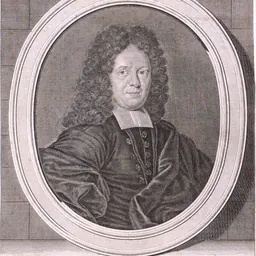
Lived 1654 – 1727 (aged 73). Johann Andreas Danz was a German university teacher, orientalist, hebraist, protestant theologian, theologian and hebraism.
Johann Andreas Danz (1 February 1654 – 20 December 1727) was a German Lutheran theologian and Hebraist.
Life Johann Andreas Danz was born at Sundhausen, a village just outside Gotha in central Germany. His initial schooling was provided locally at the village school, but his exceptional scholastic potential was soon brought to the attention of the local duke, Friedrich of Gotha who took on responsibility for funding his higher education. When he was ten he was sent away to school in Friedrichroda, some twenty kilometers distant. Four years later, in 1668 he was enrolled at the prestigious "Gymnasium" (secondary school) in Gotha, at that time operating under the direction of Andreas Reyher who combined the two roles of school head and pioneering advisor on education reform to The Duke. In 1673 he moved on to the University of Wittemberg, matriculating on 17 September. He studied Philosophy, Philology and Theology, and received his Magister degree in Philosophy on 16 October 1676, four days after defending his work and surviving his "inaugural disputation". Others whom he met in Hamburg while studying with Edzardus included Dauidis Hieronymi, one of more than a hundred Jewish students and scholars whom Esdras Edzardus baptised into Christianity over the years, without on any way seeking to denigrate their Jewish heritage: the practice was considered worthy of note by commentators, however. Together Danz and Hieronymus read the (linguistically challenging) Zohar. He also met Jacob ben Abraham Fidanque, a controversial and briefly prominent Hamburg rabbi originally from Portugal. Although he continued to enjoy a stellar reputation as a professor of oriental and biblical languages, it is clear from the written work he continued to produce that he still sustained a lively appetite for theological and biblical study.
Johann Andreas Danz died at Jena on 20 December 1727. His credentials as an outstandingly knowledgeable expert on "Oriental languages" were and are widely acknowledged by contemporaries and later scholars. His 1696 Hebrew Grammar was for many years an indispensable volume for students of the subject, with revised editions appearing throughout the eighteenth century. That was a tribute to the work's central importance, but the book was never an easy read. There were criticisms that the generally unspoken base assumptions underlying Hebrew and Latin were different to the point of mutual incompatibility, making this attempt by a brilliant man to deal with one of these languages in terms of the other without drawing charges of obfuscation from frustrated users, a visibly impossible challenge. Nevertheless, many terms and phrases which subsequently became mainstream among philologists and other linguists working in this respected niche can be traced back to Johann Andreas Danz.
Selected works . Wittenberg 1679 (Präs. Andreas Sennert) Wittenberg 1679 (Resp. Nicol Bruns) Jena 1680 (Resp. Johann Georg Wittich) Jena 1682 (Resp. Johann Phillip Juncker) 15. Jena 1682 (Resp. Stockmann) Jena 1683 (Resp. Andreas Daniel Hattenbach) Jena 1683 (Resp. Johann Wilke) 10.11.13.
Jena 1685, 1696 (and under the title: Literator Ebraeo-Chaldaeus... 1696) (Resp. Heinrich Ludwig Münster, Online) 1688 Jena 1688 (Resp. Johann Hartmann Scheibler) Jena 1689, 1735, Frankfurt 1765, (Resp. Jacob Velten) 1689, 1699, 1720 1689 (Resp. Quodvultdeus Abraham Müller) 1690 (Resp. Georg Ferdinand Gleich) 1692 1696 1696, 1755, 1773 German 1757, Leipzig 1780 Jena 1699, 1735, 1699 (Resp. M. Johann Conrad Wake, Online) 1699 1700 (Resp. M. Heinrich Kirschgart, Online) 1700 (Resp. Philipp Julius Rethmeier, Online) 1703 (Resp. Heinrich Bernhard Witter) 1704 (Resp. Coelestin Amando Prinz) Jena 1706, 1765 (Online) (Online), 1735, 1742, Frankfurt 1748 1708, 1715 (Online), 1736 1709, 1731(Online), 1735, 1751 (Online) 1709 (Resp. Heinrich Scharbau, (Online)) 1710, 1715, 1720 (Präs. Johann Franz Buddeus) 1710 (Resp. Gotthard Georg Schrader) 1710 1711 (Resp. Christoph von Kalm) 1711 (Resp. Heinrich Gottlieb Reime, Online) 1713 1713 1715 1715–1719 1716 (Resp. Friedrich Ludwig Munster) 1717 (Resp. M. Johann Heinrich Olpe) 1717 (Online) 1720 (Resp. Johann Moneta) 1720 to 1724 1726
Don’t just read it —
keep it.
Full-length biographies made to live with: read them, listen on the way to work, watch them tonight.
- E-book
- Audio
- Video
Instant download · yours to keep · every purchase keeps this site free
Important facts
People in Johann Andreas Danz's life
Named in this biography and alive at the same time


Related people
Same field, nearest in time


Contemporaries
People whose lives overlapped Johann Andreas Danz's





Frequently asked questions
Who was Johann Andreas Danz?
German theologian
When was Johann Andreas Danz born?
Johann Andreas Danz was born on 1 February 1654 in Sundhausen.
When did Johann Andreas Danz die?
Johann Andreas Danz died on 20 December 1727 in Jena.
What was Johann Andreas Danz's occupation?
Johann Andreas Danz was a university teacher, orientalist, hebraist, protestant theologian, theologian and hebraism.
What nationality was Johann Andreas Danz?
Johann Andreas Danz was German.
Sources & further reading
· Wikipedia: Johann Andreas Danz
· DBpedia: Johann Andreas Danz
Cite this page
APA: Biography.guide. (2026). Johann Andreas Danz. https://biography.guide/johann-andreas-danz/
MLA: "Johann Andreas Danz." Biography.guide, https://biography.guide/johann-andreas-danz/.
Chicago: "Johann Andreas Danz." Biography.guide. https://biography.guide/johann-andreas-danz/.
Data last updated: 2026-09-27 · Spot an error? Report a correction.
Page generated 2026-09-27 05:16 UTC