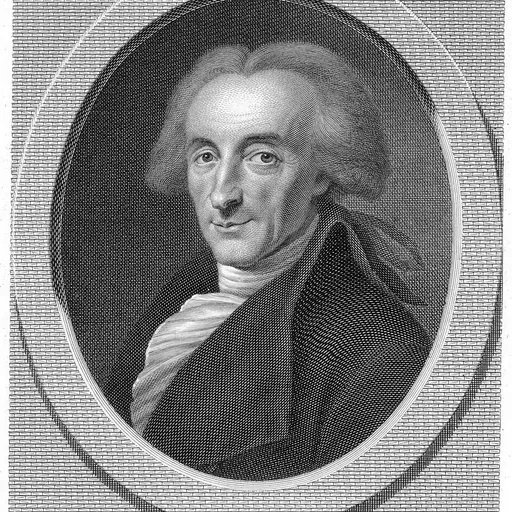
About Johann André
Lived 1741 – 1799 (aged 58). Johann André was a German conductor, composer, publisher, music theorist, pianist and music arranger.
Johann André (28 March 1741 – 18 June 1799) was a German musician, composer and music publisher of the Classical period. He was born and died in Offenbach am Main.
In 1774, as the patriarch of a Huguenot family, André founded one of the first music publishing houses to be independent of a bookshop, in Offenbach am Main. Among his closest friends in Offenbach were Goethe, at the time of his engagement to Anna Elisabeth Schönemann, and he is pictured in the seventeenth book of Goethe's autobiography Dichtung und Wahrheit with an Offenbach am Main background in 1775.
In 1777, André was appointed musical director at the German theatre in Berlin, the Deutsches Theater, without having to abandon Offenbach am Main, however. He composed some 30 operas, ballads and songs.
His son, Johann Anton André (1775–1842), followed his footsteps into composing and music theory. After taking over the music publishing business from his father in 1799, Johann Anton André acquired Mozart's musical legacy from Mozart's widow Constanze in Vienna. She entrusted him with writing concluding measures to the overture to Don Giovanni, so that it could be performed in concert.
He developed the music publishing business and introduced lithography for printing of notes. Musikhaus André and the Musikverlag Johann André, with their wide-ranging musical archive, still exist today in the centre of Offenbach.
Works
Der Töpfer (Hanau, 1773) Erwin und Elmire (Frankfurt, 1775) Der alte Freyer (Frankfurt, 1775) Herzog Michael oder Die Nachtigall (Berlin, 1775) Der Barbier von Sevilien oder Die unnütze Vorsicht (Berlin 1776) Die Bezauberten oder Peter und Hannchen (Berlin, 1777) Der Fürst im höchsten Glanze (Berlin, 1777) Die Schadenfreude (Berlin, 1778) Der Alchymist oder Der Liebesteufel (Berlin, 1778) Laura Rosetti (Berlin, 1778) Die Grazien (Berlin, 1778) Azakia (Berlin, 1778) Claudine von Villa Bella (Berlin, 1778) Das tartarische Gesetz (Berlin, 1779) Alter schützt vor Thorheit nicht (Mannheim, 1779) Die Friedensfeyer oder Die unvermuthete Wiederkunft (Berlin, 1779) Friedrichs glorreichster Sieg (Berlin, 1779) Kurze Thorheit ist die beste (Berlin, 1780) Das wüthende Heer oder Das Mädchen im Thurme (Berlin, 1780) Heinrich der Erhabene aus dem Stamme der Brennen (Berlin, 1780) Der Zauberspiegel (Berlin, 1781) Belmont und Constanze oder Die Entführung aus dem Serail (Berlin, 1781) Mehr als Großmuth (Berlin, 1781) Elmine (Berlin, 1782) Eins wird doch helfen oder Die Werbung aus Liebe (Berlin, 1782) Der Liebhaber als Automat oder Die redende Maschine (Berlin, 1782) Der Barbier von Bagdad (Berlin, 1783) Der Bräutigam in der Klemme (Frankfurt, 1796)
Don’t just read it —
keep it.
Full-length biographies made to live with: read them, listen on the way to work, watch them tonight.
- E-book
- Audio
- Video
Instant download · yours to keep · every purchase keeps this site free
Important facts
People in Johann André's life
Named in this biography and alive at the same time
Related people
Same field, nearest in time


Contemporaries
People whose lives overlapped Johann André's



Frequently asked questions
Who was Johann André?
German composer and music publisher
When was Johann André born?
Johann André was born on 28 March 1741 in Offenbach am Main.
When did Johann André die?
Johann André died on 18 June 1799 in Offenbach am Main.
What was Johann André's occupation?
Johann André was a conductor, composer, publisher, music theorist, pianist and music arranger.
What nationality was Johann André?
Johann André was German.
Sources & further reading
Cite this page
APA: Biography.guide. (2026). Johann André. https://biography.guide/johann-andre/
MLA: "Johann André." Biography.guide, https://biography.guide/johann-andre/.
Chicago: "Johann André." Biography.guide. https://biography.guide/johann-andre/.
Data last updated: 2026-09-23 · Spot an error? Report a correction.
Portrait: Wikimedia Commons · author & licence
Page generated 2026-09-27 05:06 UTC