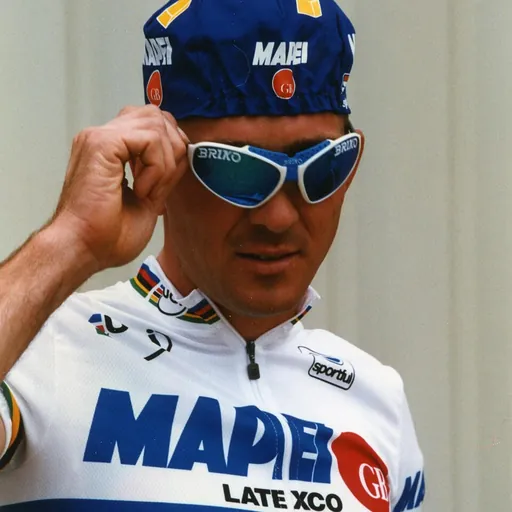
About Johan Museeuw
Born 1965. Johan Museeuw is a Belgian sport cyclist.
1990–1992: Sprinter In 1990 he signed for the Lotto team and won two prestigious stages in the 1990 Tour de France. He won the uphill-sprint stage to Mont Saint-Michel and the final stage of the Tour in Paris, both in a mass sprint. In an era of successful breakaways, he was an unfortunate sprinter, being unable to win further individual stages.
In 1991 he won several stage wins in smaller stage races and in August he won the Championship of Zürich, his first win in a World Cup race. In 1992 he placed third in Milan–San Remo, winning the peloton sprint behind Sean Kelly and Moreno Argentin. He won E3 Harelbeke, his first cobbled semi-classic race win, and the Belgian national road race title in Peer. He was second in the final points classification of the 1992 Tour de France behind Frenchman Laurent Jalabert for the second time. He did not win a stage, despite having won every peloton sprint behind a group of escapees that year. Later he won the Championship of Zürich and won the final standings of the 1995 World Cup, confirming his status as the best one-day classic rider of the year.
In 1996 he won the Brabantse Pijl, but was third in the Tour of Flanders after suffering mechanical failure. The next week, he finally claimed his first victory in Paris–Roubaix. His Mapei–GB team dominated the race and Museeuw arrived together with his Italian teammates Gianluca Bortolami and Andrea Tafi on the Roubaix Velodrome. Team manager Patrick Lefevere received a phone call from the office of Mapei's managing director, Giorgio Squinzi, ordering Museeuw to win the race. In the summer he won his second Belgian national road race title, but again failed to win a stage in the Tour de France. After a disappointing performance in Paris–Tours, where he wanted to secure his overall lead in the World Cup, he stated he intended to quit cycling altogether. He changed his mind and started the next week in the world championship road race, where he was not considered a favourite because of the mountainous course in Lugano. To the surprise of many, and on his 31st birthday, Museeuw became world champion after a long breakaway with Mauro Gianetti, beating the Swiss in a two-man sprint. Subsequently, he went on to win his second World Cup final standing.
In 1997 Museeuw started the year with three stage wins in the Ruta del Sol and Kuurne–Brussels–Kuurne, but failed to take another World Cup win. A crash in Milan–San Remo and the Tour of Flanders and a puncture in Paris–Roubaix prevented him from achieving success. He finished sixth in Liège–Bastogne–Liège, his best result in the Ardennes classic. He abandoned in the 18th stage of the Tour de France, in the rainbow jersey, after several unsuccessful attempts to win a stage in a breakaway. He went on to defend his world title in San Sebastián, but missed the winning breakaway and finished eighth.
Museeuw won his second Paris–Roubaix in 2000 on the Roubaix Velodrome. He won the Hell of the North classic three times.
1998–2000: Injury-ridden years In 1998, one week after winning E3 Harelbeke and the Brabantse Pijl in the same weekend, he won the Tour of Flanders, thereby equaling the race's record of three wins. One week later, Museeuw made a horrific fall in Paris–Roubaix on the Trouée d'Arenberg cobbled sector, leaving his kneecap shattered. On top came a dangerous gangrene infection which nearly forced doctors to amputate his left leg. He fought back and resumed cycling after a long healing process, finishing third in the Tour of Flanders of 1999 and ninth in Paris–Roubaix, exactly one year after his horror crash. In 2000 he won Paris–Roubaix a second time after a 44 km solo. Upon crossing the finish line in victory, he lifted his left leg, pointing to his knee as a reminder of the injury that had almost ended his career two years before. Later that year, he was seriously injured while riding a motor cycle with his wife and son. He suffered severe head trauma and spent several days in a coma. All three would recover, but it was his dogged determination that saw him again reach the pinnacle of the sport. His powerful riding style won him legions of fans all over the world and made him all the more popular in his native Flanders. Later the same year he won the HEW Cyclassics in Hamburg, totaling 11 World Cup wins.
2003–2004: Final years In 2003 he followed Lefevere to the newly set up team. He won the Omloop Het Volk early in the season, but an illness obstructed his preparation for the classics. Towards the end of his career, he acted as a mentor to Tom Boonen, who was widely considered to be Museeuw's successor as leading figure in the cobbled classics. In his last years as a professional he attempted to set a new record in the cobbled classics, aiming to win the Tour of Flanders or Paris–Roubaix a fourth time, but failed. With six combined victories in the Tour of Flanders and Paris–Roubaix, he held the record of combined victories in these races until Boonen improved it in 2012.
Museeuw ended his career in the spring of 2004 after 17 years as a professional and 59 professional victories. In his last classic race, the 2004 Paris–Roubaix, he punctured 5 km before the finish while riding in the leading breakaway, thereby losing his last chance of equalling Roger De Vlaeminck's record. He finished in tears, in fifth place, together with his long-time rival Peter Van Petegem. Museeuw's last race was three days later, the Scheldeprijs in Belgium, on 14 April 2004, won by his young teammate Tom Boonen. A farewell race was organized on 2 May in his home town Gistel. After his retirement, Museeuw took up a non-riding position with . He has donated many of his trophies to museums, including the Centrum Ronde van Vlaanderen, but retains three trophies from his Tour of Flander's, Paris–Roubaix and World Championship wins.
In December 2008 Museeuw was convicted for doping offences by a Belgian Court, together with former cyclists Jo Planckaert and Chris Peers who were involved in the same affair. Museeuw was given a 10-month suspended sentence, a fine of €2.500 and further litigations.
In September 2012 Museeuw gave an interview for Flemish newspaper Gazet van Antwerpen, stating that "nearly every rider of his generation doped", thereby implicitly confessing to the true extent of his doping use. He also stated that he is convinced the current generation of riders is "the cleanest cycling has ever seen". In 2018, he expressed concerns that, although comfortable about discussing former doping offences, he worries "if we keep talking about [doping], the new generation cannot show that they are different". Vlaamse Reus: 1995 Sprint d'Or: 1995, 1996, 1997, 2002 Belgian National Sports Merit Award: 1996 Vélo d'Or Mondial: 1996 Swiss Mendrisio d'Or: 1996 Bici al Chiodo Award: 1996 Honorary Citizen of Jabbeke: 1996 Officer in the Belgian Order of Leopold: 2004 Johan Museeuw Classics: from 2018
Don’t just read it —
keep it.
Full-length biographies made to live with: read them, listen on the way to work, watch them tonight.
- E-book
- Audio
- Video
Instant download · yours to keep · every purchase keeps this site free
Important facts
People in Johan Museeuw's life
Named in this biography and alive at the same time




Related people
Same field, nearest in time



Contemporaries
People whose lives overlapped Johan Museeuw's


Frequently asked questions
Who is Johan Museeuw?
Belgian racing cyclist
When was Johan Museeuw born?
Johan Museeuw was born on 13 October 1965 in Varsenare.
What is Johan Museeuw's occupation?
Johan Museeuw is a sport cyclist.
What nationality is Johan Museeuw?
Johan Museeuw is Belgian.
Sources & further reading
Cite this page
APA: Biography.guide. (2026). Johan Museeuw. https://biography.guide/johan-museeuw/
MLA: "Johan Museeuw." Biography.guide, https://biography.guide/johan-museeuw/.
Chicago: "Johan Museeuw." Biography.guide. https://biography.guide/johan-museeuw/.
Data last updated: 2026-09-23 · Spot an error? Report a correction.
Portrait: Wikimedia Commons · author & licence
Page generated 2026-09-27 05:05 UTC