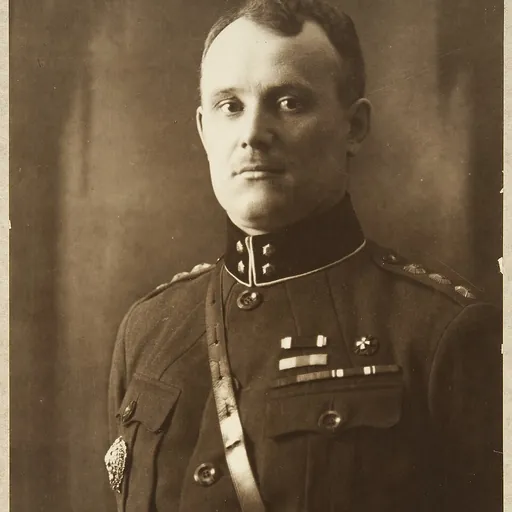
About Johan Laidoner
Lived 1884 – 1953 (aged 69). Johan Laidoner was a Russian and Estonian military officer, politician, sportsperson and national hero.
Johan Laidoner ( – 13 March 1953) was an Estonian general and statesman. He served as Commander‑in‑Chief of the Estonian Armed Forces during the Estonian War of Independence and was among the most influential people in the Estonian politics between the world wars.
Born in Viiratsi, Kreis Fellin, Governorate of Livonia, Laidoner joined the Imperial Russian Army in 1901 and fought in World War I. Following the Russian Revolution in 1917, he commanded the Estonian national units of the Russian army. In 1918, the Estonian Provisional Government appointed him commander-in-chief of the armed forces of the newly independent Republic of Estonia.
After the Estonian War of Independence, he served as a member of the parliament (Riigikogu) from 1920 to 1929. He was once again appointed commander-in-chief during the 1924 Communist coup attempt, and then again from 1934 to 1940 . After the Soviet occupation in 1940, he was arrested and deported to Russia, where he died in prison in 1953.
Early life and career Johan Laidoner was born on Raba estate in Vardja, Viiratsi Parish, to the farmhand Jaak Laidoner (1854–1911) and his wife Mari (née Saarsen; 1851–1938) as the first of four sons.
From 1909 to 1912, Laidoner studied at the Imperial Nicholas Military Academy in Saint Petersburg, graduating with a 1st grade diploma. On 30 October 1911, while studying in Saint Petersburg, Laidoner married Maria Skarbek-Kruszewska, a descendant of Polish nobility, whom he had met earlier in Vilnius. The couple had a son, Michael (also called Mihhail and nicknamed Miša) on 21 March 1913. Michael Laidoner died on 21 April 1928, aged fifteen, from a self-inflicted gunshot wound to the head while alone in his bedroom. His father was away on business in Kohila. The cause of death was officially ruled accidental, however later statements from his mother and classmates implied that he had been suicidal prior to his death. After Michael's death, the Laidoners adopted Maria's nephew, Aleksei Kruszewski. He then served at the Staff of the Caucasus Military District.
World War I At the outbreak of World War I, Laidoner served as staff aide of the 3rd Caucasus Army Corps. On 18 February 1918, the negotiations over the Treaty of Brest-Litovsk broke down and German forces, who had already captured Estonian islands, landed on the mainland. On the following day, Laidoner resigned from his post as division commander and left for Russia. On 24 February 1918, Estonia declared independence, but was subsequently occupied by Germany.
Estonian War of Independence Laidoner with senior commanders of the Estonian Armed Forces in 1920. From upper left: General Major Ernst Põdder, Dr. Arthur Lossmann, General Major Aleksander Tõnisson, Colonel Karl Parts, Colonel Viktor Puskar, Colonel Jaan Rink. From bottom left: General Major Andres Larka, General Major Jaan Soots, Commander in Chief General Lieutenant Johan Laidoner, Admiral Johan Pitka and Colonel Rudolf Reimann On 4 April 1918, the Estonian Provisional Government promoted Laidoner, then still residing in Petrograd, to the rank of Polkovnik (colonel). Following the German capitulation on 11 November 1918, the Soviet Red Army invaded Estonia on 28 November, marking the beginning of the Estonian War of Independence. On 30 November, Laidoner left Petrograd and arrived in Tallinn on 8 December. The provisional government first appointed him chief of staff on 14 December, and then on 23 December, commander-in-chief of the Estonian Armed Forces. In the first days of January, the Estonian forces managed to halt the Soviet advance at the Valkla-Kehra line and on 3 January, Laidoner launched a counter-offensive with 1st Division, supported by Finnish volunteers and armoured trains. Within 11 days, the 1st Division advanced 200 kilometres east, while the 2nd Division moved against the Soviet forces in Southern Estonia. Following the liberation of Tartu and Narva, he was promoted to the rank of major general on 20 January 1919. On Estonia's first independence day on 24 February 1919, Laidoner reported that the Soviet forces have been driven out of Estonia, as well as capturing over 6,000 men and 40 guns.
Laidoner had a crucial role in organizing and training the army in a very short time as well as establishing an effective command structure within the armed forces. Learning from his experience with trench warfare in World War I and due to the limited size of the forces available to him, Laidoner chose to achieve crucial victories – capturing strategically important roads and railway stations – with smaller and more mobile battalion- and company-sized units, supported by armoured trains and armoured cars. After the end of the war, Laidoner was promoted to lieutenant general on 21 March 1920, before resigning as commander‑in‑chief and retiring from active service on 26 March 1920.
Post-war career
After the war, Laidoner was a member of the Riigikogu (Parliament of Estonia) and from 1920 to 1929 as a member of the conservative Farmers' Assemblies. The report Laidoner's committee submitted played an important role in demarcating the border between Turkey and Iraq. The aim of declaring martial law was to halt the political rise of the Vaps Movement and their potential success in the upcoming presidential elections. Together with Päts and Kaarel Eenpalu, the Minister of the Interior, Laidoner established an authoritarian rule, disbanding political parties and limiting free speech, the so-called "Era of Silence". Laidoner remained commander-in-chief of the armed forces and oversaw national defence politics. His reforms included a large-scale weapons and equipment modernization program, expanding the military via conscription, and introduction of military training in universities. On 1 January 1938, a new constitution was enacted, which saw the creation of a bicameral Rahvuskogu (National Assembly), consisting of the Chamber of Deputies and the National Council. As the commander‑in‑chief, Laidoner became an ex officio member of the National Council. On 24 February 1939, he was promoted to the rank of general.
Soviet occupation, arrest and death
On 17 June 1940, the Soviet Union occupied Estonia. Laidoner was officially removed from his position as the commander‑in‑chief on 22 June 1940.
Maria Laidoner was released in 1954 and was allowed to return to Estonia. She died in 1978 in Jämejala, near Viljandi, and was buried in Tallinn at Siselinna Cemetery, next to her son Michael. although he has been hailed as a national hero for his leadership skills and success as a military commander in the War of Independence, he has been criticized for his support of Konstantin Päts and his involvement in the 1934 coup d'état as well as the surrender to the Soviet Union in 1940. In 2004, an equestrian statue of General Laidoner was unveiled next to the ruins of the Viljandi Castle. In Viljandi, a square and a park are named after him. In 2009, Eesti Post released a commemorative stamp to honour Laidoner's 125th anniversary. Laidoner has a plaque dedicated to him in Vilnius Military Academy.
Awards and decorations
Don’t just read it —
keep it.
Full-length biographies made to live with: read them, listen on the way to work, watch them tonight.
- E-book
- Audio
- Video
Instant download · yours to keep · every purchase keeps this site free
Important facts
People in Johan Laidoner's life
Named in this biography and alive at the same time


Related people
Same field, nearest in time


Contemporaries
People whose lives overlapped Johan Laidoner's

Frequently asked questions
Who was Johan Laidoner?
Estonian general and politician (1884-1953)
When was Johan Laidoner born?
Johan Laidoner was born on 12 February 1884 in Viiratsi, Viiratsi Rural Municipality.
When did Johan Laidoner die?
Johan Laidoner died on 13 March 1953 in Vladimir Central Prison.
What was Johan Laidoner's occupation?
Johan Laidoner was a military officer, politician, sportsperson and national hero.
What nationality was Johan Laidoner?
Johan Laidoner was Russian and Estonian.
Sources & further reading
Cite this page
APA: Biography.guide. (2026). Johan Laidoner. https://biography.guide/johan-laidoner/
MLA: "Johan Laidoner." Biography.guide, https://biography.guide/johan-laidoner/.
Chicago: "Johan Laidoner." Biography.guide. https://biography.guide/johan-laidoner/.
Data last updated: 2026-09-23 · Spot an error? Report a correction.
Portrait: Wikimedia Commons · author & licence
Page generated 2026-09-27 05:07 UTC