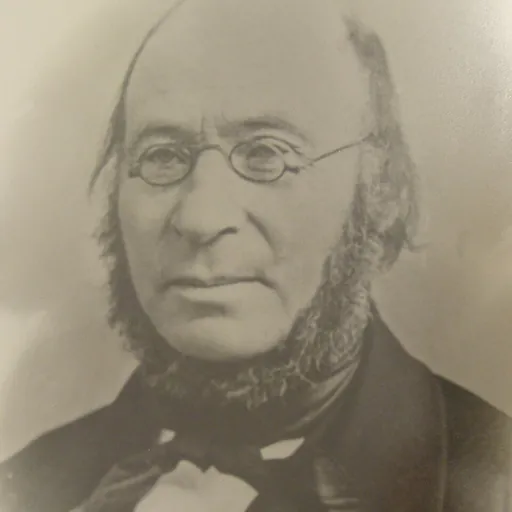
Johan Augustinussen
Norwegian Church singer, teacher and politician
About Johan Augustinussen
Lived 1808 – 1888 (aged 80). Johan Augustinussen was a Norwegian politician, poet and bell-ringer.
Johan Augustinussen, also written Augustiniussen, (born 10 May 1808 at Langset in Nesna Municipality, died 22 November 1888 in Nesna) was a Norwegian curate/choirmaster, teacher and politician.
Despite a lack of formal education, straight after his confirmation he was appointed as the communal school teacher in his native village of Nesna, and at the young age of 22, he was employed as the village's teacher and choirmaster, a position he held for almost 50 years. He also wrote poems and folk songs, and was very interested in music.
Johan Augustinussen became the first mayor of Nesna in 1838. He was mayor for a total of 14 years. He also held a number of other positions in the local community, and represented the county of Nordland in parliament for eight terms from 1848 to 1870. Only Sivert Nielsen sat more terms in the Storting for Nordland county during the 19th century. He was politically aligned with the farmer's alliance, led by Ole Gabriel Ueland. Initially, like Ueland, he supported Søren Jaabæk and Johan Sverdrup, but Augustinussen sympathized more with central parties after a while, as Jaabæk and Sverdrup moved in a more radical direction.
Childhood and adolescence Johan Augustinussen was born at "Oppigården" in Langset, a farm in Sjona some distance east of the village of Nesna. His parents were Augustinius Larssøn (1762–1815) and Kirstine Olsdatter (1770–1843). His paternal grandfather Lars Johnsen (1720–1767) was a farmer at Sandnes in Nesna, and his maternal grandfather Peder Tønder (1697–1735) had been a lensmann. Augustinius Larssøn was an enterprising fisherman; he owned, among others, both a færing and a six-oared row boat, many fishing nets and longlines, and also rorbu in Kabelvåg.
Johan was the youngest of seven siblings, but only he and Ole, the brother four years older than him, reached adulthood. Johan's father died in 1815, and his mother remarried in 1816 with Møller Andersen Zahl from Handnes who was 20 years her younger. Johan's mother died in 1843, and Zahl remarried in 1845 with Anne Pedersdatter from Handnesøya. Jenssen describes her as a warm and good person who Johan had a good relationship with. According to Jenssen however, the people surrounding hims were aware of his literary abilities at an early age, and the parish priest Jens Andreas Krogh "became interested in the bright boy and began to lend him books".
Local offices
Teacher and choirmaster Title page from the parish register of Nesna pastors from 1842. In neat handwriting: Ministerial book for use by choirmasters in Nesna parish. Began 1842. The condition of education in Nesna at the beginning o the 19th century was described as "lamentable". The education Augustinussen himself had received had mainly been from home and through the priest who lent him books. When he was asked in parliament where he studied, he answered: "Actually I ought to tell you that I was taught at home next to the stove by my mother".
This was the reason that despite a lack of schooling, straight after his confirmation, Augustinussen was employed as the communal school teacher by pastor Krogh. The communal school was meant to be preparation for regular school, where children would learn "how to read" and "the understanding of words". From 1826 he was also a home tutor for pastor Krogh's children. Here he was given access to Krogh's relatively rich library. It was tradition that the curate was the teacher there. Peter Eggen was finally suspended from his position as curate in 1829 and died the same year. The curate was also called "choirmaster", and this title was used for Augustinussen among others in connection with parliament. He had this position until he became a pensioner in 1878, thus serving for almost 50 years. He was a member of the school commission for the same time period, Nesna's first school building built in 1823. It was Augustinussen's workplace and home from 1830 to 1878. As choirmaster, Augustinussen was entitled to a municipal curate's farm at Sandenes at the end of Ranfjorden. However, he chose to live in a cramped apartment in the school building. The school building was in 1856 (after renovations in 1853) 20.5 by 9 ells. On the ground floor were the teaching room, kitchen and parlor for the curate, while the rooms on the first floor were used for housing. Originally there was a dormitory in the attic for pupils who lived far away. It was used as a school building up until 1886, and then became housing for the curate. This house has since been moved a little away. Both the schoolhouse and Augustinussen's house still stand at Nesna. Stub and Augustinussen both resigned in 1878, but according to Jenssen "paradoxically, most the attention surrounded the curate".
Johan Augustinussen left deep traces within the school system in Nesna, managing to extend both the school hours and curriculum. The minutes from the first formannskap meeting are brief:2=Møteprotokoll Nesna formannskap. He was 30 years old when he was elected as mayor, and was mayor of Nesna for terms, from 1838 to 1848 and from 1850 to 1854. Only two subsequent mayors of Nesna, Elias Olsen and Arne Langset, have served for an equivalent period. This is also shown as the herred was summoned for the first time on 20 October 1839, fifteen months after the mayoral election. The mayor did not seem important enough to take a person out of work unnecessarily.
Municipal treasuries The confidence in Augustinussen was strongly expressed during his first term as mayor, since he also "worked as the municipality's administrator". It was an old practice that the village's pastor would manage the poor relief fund and the municipal treasury, but when Krogh left Nesna in 1841, the formannskap agreed to a different arrangement. Johan Augustinussen was employed as treasurer with responsibilities for the poor relief fund, with a wage of two Spd. per year. He was also responsible for the school treasury in Nesna (but not Dønnes) with a wage of one Spd. per year. This agreement was made by the formannskap where Augustinussen was himself one of the three members, but according to Jenssen no one saw "anything suspicious about this". Augustinussen was the municipal treasurer until he became a pensioner in 1878; when previous mayor Jacob Fredrik Zahl overtook the position. Zahl was succeeded by Ivar Anton Ivarsen Mehus in 1883, who was also a successor of Augustinussen in a different capacity in 1884, when he became Nesna's second parliamentary representative.
Lindstøl states that Augustinussen was post master in Nesna for 14 years. "Nesna post office" was established by order in council on 28 July 1842. It is uncertain whether Augustinussen was the first post master; he is mentioned in the post master minutes from 1843 with the title "choirmaster". and the same day the trader Lars Aagaard Meyer succeeded Augustinussen as post master. Johan Augustinussen was born at "Oppigården" in Langset, a farm in Sjona some distance east of the village of Nesna. His parents were Augustinius Larssøn (1762–1815) and Kirstine Olsdatter (1770–1843). His paternal grandfather Lars Johnsen (1720–1767) was a farmer at Sandnes in Nesna, and his maternal grandfather Peder Tønder (1697–1735) had been a lensmann. Augustinius Larssøn was an enterprising fisherman; he owned, among others, both a færing and a six-oared row boat, many fishing nets and longlines, and also rorbu in Kabelvåg. The Constitution of Norway set strict limitations on who had suffrage. In 1814 Nesna appointed two electors for the election for 1815–1817, one of them, lensmann Jens Eliassen, was elected as the fourth deputy. In addition to the right to vote being limited, political interest was also weak. In 1841 there were 221 voters in Nesna prestegjeld and only 25 voted, in 1860, 27 voted. In the country, each county amounted to a separate electoral district, and the electors from each district would come together "at a decide location of one of the authority's and 'appoint' someone either from their own number or from among the official voters...as many representatives as the district was entitled to have..."
Johan was the youngest of seven siblings, but only he and Ole, the brother four years older than him, reached adulthood. Johan's father died in 1815, and his mother remarried in 1816 with Møller Andersen Zahl from Handnes who was 20 years her younger. These sessions, called "parliament proper" lasted around half a year during Augustinussen's time. In the eight terms from 1848 to 1870 whilst Augustinussen was a member of parliament, two parliaments super proper were summoned, in 1858 and in 1864.
Teacher and choirmaster The Storting building was completed in 1866. Up until 1854, parliament held its proceedings in Oslo Cathedral School's premises on the corner of Tollbodgaten and Dronningens gate. From 1854, the proceedings were held in the hall which is now known as "the Old festival hall" in the university building on Karl Johans gate. In more recent times, Håkon Kyllingmark was elected seven times for a period of 28 years in total from 1954 to 1981.
Political orientation Johan Sverdrup, The Liberal Party's first leader. Augustinussen first supported Sverdup and the reform movement, but over time became extremely skeptical of what he called "Jaabækianism" and"Sverdrupianism". Augustinussen abandoned active politics when the political parties formed in 1884. Parties in organized from did not exist in Norway during Augustinussen's time. The first Norwegian political parties were created in 1884 with the forming of The Liberal Party and The Conservative Party. There were still more or less organized factions and movements outside parliament. In the 1830s, Ole Gabriel Ueland had established a farmer's alliance with a formulated policy. Augustinussen became one of Ueland's faithful friends in parliament, and from the beginning he was considered to be a supporter of the farmer's alliance. After Sverdrup and Jaabæk entered into an alliance in 1869, in many ways parliament was split between the conservatives and the radicals. Augustinussen was not comfortable with this polarization, and so he distanced himself from earlier opinions and became more center orientated. Arne Bergsgård has characterized Augustinussen's early radicalism as "extremely yellow", and in a later letter to Bang, Augustinussen spoke very negatively about what he called "Jaabækianism" and "Sverdrupianism".
Poetry and music Augustinussen's daughter Christense, photo from the 1870s. Both she and her father were sources for Ole Tobias Olsen when he collected folk songs from Nordland. Johan Augustinussen was also extremely interested in music; he played the violin and also wrote several folk songs and poems. It appears from his dairies that Augustinussen used to play the violin at parties in Kristiania. In 1842 Augustinussen sought a short leave in order to take singing lessons in Bodø, During the lessons he used a psalmodicon, an instrument with only one string.
Ivar Aasen referenced Augustinussen as a source for his "words from Nordland", and mentions him several times in his diaries from 1857 to 1869.
Augustinussen's diary from his time in parliament has been used as a source for later historians. Arne Bergsgård calls it "an amusing little diary" Jens Arup Seip wrote that Augustinussen's diaries had been a great help in his work, and provided a fine picture of the political flows from that time. Sections of the poem Kveldshugnad (7 of the 20 verses) are translated in the Nesna's Village Book, volume 2, and Astøingsvise and Åsværvise are printed in Helgeland's Yearbook, 1977.
A longer poem called "The Parliament's assembly in February 1871", was posthumously printed in Helgeland's Tidings in 1899. In the poem Augustinussen is invisibly present at the opening of the Storting, and welcomes every member of parliament, one after another as they arrive. The poem has explanatory notes from Augustinussen himself. A transcript was printed in Helgeland's Yearbook in 1981 and lasted nine pages. The poem is mildly satirical, it seems to be mostly be cheerful with friendly comments. Its sting is certainly pointed against Jaabæk and his supporters, and he also brings up old political battles, that hints at the debate over the railway in Trondheim.
Family and children Bishop, professor and minister Anton Christian Bang knew Augustinussen from the time of his own confirmation and expressed great admiration for him. His book Erindringer from 1909 is used as a source. In 1833, Johan Augustinussen was married to Christine Birgitte Iversdatter (1807–1887), daughter of Ivar Olsen Løkberg (1753-1810) and Kiersten Pedersdatter (1773-1861). His other son Ivar became a teacher and was, since the time of his confirmation, a close friend of future bishop and minister Anton Christian Bang.
Don’t just read it —
keep it.
Full-length biographies made to live with: read them, listen on the way to work, watch them tonight.
- E-book
- Audio
- Video
Instant download · yours to keep · every purchase keeps this site free
Important facts
People in Johan Augustinussen's life
Named in this biography and alive at the same time



Related people
Same field, nearest in time



Contemporaries
People whose lives overlapped Johan Augustinussen's





Frequently asked questions
Who was Johan Augustinussen?
Norwegian Church singer, teacher and politician (1808-1888)
When was Johan Augustinussen born?
Johan Augustinussen was born on 10 May 1808 in Nesna Municipality.
When did Johan Augustinussen die?
Johan Augustinussen died on 22 November 1888 in Nesna Municipality.
What was Johan Augustinussen's occupation?
Johan Augustinussen was a politician, poet and bell-ringer.
What nationality was Johan Augustinussen?
Johan Augustinussen was Norwegian.
Sources & further reading
· Wikipedia: Johan Augustinussen
· DBpedia: Johan Augustinussen
Cite this page
APA: Biography.guide. (2026). Johan Augustinussen. https://biography.guide/johan-augustinussen/
MLA: "Johan Augustinussen." Biography.guide, https://biography.guide/johan-augustinussen/.
Chicago: "Johan Augustinussen." Biography.guide. https://biography.guide/johan-augustinussen/.
Data last updated: 2026-09-22 · Spot an error? Report a correction.
Portrait: Wikimedia Commons · author & licence
Page generated 2026-09-27 05:02 UTC