
Joaquín Guzmán
Mexican drug lord (born 1957)
About Joaquín Guzmán
Born 1957. Joaquín Guzmán is a Mexican drug trafficker and drug lord.
Joaquín Archivaldo Guzmán Loera (; born 4 April 1957), commonly known as "El Chapo" , is a Mexican former drug lord and the former top leader of the Sinaloa Cartel. Guzmán is believed to be responsible for the deaths of over 34,000 people, and was considered to be the most powerful drug trafficker in the world until he was extradited to the United States and sentenced to life in prison.
Guzmán was born in Sinaloa and raised in a poor farming family. He endured much physical abuse at the hands of his father, through whom he also entered the drug trade. During his early adulthood, his father helped him grow marijuana for local dealers. By the late 1970s, Guzmán had begun working with Héctor Luis Palma Salazar, one of the nation's rising drug lords. He helped Salazar map routes to move drugs through Sinaloa and into the United States. He supervised logistics for Miguel Ángel Félix Gallardo, one of the nation's leading kingpins, in the mid-1980s, but founded his own cartel in 1988 after Félix's arrest.
Guzmán oversaw operations whereby cocaine, methamphetamine, marijuana, and heroin were mass-produced, smuggled into, and distributed throughout the United States and Europe, the world's largest users. He pioneered the use of distribution cells and long-range tunnels near borders, Guzmán's leadership of the cartel brought immense wealth and power; Forbes ranked him one of the most powerful people in the world between 2009 and 2013, while the Drug Enforcement Administration estimated that he matched the influence and wealth of Colombian drug lord Pablo Escobar.
Guzmán was first captured in 1993 in Guatemala and then was extradited and sentenced to 20 years in prison in Mexico for murder and drug trafficking. He escaped prior to formal sentencing in 2015, through a tunnel dug by associates into his jail cell. Mexican authorities recaptured him following a shoot-out in January 2016, and extradited him to the U.S. a year later. In 2019, he was found guilty of a number of criminal charges related to his leadership of the Sinaloa Cartel, was sentenced to life imprisonment, and incarcerated in ADX Florence, Colorado, United States.
Early life Joaquín Archivaldo Guzmán Loera was born on 4 April 1957 into a poor family in the rural community of La Tuna, Badiraguato, Sinaloa. His parents were Emilio Guzmán Bustillos and María Consuelo Loera Pérez. His paternal grandparents were Juan Guzmán and Otilia Bustillos, and his maternal grandparents were Ovidio Loera Cobret and Pomposa Pérez Uriarte. For many generations, his family lived at La Tuna. His father was officially a cattle rancher, as were most in the area where he grew up; according to some sources, however, he might also have been a gomero, an opium poppy farmer. He has two younger sisters named Armida and Bernarda and four younger brothers named Miguel Ángel, Aureliano, Arturo, and Emilio. He had three unnamed older brothers who reportedly died of natural causes when he was very young.
Few details are known about Guzmán's upbringing. As a child, he sold oranges and dropped out of school in third grade to work with his father and as a result is functionally illiterate. He was known for being a practical joker and enjoyed playing pranks on his friends and family when he was young. He was regularly beaten, and he sometimes fled to his maternal grandmother's house to escape such treatment. However, he stood up to his father to protect his younger siblings from being beaten. It is possible that Guzmán incurred his father's wrath for trying to stop him from beating them. His mother was his "foundation of emotional support". The nearest school to his home was about away, and he was taught by traveling teachers during his early years. The teachers stayed for a few months before moving to other areas. With few opportunities for employment in his hometown, he turned to the cultivation of opium poppy, a common practice among local residents. During harvest season, Guzmán and his brothers hiked the hills of Badiraguato to cut the bud of the poppy. Once the plant was stacked in kilos, his father sold the harvest to other suppliers in Culiacán and Guamúchil. He sold marijuana at commercial centers near the area while accompanied by Guzmán. His father spent most of the profits on liquor and women and often returned home with no money. Tired of his mismanagement, Guzmán cultivated his own marijuana plantation at age 15 with cousins Arturo, Alfredo, Carlos, and Héctor Beltrán Leyva, and he supported his family with his marijuana production. Most people in Badiraguato worked in the poppy fields of the Sierra Madre Occidental for most of their lives, but Guzmán left his hometown in search of greater opportunities through his uncle Pedro Avilés Pérez, one of the pioneers of Mexican drug trafficking. He left Badiraguato in his twenties and joined organized crime.
Early career
During the 1980s, the leading crime syndicate in Mexico was the Guadalajara Cartel, which was headed by Miguel Ángel Félix Gallardo (alias "El Padrino" or "The Godfather"), Rafael Caro Quintero, Ernesto Fonseca Carrillo (alias "Don Neto"), Juan José Esparragoza Moreno (alias El Azul, "The Blue One") and others. In the 1970s, Guzmán first worked for the drug lord Héctor "El Güero" Palma by transporting drugs and overseeing their shipments from the Sierra Madre region to urban areas near the Mexico–U.S. border by aircraft. Since his initial steps in organized crime, Guzmán was ambitious and regularly pressed on his superiors to allow him to increase the share of narcotics that were smuggled across the border. He also favored a violent and serious approach when doing business; if any of his drug shipments were not on time, Guzmán would simply kill the smuggler himself by shooting him in the head. Those around him learned that cheating him or going with other competitors—even if they offered better prices—was unwise. The leaders of the Guadalajara Cartel liked Guzmán's business acumen, and in the early 1980s introduced him to Félix Gallardo, one of the major drug lords in Mexico at that time. Guzmán worked as a chauffeur for Félix Gallardo, before being put in charge of logistics, where Guzmán coordinated drug shipments from Colombia to Mexico by land, air, and sea. Palma ensured the deliveries arrived in the United States. Guzmán earned enough standing and began working for Félix Gallardo directly.
Throughout most of the late 1970s and early 1980s, the Mexican drug traffickers were also middlemen for the Colombian trafficking groups, and transported cocaine across the Mexico–U.S. border. Mexico, however, remained a secondary route for the Colombians, given that most of the drugs trafficked by their cartels were smuggled through the Caribbean and the Florida corridor. During the 1980s, however, the Drug Enforcement Administration (DEA) was conducting undercover groundwork in Mexico, where several of its agents worked as informants.
One DEA agent, Enrique Camarena Salazar, was working as an informant and grew close to many top drug barons, including Félix Gallardo. In November 1984, the Mexican military—acting on the intelligence information provided by Camarena—raided a large marijuana plantation owned by the Guadalajara Cartel and known as "Rancho Búfalo". Angered by the suspected betrayal, Félix Gallardo and his men exacted revenge when they kidnapped, tortured, and killed Camarena in February 1985. The death of Camarena outraged Washington, and Mexico responded by carrying out a massive manhunt to arrest those involved in the incident. Guzmán took advantage of the internal crisis to gain ground within the cartel and take over more drug trafficking operations. In return, the drug lords were paid through large suitcases filled with millions of dollars in cash. These suitcases were flown from the U.S. to Mexico City, where corrupt customs agents at the airport made sure the deliveries were not inspected. Large sums of that money were reportedly used as bribes for members of the Attorney General's Office. It was known as the first beheading linked to the drug trade in Mexico. Two weeks later, Clavel killed Palma's children, Héctor (aged 5) and Nataly (aged 4), by throwing them off a bridge in Venezuela. Palma retaliated by sending his men to kill Clavel while he was in prison. In 1991, Ramón killed another Sinaloa Cartel associate, Rigoberto Campos Salcido (alias "El Rigo"), and prompted bigger conflicts with Guzmán. In early 1992, a Tijuana Cartel-affiliated and San Diego-based gang known as Calle Treinta kidnapped six of Guzmán's men in Tijuana, tortured them to obtain information, and then shot them in the back of their heads. Their bodies were dumped on the outskirts of the city. Shortly after the attack, a car bomb exploded outside one of Guzmán's properties in Culiacán. No injuries were reported, but the drug lord became fully aware of the intended message.
Guzmán and Palma struck back against the Arellano Félix brothers (Tijuana Cartel) with nine killings on 3 September 1992 in Iguala; among the dead were lawyers and family members of Félix Gallardo, who was also believed to have orchestrated the attack against Palma's family. Mexico's Attorney General formed a special unit to look into the killings, but the investigation was called off after the unit found that Guzmán had paid off some of the top police officials in Mexico with , according to police reports and confessions of former police officers. Six people were killed in the shootout, but the Arellano Félix brothers were in the restroom when the raid started and reportedly escaped through an air-conditioning duct before leaving the scene in one of their vehicles. On 9 and 10 December 1992, four alleged associates of Félix Gallardo were killed. The antagonism between Guzmán's Sinaloa Cartel and the Arellano Félix clan left several more dead and was accompanied by more violent events in the states of Baja California, Sonora, Sinaloa, Durango, Jalisco, Guerrero, Michoacán and Oaxaca.
The war between both groups continued for six more months, yet none of their respective leaders were killed. In mid-1993, the Arellano Félix clan sent their top gunmen on a final mission to kill Guzmán in Guadalajara, where he moved around frequently to avoid any possible attacks. Having no success, the Tijuana Cartel hitmen decided to return to Baja California on 24 May 1993. As Francisco Javier was at Guadalajara International Airport booking his flight to Tijuana, informant tips notified him that Guzmán was at the airport parking lot awaiting a flight to Puerto Vallarta. Having spotted the white Mercury Grand Marquis car where Guzmán was thought to be hiding, about 20 gunmen of the Tijuana Cartel descended from their vehicles and opened fire at around 4:10 p.m. However, the drug lord was inside a green Buick sedan a short distance from the target. Inside the Mercury Grand Marquis was the cardinal and archbishop of Guadalajara Juan Jesús Posadas Ocampo, who died at the scene from fourteen gunshot wounds. Six other people, including the cardinal's chauffeur, were caught in the crossfire and killed. Amidst the shootout and confusion, Guzmán escaped and headed to one of his safe houses in Bugambilias, a neighborhood 20 minutes away from the airport.
Flight and first arrest 1993 The night the cardinal was killed, Mexican president Carlos Salinas de Gortari flew to Guadalajara and condemned the attack, stating it was "a criminal act" that targeted innocent civilians, but he did not give any indications of the involvement of organized crime. On 9 June 1993, Guzmán was arrested by the Guatemalan Army at a hotel near Tapachula, close to the Guatemala–Mexico border. He was extradited to Mexico two days later aboard a military airplane, where he was immediately taken to the Federal Social Readaptation Center No. 1 (often referred to simply as "La Palma" or "Altiplano"), a maximum-security prison in Almoloya de Juárez, State of Mexico. He met his longtime mistress and later Sinaloa associate, former police officer Zulema Hernández, while in prison, where she was serving time for armed robbery. Hernández later controlled Sinaloa's expansion into Mexico City, but in 2008 her body was found in a trunk, carved with multiple Zs, signifying Los Zetas, Sinaloa's archrivals.
When Palma was arrested by the Mexican Army on 23 June 1995, Guzmán took leadership of the cartel. Palma was later extradited to the United States, where he is in prison on charges of drug trafficking and conspiracy. Guzmán also had another close associate, his trusted friend Ignacio "Nacho" Coronel Villarreal.
A U.S. indictment states that from 2012, Guzmán and the Sinaloa Cartel bribed Juan Orlando Hernández with millions of dollars that helped him become President of Honduras in 2013. This influence helped the Cartel and its allies control and protect vital maritime and air transshipment destinations between the United States and South America.
His drug empire made Guzmán a billionaire, and he was ranked the tenth-richest man in Mexico and 1,140th in the world in 2011, with a net worth of roughly . To assist his drug trafficking, the Sinaloa Cartel also built a shipping and transport empire. and the U.S. DEA considered him "the godfather of the drug world" and strongly estimates he surpassed the influence and reach of Pablo Escobar. In 2013, the Chicago Crime Commission named Guzmán "Public Enemy Number One" for the influence of his criminal network in Chicago (however, there is no evidence Guzmán has ever visited the city). The last person to receive such notoriety was Al Capone in 1930.
At the time of his 2014 arrest, Guzmán imported more drugs into the United States than anyone else. He took similar advantage of the situation when his rival cartels were brought down by an intense crackdown from the Mexican government, but the Sinaloa gang emerged largely unscathed.
Methamphetamine production After the fall of the Amezcua brothers—founders of the Colima Cartel—in 1999 on methamphetamine trafficking charges, there was a demand for leadership throughout Mexico to coordinate methamphetamine shipments north. Guzmán saw an opportunity and seized it. Easily arranging precursor shipments, Guzmán and Ismael Zambada García ("El Mayo") made use of their previous contacts on Mexico's Pacific coast. Importantly, for the first time, the Colombians would not have to be paid—they simply joined methamphetamine with cocaine shipments. This fact meant no additional money was needed for airplanes, pilots, boats and bribes; they used the existing infrastructure to pipeline the new product.
Until this point, the Sinaloa Cartel had been a joint venture between Guzmán and Ismael Zambada García; the methamphetamine business would be Guzmán's alone. He cultivated his own ties to China, Thailand and India to import the necessary precursor chemicals. Throughout the mountains of the states of Sinaloa, Durango, Jalisco, Michoacán and Nayarit, Guzmán constructed large methamphetamine laboratories and rapidly expanded his organization.
Guzmán's nomadic existence allowed him to nurture contacts throughout the country. He was now operating in 17 of the 31 Mexican states. With his business expanding, he placed his trusted friend Ignacio Coronel Villarreal in charge of methamphetamine production; this way Guzmán could continue being the boss of bosses. Coronel Villarreal proved so reliable in the Guzmán business that he became known as the "Crystal King".
First escape and second arrest
First escape: 2001 While still in prison in Mexico, Guzmán was indicted in San Diego on U.S. charges of money laundering and importing tons of cocaine into California, along with his Sinaloa attorney Humberto Loya-Castro, or Licenciado Perez ("Lawyer Perez"), who was charged with bribing Mexican officials on Sinaloa's behalf and making sure that any cartel members arrested were released from custody. After a ruling by the Supreme Court of Mexico made extradition between Mexico and the United States easier, Guzmán bribed guards to aid his escape. On 19 January 2001, Francisco "El Chito" Camberos Rivera, a prison guard, opened Guzmán's electronically operated cell door, and Guzmán got into a laundry cart that maintenance worker Javier Camberos rolled through several doors and eventually out the front door. He was then transported in the trunk of a car driven by Camberos out of the town. At a petrol station, Camberos went inside, but when he came back, Guzmán was gone on foot into the night. According to officials, 78 people have been implicated in his escape plan. Camberos is in prison for his assistance in the escape.
Manhunt: 2001–2014
Mexican cartel wars
Since his 2001 escape from prison, Guzmán had wanted to control the Ciudad Juárez crossing points, which were in the hands of the Carrillo Fuentes family of the Juárez Cartel. Despite a high degree of mistrust between the two organizations, the Sinaloa and Juárez cartels had a working agreement at the time. Guzmán convened a meeting in Monterrey with Ismael Zambada García ("El Mayo"), Juan José Esparragoza Moreno ("El Azul") and Arturo Beltrán Leyva. In this meeting, they discussed killing Rodolfo Carrillo Fuentes, who was in charge of the Juárez Cartel at the time. On 11 September 2004, Rodolfo, his wife and two young children were visiting a Culiacán shopping mall. While leaving the mall, escorted by police commander Pedro Pérez López, the family was ambushed by members of Los Negros, assassins for the Sinaloa Cartel. Rodolfo and his wife were killed; the policeman survived.
The city was no longer controlled only by the Carrillo Fuentes family. Instead, the city found itself as the front line in the Mexican drug war and would see homicides skyrocket as rival cartels fought for control. With this act, Guzmán was the first to break the nonaggression "pact" the major cartels had agreed to, setting in motion the fighting between cartels for drug routes that has claimed more than 60,000 lives since December 2006.
When Mexican president Felipe Calderón took office in December 2006, he announced a crackdown on cartels by the Mexican military to stem the increasing violence. After four years, the additional efforts had not slowed the flow of drugs or the killings tied to the drug war.
This became a key factor influencing the break between the Sinaloa Cartel and the Beltrán Leyva brothers, five brothers who served as Guzmán's top lieutenants, primarily working for the cartel in the northern region of Sinaloa. Sinaloa lawyer Loya-Castro, who like Guzmán had been wanted on federal charges in the United States since 1993, voluntarily approached the DEA offering them information in 1998, eventually signing paperwork as a formal informant in 2005, and his U.S. indictment was thrown out in 2008.
That high-profile arrest was followed by the arrest of 11 Beltrán Leyva hit squad members in Mexico City, with police noting that the arrests were the first evidence that Sinaloa had expanded into the capital city. U.S. Ambassador to Mexico Tony Garza called the arrests a "significant victory" in the drug war. The Mexican military claims that Guzmán and the Beltrán Leyva brothers were at odds over Guzmán's relationship with the Valencia brothers in Michoacán.
Following the killing of Guzmán's son Édgar, violence increased. From 8 May through the end of the month, over 116 people were murdered in Culiacán, 26 of them police officers. In June 2008, over 128 were killed; in July, 143 were slain. An additional deployment of 2,000 troops to the area failed to stop the turf war. The wave of violence spread to other cities such as Guamúchil, Guasave and Mazatlán.
However, the Beltrán Leyva brothers were involved in some double-dealing of their own. Arturo and Alfredo had met with leading members of Los Zetas in Cuernavaca, where they agreed to form an alliance to fill the power vacuum. They would not necessarily go after the main strongholds, such as the Sinaloa and Gulf Cartel; instead, they would seek control of southern states like Guerrero (where the Beltrán Leyvas already had a big stake), Oaxaca, Yucatán and Quintana Roo. They worked their way into the center of the country, where no single group had control. The Beltrán Leyva organization allied with the Gulf Cartel and its hit squad Los Zetas against Sinaloa. which prohibits people and corporations in the U.S. from conducting businesses with them and freezes their U.S. assets.
First manhunt
Guzmán was known among drug lords for his longevity and evasion of authorities, assisted by alleged bribes to federal, state and local Mexican officials. Despite the progress made in arresting others in the aftermath of Guzmán's escape, including a handful of his foremost logistics and security men, the huge military and federal police manhunt failed to capture Guzmán for years. In the years between his escape and capture, he was Mexico's most-wanted man. His elusiveness from law enforcement made him a near-legendary figure in Mexico's narcotics folklore; stories abounded that Guzmán sometimes strolled into restaurants, his bodyguards confiscating peoples' cellphones, he ate his meal, and then left after paying everyone's tab. Rumors circulated of Guzmán being seen in different parts of Mexico and abroad.
Although his whereabouts were unknown, the authorities thought that he was likely hiding in the "Golden Triangle" (Spanish: Triángulo Dorado), an area that encompasses parts of Sinaloa, Durango, and Chihuahua in the Sierra Madre region. The region is a major producer of marijuana and opium poppies in Mexico, and its remoteness from the urban areas makes it an attractive territory for the production of synthetic drugs in clandestine laboratories and for its mountains that offer potential hideouts. Guzmán reportedly commanded a sophisticated security circle of at least 300 informants and gunmen resembling the manpower equivalent to those of a head of state. His inner circle would help him move around through several isolated ranches in the mountainous area to avoid capture. Since many of these locations in the Golden Triangle are only accessible via single-track dirt roads, local residents easily detected the arrival of law enforcement or any outsiders. Their distrust towards non-residents and their aversion towards the government, alongside a combination of bribery and intimidation, helped keep the locals loyal to Guzmán and the Sinaloa Cartel in the area. According to law enforcement intelligence, attempting to have launched an attack to capture Guzmán by air would have had similar results; his security circle would have warned him of the presence of an aircraft 10 minutes away from Guzmán's location, giving him ample time to escape the scene and avoid arrest. In addition, his gunmen reportedly carried surface-to-air missiles that possibly could have brought down aircraft in the area.
Second arrest: 2014 Although Guzmán had hidden for long periods in remote areas of the Sierra Madre mountains without being captured, the arrested members of his security team told the military he had begun venturing out to Culiacán and the beach town of Mazatlán. On 16 February 2014, the Mexican military followed the bodyguards' tips to Guzmán's former wife's house, but they had trouble ramming the steel-reinforced front door, which allowed Guzmán to escape through a system of secret tunnels that connected six houses, eventually moving south to Mazatlán.
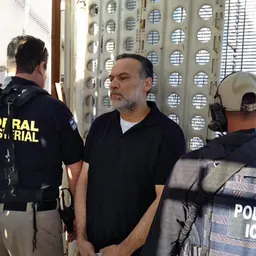
On 22 February 2014, at around 6:40 AM, Mexican authorities arrested Guzmán at a hotel in a beachfront area on Mazatlán malecon, following an operation by the Mexican Navy, with joint intelligence from the DEA and the U.S. Marshals Service. A few days before his capture, Mexican authorities had been raiding several properties owned by members of the Sinaloa Cartel who were close to Guzmán throughout the state of Sinaloa. The operation leading to his capture began at 3:45 AM, when ten pickup trucks of the Mexican Navy carrying over 65 Marines made their way to the resort area. Guzmán was hiding at the Miramar condominiums, located at #608 on Avenida del Mar. Their two daughters were reported to have been at the condominium during the arrest. Guzmán tried to resist arrest physically, Amid the quarrel with the marines, the drug lord was hit four times. By 6:40 AM, he was arrested, taken to the ground floor, and walked to the condominium's parking lot, where the first photos of his capture were taken. His identity was confirmed through a fingerprint examination immediately following his capture. He was then flown to Mexico City for formal identification. According to the Mexican government, no shots were fired during the operation.
Guzmán was presented in front of cameras during a press conference at Mexico City International Airport that afternoon, and then he was transferred to the Federal Social Readaptation Center No. 1, a maximum-security prison in Almoloya de Juárez, State of Mexico, on a Federal Police Black Hawk helicopter. The helicopter was escorted by two Navy helicopters and one from the Mexican Air Force. Surveillance inside the penitentiary and surrounding areas was increased by a large contingent of law enforcement.
Reactions Mexican president Enrique Peña Nieto confirmed the arrest through Twitter and congratulated the Secretariat of National Defense (SEDENA), Secretariat of the Navy (SEMAR), Office of the General Prosecutor (PGR), the Federal Police, and the Centro de Investigación y Seguridad Nacional (CISEN) for Guzmán's capture. In the United States, Attorney General Eric Holder said Guzmán had caused "death and destruction of millions of lives across the globe" and called the arrest "a landmark achievement, and a victory for the citizens of both Mexico and the United States". Colombia's defense minister, Juan Carlos Pinzón, congratulated Mexico on Guzmán's arrest and stated that his capture "contributes to eradicate this crime (drug trafficking) in the region". Guatemala's president Otto Pérez Molina congratulated the Mexican government for the arrest. Costa Rica's president Laura Chinchilla congratulated the Mexican government through Twitter for the capture too. The French government extended its congratulations on 24 February and supported the Mexican security forces in their combat against organized crime. News of Guzmán's capture made it to the headlines of many media outlets across the U.S., Latin America, and Europe. On Twitter, Mexico and Guzmán's capture were trending topics throughout most of 22 February 2014.
Bob Nardoza, a spokesman for the U.S. attorney's office for the District Court for the Eastern District of New York, announced that U.S. authorities plan to seek the extradition of Guzmán for several cases pending against him in New York and other United States jurisdictions.
Charges and imprisonment Guzmán was imprisoned at Federal Social Readaptation Center No. 1, area #20, Hallway #1, on the same day of his capture on 22 February 2014. The area where he lived was highly restricted; the cells are without windows, inmates are not allowed to interact with each other, and they are not permitted to contact their family members. His cell was close to those of José Jorge Balderas (alias "El JJ"), former lieutenant of the Beltrán Leyva Cartel, and Jaime González Durán (alias "El Hummer"), a former leader of Los Zetas drug cartel. Miguel Ángel Guzmán Loera, one of his brothers, was in one of the other units. Guzmán was alone in his cell, and had one bed, one shower, and a single toilet. His lawyer was Óscar Quirarte. Guzmán was allowed to receive visits from members of his family every nine days from 9:00 to 17:00 (if approved by a judge), and was granted by law the right to receive MXN$638 (about ) every month to buy products for personal hygiene.
On 24 February, the Mexican government formally charged Guzmán for drug trafficking, a process that slowed down his possible extradition to the U.S. The decision to initially file only one charge against him showed that the Mexican government was working on preparing more formal charges against Guzmán, and possibly including the charges he faced before his escape from prison in 2001. The kingpin also faced charges in at least seven U.S. jurisdictions, and U.S. officials filed for his extradition. Guzmán was initially granted an injunction preventing immediate extradition to the United States. On 25 February, a Mexican federal judge set the trial in motion for drug-related and organized crime charges, On 4 March 2014, a Mexican federal court issued a formal charge against Guzmán for his involvement in organized crime.
On 5 March 2014, a Mexico City federal court rejected Guzmán's injunction against extradition to the U.S. on the grounds that the U.S. officials had not formally requested his extradition from Mexico. The court said that if the U.S. files a request in the future, Guzmán can petition for another injunction. The court had until 9 April 2014 to issue a formal declaration of the injunction's rejection, and Guzmán's lawyers could appeal the court's decision in the meantime. The same day that the injunction was rejected, another federal court issued formal charges against Guzmán, totaling up to five different Mexican federal courts where he was wanted for drug trafficking and organized crime charges. The court explained that although Guzmán faces charges in several different courts, he cannot be sentenced for the same crime twice because that would violate Article 23 of the Constitution of Mexico.
On 17 April 2014, the Attorney General of Mexico, Jesús Murillo Karam, said that Mexico had no intention of extraditing Guzmán to the U.S. even if a formal request were to be presented. He said he wished to see Guzmán face charges in Mexico, and expressed his disagreement with how the U.S. cuts deals with extradited Mexican criminals by reducing their sentences (as in Vicente Zambada Niebla's case) in exchange for information.
On 16 July 2014, Guzmán reportedly helped organize a five-day hunger strike in the prison in cooperation with inmate and former drug lord Edgar Valdez Villarreal (alias "La Barbie"). Over 1,000 prisoners reportedly participated in the protest and complained of the prison's poor hygiene, food, and medical treatment. The Mexican government confirmed that the strike took place and that the prisoners' demands were satisfied, but denied that Guzmán or Valdez Villarreal were involved in it given their status as prisoners in solitary confinement.
On 25 September 2014, Guzmán and his former business partner Zambada were indicted by the United States District Court for the Eastern District of New York in Brooklyn. According to the court documents, both of them conspired to kill Mexican law enforcement officers, government officials, and members of the Mexican Armed Forces. Among the people killed under the alleged orders of Guzmán were Roberto Velasco Bravo (2008), the chief of Mexico's organized crime investigatory division; Rafael Ramírez Jaime (2008), the chief of the arrest division of the Attorney General's Office; Rodolfo Carrillo Fuentes (2004), former leader of the Juárez Cartel, among other criminals from the Tijuana, Los Zetas, Beltrán Leyva, and Juárez crime syndicates. In addition, it alleged that he oversaw a drug-trafficking empire that transported multi-ton shipments of narcotics from South America, through Central America and Mexico, and then to the U.S., and that his network was facilitated by corrupt law enforcement and public officials. It also alleged that Guzmán laundered more than in drug proceeds along with several other high-ranking drug lords.
On 11 November 2014, a federal court in Sinaloa granted Guzmán an injunction for weaponry charges after the judge determined that the arrest was not carried out the way the Mexican Navy reported it. According to law enforcement, the Navy apprehended Guzmán after they received an anonymous tip on an armed individual in the hotel where he was staying. However, no evidence of the anonymous tip was provided. The judge also determined that the investigations leading to his arrest were not presented in court. He determined that law enforcement's version of the arrest had several irregularities because the Navy did not have a raid warrant when they entered the premises and arrested Guzmán (when he was not the subject matter of the anonymous tip in the first place).
On 20 January 2015, Guzmán requested another injunction through his lawyer Andrés Granados Flores to prevent his extradition to the U.S. His defense argued that if he were to be extradited and judged in a foreign court, his constitutional rights expressed in Articles 1, 14, 16, 17, 18 and 20 of the Constitution of Mexico would be violated. The decision of his defense was made after Attorney General Murillo Karam said at a press conference that the U.S. was pushing to formally request his extradition. The PGR and Mexico's Secretariat of Foreign Affairs stated that Guzmán had a provisional arrest with extradition purposes from the U.S. government since 17 February 2001, but that the formal proceedings to officiate the extradition were not realized because investigators considered that the request was outdated and believed it would have been difficult to gather potential witnesses. Murillo Karam said that the Mexican government would process the request when they deemed it appropriate. He asked for a second injunction preventing his extradition on 26 January. Mexico City federal judge Fabricio Villegas asked federal authorities to confirm in 24 hours if there was a pending extradition request against Guzmán. In a press conference the following day, Murillo Karam said that he was expecting a request from Washington, but said that they would not extradite him until he faces charges and completes his sentences in Mexico. If all the charges are added up, Guzmán may receive a sentence between 300 and 400 years.
Second escape and third arrest
Second escape: 2015 On 11 July 2015, Guzmán escaped from Federal Social Readaptation Center No. 1. After the guards did not see him for twenty-five minutes on surveillance video, personnel went looking for him. When they reached his cell, Guzmán was gone. It was discovered he had escaped through a tunnel leading from the shower area to a house construction site away in a Santa Juanita neighborhood. The tunnel lay deep underground, and Guzmán used a ladder to climb to the bottom. The tunnel was tall and in width. It was equipped with artificial light, air ducts, and high-quality construction materials.
Second manhunt: 2015–2016 The escape of Guzmán triggered a wide-range manhunt. According to Mexico's National Security Commissioner Monte Alejandro Rubido García, the manhunt was instituted immediately in the surrounding area by putting up several checkpoints and air searches by helicopter. The entire prison was put on lockdown and no one was allowed to enter or leave. The search was then extended to other federal entities: Mexico City, the State of Mexico, Morelos, Puebla, Guerrero, Michoacán, Querétaro, Hidalgo and Tlaxcala. However, most of the military officers involved in the search were sent to the State of Mexico. The Mexican government also issued an international warning to prevent Guzmán from escaping the country through airports, border checkpoints, or ports. Interpol and other security organizations were alerted to the possibility of him escaping into another country. Flights at the Toluca International Airport were cancelled, while soldiers occupied parts of Mexico City International Airport. By the afternoon, a total of 31 people had been called in for questioning. The director of the prison, Valentín Cárdenas Lerma, was among those detained.
When the news of the escape broke, President Peña Nieto was heading to a state visit in France along with several top officials from his cabinet and many others. The Secretary of the Interior Miguel Ángel Osorio Chong, who was already in France waiting for them, returned to Mexico after learning of Guzmán's prison break. Peña Nieto returned to Mexico on 17 July. In a press conference, Peña Nieto said he was shocked by Guzmán's escape, and promised that the government would carry out an intensive investigation to see if officials had collaborated in the prison break. In addition, he claimed that Guzmán's escape was an "affront" to the Mexican government, and that they would not spare any resources in trying to recapture him. Peña Nieto, however, was severely criticized for the incident, and media outlets pointed out that this incident was among the administration's most embarrassing episodes. Critics stated that Guzmán's escape highlighted the high levels of corruption within the government, and questioned the government's ability to combat the country's organized crime groups.
On 13 July 2015, Osorio Chong met with members of the cabinet that specialize in security and law enforcement intelligence to discuss the escape of Guzmán, and scheduled a press conference that day. The objective of the meeting and the conference was to analyze the actions the government employed to recapture him. Among them were Rubido García, Arely Gómez González, the Attorney General of Mexico and Eugenio Imaz Gispert, head of the Center for Research and National Security. At the press conference, the government placed a $60 million MXN bounty (approximately ) for information that leads to Guzmán's arrest.
A number of officials were indicted; of these, three were police officers employed within the Division of Intelligence, and another two were employed by CISEN.
Colombian assistance Officials of the Mexican government appealed to three Colombian Police retired generals for assistance in the closure of issues relating to Guzmán, according to a report dated to 1 August 2015. Among them is Rosso José Serrano, a decorated officer and one of the masterminds behind the dismantling of the Cali Cartel and Medellín Cartel and Luis Enrique Montenegro, protagonist in the arrests of Miguel and Gilberto Rodríguez Orejuela. They suggested particular Colombian strategies like creation of special search units ("Bloques de Búsqueda" or Search Blocs), specialized investigation and intelligence units, like DIJIN (Directorate of Criminal Investigation and Interpol) and DIPOL (Directorate of Police Intelligence) and new laws about money laundering and asset forfeiture. After the third capture of Guzmán, it was revealed that the Government of Colombia had sent a team of 12 officials to assist the Mexican authorities on tracking down Guzmán.
Kate del Castillo meeting Mexican actress Kate del Castillo was first approached by Guzmán's lawyers in 2014, after having published an open letter to Guzmán in 2012 in which she expressed her sympathy and requested him to "traffic in love" instead of in drugs; Guzmán reached out again to del Castillo after his 2015 escape, and allegedly sought to cooperate with her in making a film about his life.
On 2 October, del Castillo and Penn visited Guzmán for seven hours at his hideout in the mountains, with Penn interviewing the fugitive for Rolling Stone magazine. Guzmán, who had never before acknowledged his drug trafficking to a journalist, told Penn he had a "fleet of narco-submarines, airplanes, trucks and boats" and that he supplied "more heroin, methamphetamine, cocaine and marijuana than anybody else in the world". with cell phone interceptions and information from U.S. authorities The raid on the ranch was met with heavy gunfire and Guzmán was able to flee. The Attorney General of México declared that "El Chapo ran away through a gully and, although he was found by a helicopter, he was with two women and a girl and it was decided not to shoot". The two women were later revealed to be Guzmán's personal chefs, who had traveled with him to multiple safe houses. At one point, Guzmán reportedly carried a child on his arms "obscuring himself as a target".
Third arrest: 2016
According to the official report published by the Mexican Navy, citizens reported "armed people" in a house at the coastal city of Los Mochis in northern Sinaloa, which was then placed under surveillance for one month. Monitored communications indicated the home was being prepared for the arrival of "Grandma" or "Aunt", which authorities suspected was code for a high-priority potential target. in Operation Black Swan, by 17 marines from the Mexican Navy's Special Forces with support from the Mexican Army and the Federal Police —but Guzmán and a lieutenant escaped through a secret tunnel, emerging 1.5 km away and stealing a vehicle at gunpoint.
A statewide alert was issued for the stolen vehicle, and the Federal Police located and intercepted it about 20 km south of Los Mochis near the town of Juan José Ríos. Guzmán attempted to bribe the officers with offers of cash, properties, and offers of jobs. and later, hand over the prisoners to the marines. They were subsequently taken to Los Mochis airport for transport to Mexico City, where Guzmán was presented to the press at the Mexico City airport and then flown by a Navy helicopter to the same maximum-security prison from which he escaped in July 2015.
During the raid, five gunmen were killed, six others arrested, and one Marine was wounded.
Reactions Mexican secretary of the interior Miguel Ángel Osorio Chong was hosting a reunion with Mexico's ambassadors and consuls when he received a notice from the president on Guzmán's capture. He returned a few moments later with Secretary of National Defense Salvador Cienfuegos Zepeda, Secretary of Navy Vidal Francisco Soberón Sanz and Secretary of Foreign Affairs Claudia Ruiz Massieu. This was followed by a spontaneous rendition of the National Anthem by the crowd. Loretta Lynch, United States Attorney General, praised Mexican authorities "who have worked tirelessly in recent months to bring Guzmán to justice".
Arrest of Emma Coronel Aispuro Emma Coronel Aispuro, 31, the wife of Joaquín Guzmán, was arrested at Dulles International Airport on 22 February 2021, accused of helping her husband run his cartel and plot his escape from prison in 2015. Coronel was charged with conspiracy to distribute cocaine, methamphetamine, heroin and marijuana in the U.S. She has not been charged with any crimes in Mexico, although her father, Inés Coronel Barreras, and her brother, Édgar Coronel, were arrested on drug charges and allegations of helping Guzman′s first prison escape. Inés Coronel was arrested in 2013 and sentenced to ten years, 3 months in prison in 2017. Édgar Coronel Aispuru was arrested in 2015 and is imprisoned in Aguaruto prison, Sinaloa.
Coronel was sentenced to three years in prison, but was released early in September 2023.
United States extradition and prosecution
Mexico formally launched a renewed process of extradition to the United States two days after Guzmán was recaptured on 8 January 2016 after his second prison escape. Guzmán's lawyers mounted "numerous and creative injunctions" to prevent extradition. Vicente Antonio Bermúdez Zacarías was a federal judge involved in Guzmán's extradition proceedings, and he was assassinated on 17 October 2016 while jogging near Mexico City. There is no definitive evidence that the death of the federal judge was ordered by or on behalf of El Chapo.
Guzmán was wanted in Chicago, San Diego, New York City, New Hampshire, Miami, and Texas, in addition to having indictments in at least seven different U.S. federal courts. Charges in the United States include drug trafficking with intent to distribute, conspiracy association, organized crime against health, money laundering, homicide, illegal possession of firearms, kidnapping, and murder in Chicago, Miami, New York, and other cities. A critical requirement for extradition was that the U.S. must guarantee that they would not sentence Guzmán to death if he were found guilty of homicide charges.
On 19 January 2017, Guzmán was extradited to the U.S. to face the charges and turned over to the custody of HSI and DEA agents. He was housed at the maximum-security wing of the Metropolitan Correctional Center, New York located in Manhattan. He pled not guilty on 20 January to a 17-count indictment in the United States District Court in New York. U.S. District Judge Brian Cogan scheduled his trial for 5 November 2018, when jury selection began. According to the prosecutors, juror anonymity and an armed escort were necessary, even if Guzmán is in isolation, due to his history of having jurors and witnesses murdered. The judge agreed to keep jurors anonymous and to have Guzmán transported to and from the courthouse by U.S. Marshals and sequestered from the public while in the courthouse. Opening arguments began Tuesday 13 November, and closing arguments took place on 31 January 2019. Guzmán was found guilty of all counts on 12 February 2019, and was sentenced on 17 July 2019 to life in prison plus 30 years and ordered to forfeit more than .
Personal and family criminal activities Guzmán's family is heavily involved in drug trafficking. Several members of his family, including his brother, one of his sons, and a nephew were killed by Sinaloa's archrival cartels, Los Zetas and the Beltrán-Leyva Organization.
Guzmán's sons followed him into the drug business, and his third wife, López Pérez, was arrested in 2010, in Culiacán. Édgar died after a 2008 ambush in a shopping center parking lot, in Culiacán, Sinaloa. Afterwards, police found more than 500 AK-47 bullet casings at the scene. Ovidio was arrested on 5 January 2023 and extradited to U.S. on September 15 that year, and Joaquín was arrested in El Paso, Texas on 25 July 2024, along with Ismael "El Mayo" Zambada.
In November 2007, Guzmán married an 18-year-old U.S. beauty queen, Emma Coronel Aispuro, the daughter of one of his top deputies, Inés Coronel Barreras, in Canelas, Durango. In August 2011, she gave birth to twin girls at Los Angeles County Hospital, in California. Emma Coronel Aispuro pleaded guilty on 6 June 2021, to charges in the U.S. and admitted that she helped her husband run his multibillion-dollar criminal empire.
On 1 May 2013, Guzmán's father-in-law, Inés Coronel Barreras, was captured by Mexican authorities in Agua Prieta, Sonora, with no gunfire exchanged. U.S. authorities believe Coronel Barreras was a "key operative" of the Sinaloa Cartel who grew and smuggled marijuana through the Arizona border area. He was sentenced to five years in a federal prison but released in April 2008, after a Mexican federal judge, Jesús Guadalupe Luna, ruled that there was no proof his cash came from drugs other than that he was a drug lord's son. Luna and another judge were later suspended on suspicion of unspecified irregularities in their decisions, including Luna's decision to release "El Chapito". Authorities described Guzmán Salazar as a growing force within his father's organization and directly responsible for Sinaloa's drug trade between the U.S. and Mexico and for managing his billionaire father's growing list of properties. Guzmán Salazar and his mother, Guzmán's former wife María Alejandrina Salazar Hernández, were both described as key operatives in the Sinaloa Cartel and added to the U.S.'s financial sanction list under the Kingpin Act on 7 June 2012.
The U.S. Treasury Department described Salazar as Guzmán's wife, in its sanction against her, and described Guzmán as her husband. Guzmán's second wife, Griselda López Pérez, was also sanctioned by the U.S. under the Kingpin Act and described as Guzmán's wife.
Jesús Guzmán Salazar was reported to have been detained by Mexican Marines in an early morning raid, in the western state of Jalisco on 21 June 2012. Months later, however, the Mexican Attorney General's Office announced the Marines had arrested the wrong man and that the man captured was actually Félix Beltrán León, who said he was a used-car dealer, not the drug lord's son. She was arrested on fraud charges for entering the country with a false visa.
Obied was a brother of Luis Alberto Cano Zepeda (alias "El Blanco")'s, another nephew of Guzmán's who worked as a pilot drug transporter for the Sinaloa Cartel. The latter was arrested by the Mexican military in August 2006.
Even after Guzman's arrest, the Sinaloa Cartel remained the primary drug distributor (in 2018) in the U.S. among Mexican cartels, according to the U.S. DEA.
In popular culture Film Netflix released in 2026 Facing El Chapo, a film about the recapture of El Chapo.
Literature Martin Corona, the chief assassin for a rival cartel of Sinaloa's who mistakenly killed a priest when aiming at Guzmán, published a tell-all memoir titled Confessions of a Cartel Hit Man in 2017.
Music Several Mexican narcocorridos (narco ballads) narrate the exploits of Guzmán and his organization. Additionally, some U.S. artists have made songs with references to Guzmán, such as Uncle Murda, Skrillex, YG, Gucci Mane, and The Game.
Television In 2017, Netflix and Univision began co-producing the series El Chapo about the life of Guzmán. The series premiered on Sunday, 23 April 2017 and was followed by a 20-minute Facebook Live after-show titled "El Chapo Ilimitado".
Guzmán is also portrayed by Alejandro Edda in the Netflix television series Narcos: Mexico.
Don’t just read it —
keep it.
Full-length biographies made to live with: read them, listen on the way to work, watch them tonight.
- E-book
- Audio
- Video
Instant download · yours to keep · every purchase keeps this site free
Important facts
more
Joaquin El Chapo Guzman, Joaquín Archivaldo Guzmán LoeraPeople in Joaquín Guzmán's life
Named in this biography and alive at the same time



Related people
Same field, nearest in time




Contemporaries
People whose lives overlapped Joaquín Guzmán's

Frequently asked questions
Who is Joaquín Guzmán?
Mexican drug lord (born 1957)
When was Joaquín Guzmán born?
Joaquín Guzmán was born on 4 April 1957 in La Tuna.
What is Joaquín Guzmán's occupation?
Joaquín Guzmán is a drug trafficker and drug lord.
What nationality is Joaquín Guzmán?
Joaquín Guzmán is Mexican.
Sources & further reading
Cite this page
APA: Biography.guide. (2026). Joaquín Guzmán. https://biography.guide/joaquin-guzman/
MLA: "Joaquín Guzmán." Biography.guide, https://biography.guide/joaquin-guzman/.
Chicago: "Joaquín Guzmán." Biography.guide. https://biography.guide/joaquin-guzman/.
Data last updated: 2026-09-20 · Spot an error? Report a correction.
Page generated 2026-09-27 05:31 UTC