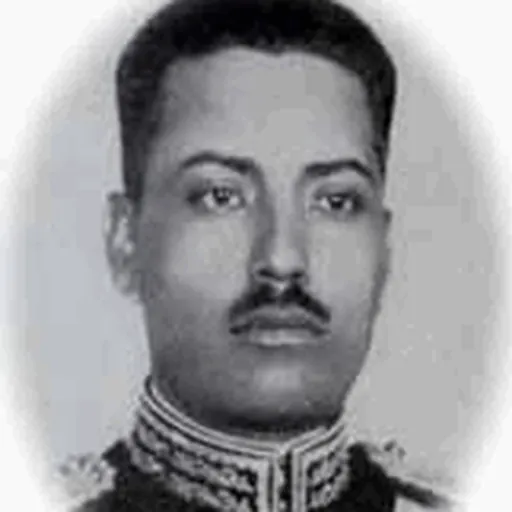
Joaquin Amaro
Mexican revolutionary general and military reformer
About Joaquin Amaro
Lived 1889 – 1952 (aged 62). Joaquin Amaro was a Mexican politician, military personnel and secretary of National Defense (Mexico).
Joaquín Amaro Domínguez (August 16, 1889 – March 15, 1952) was a Mexican revolutionary general and military reformer. He served as Secretary of War in the cabinets of Presidents Plutarco Elías Calles, Emilio Portes Gil, and Pascual Ortiz Rubio, making him one of the longest-serving cabinet-level officials in Mexican history. His ambitious reforms of the fractious Mexican military transformed the armed forces from a political partisan to an armed force loyal to the president and government. He accomplished this "through a process of cultural reeducation that replaced an entrenched tradition of militarism with one emphasizing such values as discipline, duty, honor, and loyalty to the civilian government."
Early life Amaro was born in Corrales de Abrego in the municipality of Sombrerete, Zacatecas, the first of Antonio Amaro and Angela Domínguez's ten children. His family was of Indigenous ancestry, although they were probably not Yaqui, as was widely assumed. While Amaro was still a child, the family moved to the nearby state of Durango, where his father worked on an hacienda. Together, they built a large family, becoming the parents of at nine children six sons and three daughters. Amaro was later instrumental in freeing Jesús Salas Barraza, the leader of the group of assassins, from jail.
Amaro never wavered from his support for Calles and Obregón, and he fully shared Calles' hatred of the clergy. Calles gave Amaro full support in continuing the latter's plan to reform the Mexican armed forces along anti-clerical and populist lines: I have fought without rest [...] against clericalism, large landowners, the militarism of the ex-Federals, the Spanish, and in general all those that do not contribute to the enrichment of our beloved homeland and the betterment of the working class.
Despite these sentiments, neither Calles nor Amaro hesitated in taking action against the extreme left-wing. When José Guadalupe Rodríguez tried to organise "soldier soviets" on the Bolshevist pattern, he was promptly arrested and shot along with some of his soldiers. Moreover, when a peasant and labor bloc of the Communist International was formed under the artist Diego Rivera, it was forcibly disbanded.
Another example is the story that Amaro shot and killed a groom whom disobeyed his order to walk his polo pony and instead rode it to the stables, which the U.S. Ambassador to Mexico and his military attache passed to the Department of State. However, there is good reason to believe that Ambassabor James R. Sheffield loathed the Mexican Revolutionary leaders and would have passed on any rumor to discredit them regardless of its veracity. He used racial stereotypes to describe them, calling Calles "an Armenian and Indian" and "Amaro, Secretary of War, a pure blooded Indian and very cruel."
Later career Amaro sought to create a Superior War College along the lines of France's École Supérieure de Guerre to train an elite group of officers. To this end he sent a number of generals to study the militaries and military academies of European and South American states. Amaro led the Heroic Military Academy from 1931 until 1935, and directed military education for the Secretariat of War from 1931 to 1936. He retired from active service on 16 August 1939.
In October 1942, during World War II, Amaro was reintegrated into the army, where he was responsible for defending the region of the Isthmus of Tehuantepec from Axis aggressions.
Legacy Amaro died in 1952 and was buried in the Panteón Francés de la Piedad. In 1966, his body was exhumed and reburied in Panteón Francés de San Joaquín. In the 1960s, a statue of Amaro on horseback was erected in Mexico City's Chapultepec Park.
Don’t just read it —
keep it.
Full-length biographies made to live with: read them, listen on the way to work, watch them tonight.
- E-book
- Audio
- Video
Instant download · yours to keep · every purchase keeps this site free
Important facts
People in Joaquin Amaro's life
Named in this biography and alive at the same time


Related people
Same field, nearest in time





Contemporaries
People whose lives overlapped Joaquin Amaro's



Frequently asked questions
Who was Joaquin Amaro?
Mexican revolutionary general and military reformer (1889-1952)
When was Joaquin Amaro born?
Joaquin Amaro was born on 16 August 1889 in Zacatecas.
When did Joaquin Amaro die?
Joaquin Amaro died on 15 March 1952 in Pachuca.
What was Joaquin Amaro's occupation?
Joaquin Amaro was a politician, military personnel and secretary of National Defense (Mexico).
What nationality was Joaquin Amaro?
Joaquin Amaro was Mexican.
Sources & further reading
Cite this page
APA: Biography.guide. (2026). Joaquin Amaro. https://biography.guide/joaquin-amaro/
MLA: "Joaquin Amaro." Biography.guide, https://biography.guide/joaquin-amaro/.
Chicago: "Joaquin Amaro." Biography.guide. https://biography.guide/joaquin-amaro/.
Data last updated: 2026-09-20 · Spot an error? Report a correction.
Page generated 2026-09-27 05:10 UTC