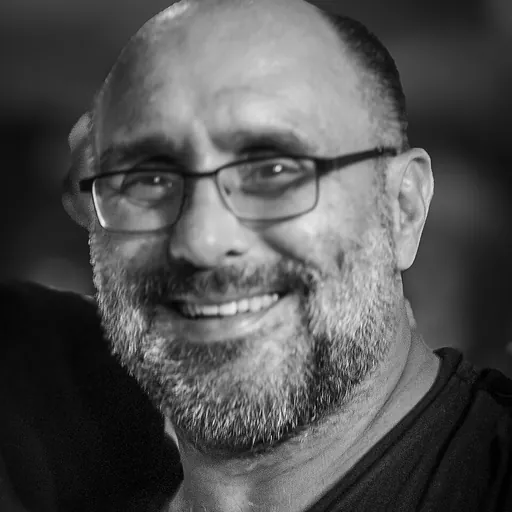
About João Silva
Born 1966. João Silva is a South African and Portuguese photographer, war photographer, photojournalist and journalist.
João Silva (born 9August 1966) is a Portuguese-born South African war photographer. He is the last working member of the Bang-Bang Club, a group of photographers who covered South Africa from the time of Nelson Mandela's release from prison in 1990, to the country's first multiracial elections in 1994. He has worked in Africa, the Balkans, Central Asia, Russia, and the Middle East.
In October 2010, Silva stepped on a land mine while on patrol with invading US soldiers in Kandahar, Afghanistan and lost his left leg below the knee, and his right leg from just above it. After recovery and receiving two prostheses, his first assignment out of Walter Reed Army Medical Center for The New York Times was at the White House. He now works as staff photographer for The New York Times in Africa.
Early life Silva was born in Lisbon, Portugal. He came to South Africa when he was nine years old. His parents immigrated from Portuguese Mozambique to South Africa, because of the Mozambican War of Independence. Silva was sent to stay with his godfather to Portugal for a year. After his parents re-settled in Vereeniging, south of Johannesburg, Silva came on an immigrant visa to South Africa. Studying at a local high school, he decided to drop out, telling his parents that the school had nothing more to teach him.
Silva gave up his other jobs, bought a second-hand camera and studied black-and-white photography at a vocational night school. At the end of 1989, he moved to Johannesburg and established himself as photographer.
Early career Silva began working as freelancer for the Johannesburg Herald in 1990. Beside his jobs for the Alberton Record in 1991, taking pictures of road accidents and Rotary meetings, he photographed the conflict zones of Thokoza and Soweto. There, he shot his first pictures of the killings in the developing violence in the townships. Weeks later he showed his portfolio to the Reuters office in Johannesburg and arranged to submit photos for possible publication. He soon left the paper and worked as a freelancer for Reuters. His next step was to go with a new portfolio to The Star, where Ken Oosterbroek saw the pictures. Silva then began to freelance for the Sunday Star and was later hired by Oosterbroek as a staff photographer.
Silva and Kevin Carter in Sudan
Invitation by UN Operation Lifeline Sudan In March 1993, Robert Hadley, information officer for the UN Operation Lifeline Sudan, invited Silva and Kevin Carter to come to Sudan and report on the 1993 famine in South Sudan. The two flew to Nairobi to get from there to Sudan. Increasing fighting in Sudan held them up in Nairobi, but Carter managed to fly with the UN for one day to Juba in the south Sudan to take photos of a barge, used as a route for food aid for the region. The UN then received permission from a rebel group to fly food aid to Ayod, and Robert Hadley invited Silva and Carter to accompany him on this trip.
In Ayod The following day, they arrived on a light plane to the tiny hamlet of Ayod. The cargo plane landed shortly thereafter. The villagers were already waiting next to the runway to get food, wrote Marinovich, and "the mother had joined waiting for food leaving her children on the sandy ground nearby." Silva and Carter separated to shoot pictures of children and the people, the living and dead victims of the hunger catastrophe that had arisen through the war. Carter went several times to Silva to tell him about the shocking situation he had just photographed. Witnessing the famine touched his emotions very strongly. Silva was searching for rebel soldiers who could take him to someone in authority. He found some soldiers and Carter joined him. The soldiers did not speak English, but one was interested in Carter's wrist watch. Carter gave him his cheap wrist watch as a gift. The soldiers were their bodyguards and followed them for their protection.
To stay a week with the rebels they needed the permission of a rebel commander. Their plane would take off in an hour and without the permission they had to fly back. Again they separated and Silva went to the clinic complex to ask for the rebel commander. The rebel commander was to find in Kongor, south Sudan he was told. That was good news for Silva, "their small UN plane was heading there next". He left the clinic and went back to the runway, taking on his way pictures of children and people. It was then that "he came across a child lying on his face in the hot sun – and he took a picture".
Prize-winning "The vulture and the little girl" photograph in Sudan
As a result, Silva was nearby when Carter took his Pulitzer Prize-winning photograph "The vulture and the little girl": Carter approached Silva on the runway, came quickly towards him and said:
Silva asked him where he shot the picture and was looking around to take the photo too. Carter pointed to a place away. Then Carter told him that he had chased the vulture away. Carter was completely shocked by the situation he had just photographed. He said to Silva, "I see all this, and all I can think of is [Carter's young daughter] Megan." Lighting a cigarette, he became more emotional saying, "I can't wait to hug her when I get home." A few minutes later they got into the small UN plane and left Ayod for Kongor.
Conflict and war photographer On 23October 2010, Silva stepped on a land mine while on patrol with US soldiers in Kandahar, Afghanistan and lost his left leg below the knee, and his right leg from just above it.
In 2011 Silva spoke at Bronx Documentary Center in New York about his life as photojournalist. His speech was published in The New York Times and the lens.blogs.nytimes.com. after The New York Times insisted that he get the best medical attention. After more than eighty operations and rehabilitation training, he was working again as photographer. In between, he took part in a marathon, a year after he stepped on the landmine. He took part in the New York City Marathon on a hand-cranked bike finishing it in 2 hours 38 minutes. In December 2011, he returned home in Johannesburg, South Africa, as a staff member of The New York Times.
After returning to South Africa, Silva bought a Harley-Davidson XL883L Super Low, motorcycles being part of his passion. Silva had it modified to be able to ride the motorcycle with his prostheses. To test it he went to a racetrack accomplishing fifty laps.
Exhibitions Work from Silva's first 20 years as a conflict photographer was first displayed at the 25th annual Visa pour l'Image international photojournalism festival in Perpignan, France. Later his images were included in an exhibition in New York, Munich, Milan and Johannesburg.
Group exhibitions 2010 Visa Pour l'Image, international photojournalism festival, Perpignan, France, 2013 Visa Pour l'Image 2013, Perpignan, France 2014 Rise and Fall of Apartheid: Photography and the Bureaucracy of Everyday Life, Museum Africa, Johannesburg, South Africa. The exhibition opened in September 2012 in New York and travelled via Munich, Milan to Johannesburg.
Solo exhibition 2014–2015 João Silva: A Man Torn Apart by War, Museum Africa, Johannesburg, South Africa.
Awards 1992: South African Press Photographer of the Year Award 1992: 2nd prize and an honourable mention in the World Press Photo awards 1995: Selected for the World Press Photo Joop Swart Masterclass 2006: World Press Photo: Award-winning photographer, Contemporary Issues, second prize singles 2007: World Press Photo: Award-winning photographer, Spot News, Honorable Mention prize stories 2011: Chevalier de l'Ordre des Arts et Lettres on 4 April 2011, France 2012: Order of Liberty (Ordem da Liberdade) by the Portuguese Government 2012: Honorary doctorate in Fine Arts, Corcoran School of Arts and Design in Washington DC, USA
Published works The Bang-Bang Club: Snapshots from a Hidden War, Greg Marinovich and Silva In the Company of God, Silva
Don’t just read it —
keep it.
Full-length biographies made to live with: read them, listen on the way to work, watch them tonight.
- E-book
- Audio
- Video
Instant download · yours to keep · every purchase keeps this site free
Important facts
People in João Silva's life
Named in this biography and alive at the same time




Related people
Same field, nearest in time


Contemporaries
People whose lives overlapped João Silva's


Frequently asked questions
Who is João Silva?
South African photojournalist
When was João Silva born?
João Silva was born on 9 August 1966 in Lisbon.
What is João Silva's occupation?
João Silva is a photographer, war photographer, photojournalist and journalist.
What nationality is João Silva?
João Silva is South African and Portuguese.
Sources & further reading
· DBpedia: João Silva (photographer)
Cite this page
APA: Biography.guide. (2026). João Silva. https://biography.guide/joao-silva-photographer/
MLA: "João Silva." Biography.guide, https://biography.guide/joao-silva-photographer/.
Chicago: "João Silva." Biography.guide. https://biography.guide/joao-silva-photographer/.
Data last updated: 2026-09-22 · Spot an error? Report a correction.
Portrait: Wikimedia Commons · author & licence
Page generated 2026-09-27 05:04 UTC