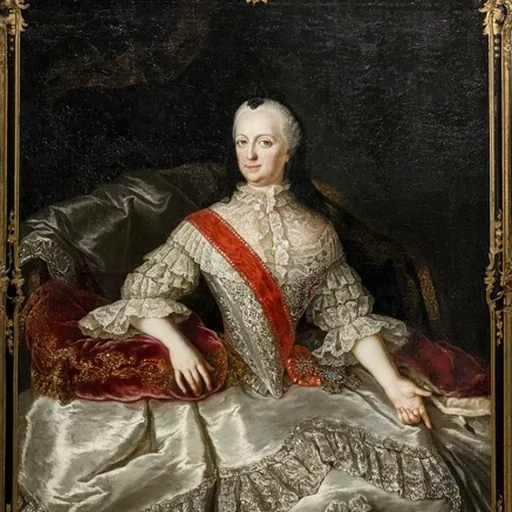
Joanna Elisabeth of Holstein-Gottorp
Princess of Anhalt-Zerbst (1712-1760), mother of Catherine II of Russia
About Joanna Elisabeth of Holstein-Gottorp
Lived 1712 – 1760 (aged 47). Joanna Elisabeth of Holstein-Gottorp was a German regent.
Joanna Elisabeth of Holstein-Gottorp (24 October 1712 – 30 May 1760) was a member of the German House of Holstein-Gottorp, a princess consort of Anhalt-Zerbst by marriage, and the regent of Anhalt-Zerbst from 1747 to 1752 on behalf of her minor son, Frederick Augustus. She is best known as the mother of Catherine the Great.
Early life Joanna Elisabeth was born to Christian August, Duke of Holstein-Gottorp (1673–1726), Prince of Eutin and Prince-Bishop of Lübeck, and his wife, Albertina Frederica of Baden-Durlach (1682–1755), who belonged to a minor branch of the influential House of (Schleswig-Holstein-Gottorp). Since her father was not rich and had eleven children, he sent Joanna to the court of her godmother, Duchess Elisabeth Sophie Marie of Schleswig-Holstein-Sonderburg-Norburg (1683–1767), who had no children of her own.
On 22 January 1729, after Christian August was appointed commander of Stettin, the couple moved into the castle in the middle of the city. Joanna, who remained dissatisfied with her position and her social isolation, started travelling to escape Stettin. She often visited Brünswick, her childhood home, and every February during the carnival season she paid her respects to the King of Prussia. Much to her dismay, she was treated as a poor relative and pitied for her marriage to someone below her in rank.
On 21 April 1729, Joanna gave birth to her first child, Sophie Auguste Friederike. Everyone had hoped for a son and heir to his father. As compensation for having to marry a minor prince, Joanna wanted to raise a great ruler. To her great disappointment, the baby was a girl. on 8 August 1734, to Frederick Augustus, who would succeed his father as Prince of Anhalt-Zerbst; and on 10 November 1736, to Auguste Charlotte Christine, who died two weeks later.
Joanna's relationship with her eldest child remained strained. According to Sophie's memoirs, Joanna was often violent and angry towards her for no reason.
In 1741, Grand Duchess Elizabeth Petrovna of Russia ascended to the throne as empress. She had once been engaged to Joanna's brother Charles Augustus (1706–1727), who died shortly before the wedding, and she cherished his memory for her whole life. Joanna was quick to write a congratulatory letter, and later sent a portrait of Elizabeth's deceased sister, Grand Duchess Anna Petrovna, and received a valuable portrait of the Empress in return. To further the relationship, Joanna sent a portrait of Sophie to the Empress, who was pleased with her beauty.
In Russia On 1 January 1744, Joanna was handed a letter from Otto Brümmer, the Grand Marshal of Grand Duke Peter's court. (Peter Ulrich had converted to Russian Orthodoxy and had taken the name Pyotr Fyodorovich.) In the letter, Brümmer asked Joanna to come to Russia with her eldest daughter as soon as possible on the command of the Empress. Only a few hours later, a letter from Frederick II of Prussia arrived to inform Joanna that Frederick saw a possibility to arrange a marriage between Peter and Sophie. There the King secretly asked Joanna to become an agent of Prussia in Saint Petersburg in place of Vice Chancellor Count Alexey Bestuzhev-Ryumin (1693–1768), an enemy of Prussia who wanted Russia to be allied with Austria and opposed the marriage of Peter and Sophie. Joanna enthusiastically accepted.
On 16 January, after the family and their company left Berlin, Christian August said goodbye and returned to Zerbst, as the Empress had asked him not to go to Russia.
At first, Joanna had a cordial relationship with Empress Elizabeth, often expressing gratitude for her kindness towards her family. However, when Sophie fell ill and the doctors wanted to bleed her, Joanna refused to allow it. That angered the Empress, who removed Joanna from her daughter's bed and tended to Sophie herself. Joanna's constant complaining during this period caused the Russian court to dislike her. While in Russia, Joanna was working on the mission she had received from the King of Prussia, trying to undermine Vice Chancellor Bestuzhev. After Bestuzhev intercepted letters between Joanna, the Prussian and the French ambassador, and the Prussian and French courts, he eventually presented copies to the Empress, who was furious and declared that Joanna must leave Russia right after the wedding. Between the betrothal and the wedding, Joanna's relationship with her future son-in-law also deteriorated.
After Peter and Sophie were married on 21 August 1745 (O.S.), Joanna left Russia without saying goodbye to Sophie (now known as Grand Duchess Catherine Alexeievna), whom she would never see again. Although Joanna departed with many presents from the Empress, in Riga, she was directed to take a message to the King of Prussia, asking him to call back the ambassador who had been caught in the conspiracy against Bestuzhev. This request was a humiliating punishment for Joanna's part in the plot.
Regency and later life
After Joanna's husband, Christian August, died on 16 March 1747, their son Frederick Augustus succeeded him as Prince of Anhalt-Zerbst. During his minority, Joanna acted as regent.
She had a new palace built by Friedrich Joachim Stengel in Dornburg to have a more suitable place for hosting her brother, King Adolf Frederick of Sweden, and her daughter, the Grand Duchess, but neither of them ever visited. Her regency was ended when her son reached his majority in 1752.
In 1758, when Prussia invaded Anhalt-Zerbst during the Seven Years' War, the Dowager Princess and her son Frederick Augustus were forced into exile in Paris. Joanna died there in 1760 at the age of 47.
Two years later, her daughter became the Empress Regnant of Russia. Her son, Frederick Augustus never returned to Zerbst.
Appearance and personality Contemporary accounts described Joanna Elisabeth as having curly blonde hair and a social manner. She was noted for being outgoing in company, talkative, and emotionally expressive. boxstyle_1=background-color: #fcc; boxstyle_2=background-color: #fb9; boxstyle_3=background-color: #ffc; boxstyle_4=background-color: #bfc; boxstyle_5=background-color: #9fe; 1= 1. Joanna Elisabeth of Holstein-Gottorp 2= 2. Christian August of Holstein-Gottorp, Prince of Eutin 3= 3. Albertina Frederica of Baden-Durlach 4= 4. Christian Albert, Duke of Holstein-Gottorp 5= 5. Frederikke Amalie of Denmark 6= 6. Frederick VII, Margrave of Baden-Durlach 7= 7. Augusta Marie of Holstein-Gottorp 8= 8. Frederick III, Duke of Holstein-Gottorp (=14) 9= 9. Marie Elisabeth of Saxony (=15) 10= 10. Frederick III of Denmark 11= 11. Sophie Amalie of Brunswick-Lüneburg 12= 12. Frederick VI, Margrave of Baden-Durlach 13= 13. Christina Magdalena of the Palatinate-Zweibrücken 14= 14. Frederick III, Duke of Holstein-Gottorp (=8) 15= 15. Marie Elisabeth of Saxony (=9) 16= 16. John Adolf, Duke of Holstein-Gottorp (=28) 17= 17. Augusta of Denmark (=29) 18= 18. John George I, Elector of Saxony (=30) 19= 19. Magdalene Sibylle of Prussia (=31) 20= 20. Christian IV of Denmark 21= 21. Anne Catherine of Brandenburg 22= 22. George, Duke of Brunswick-Lüneburg 23= 23. Anne Eleonore of Hesse-Darmstadt 24= 24. Frederick V, Margrave of Baden-Durlach 25= 25. Barbara of Württemberg 26= 26. John Casimir, Count Palatine of Kleeburg 27= 27. Catharina of Sweden 28= 28. John Adolf, Duke of Holstein-Gottorp (=16) 29= 29. Augusta of Denmark (=17) 30= 30. John George I, Elector of Saxony (=18) 31= 31. Magdalene Sibylle of Prussia (=19)
In popular culture Joanna appears as a character in the historical novel A Princess at the Court of Russia by Eva Martens. She was played by Isabelle Schosing in the 2014 Russia-1 historical television drama-documentary Ekaterina and by Gillian Anderson in season two of the loosely historically based series The Great.
Don’t just read it —
keep it.
Full-length biographies made to live with: read them, listen on the way to work, watch them tonight.
- E-book
- Audio
- Video
Instant download · yours to keep · every purchase keeps this site free
Important facts
People in Joanna Elisabeth of Holstein-Gottorp's life
Named in this biography and alive at the same time
Related people
Same field, nearest in time


Contemporaries
People whose lives overlapped Joanna Elisabeth of Holstein-Gottorp's




Frequently asked questions
Who was Joanna Elisabeth of Holstein-Gottorp?
Princess of Anhalt-Zerbst (1712-1760), mother of Catherine II of Russia
When was Joanna Elisabeth of Holstein-Gottorp born?
Joanna Elisabeth of Holstein-Gottorp was born on 24 October 1712 in Gottorf Castle.
When did Joanna Elisabeth of Holstein-Gottorp die?
Joanna Elisabeth of Holstein-Gottorp died on 30 May 1760 in Paris.
What was Joanna Elisabeth of Holstein-Gottorp's occupation?
Joanna Elisabeth of Holstein-Gottorp was a regent.
What nationality was Joanna Elisabeth of Holstein-Gottorp?
Joanna Elisabeth of Holstein-Gottorp was German.
Sources & further reading
· Wikipedia: Joanna Elisabeth of Holstein-Gottorp
· DBpedia: Duchess Joanna Elisabeth of Holstein-Gottorp
Cite this page
APA: Biography.guide. (2026). Joanna Elisabeth of Holstein-Gottorp. https://biography.guide/joanna-elisabeth-of-holstein-gottorp/
MLA: "Joanna Elisabeth of Holstein-Gottorp." Biography.guide, https://biography.guide/joanna-elisabeth-of-holstein-gottorp/.
Chicago: "Joanna Elisabeth of Holstein-Gottorp." Biography.guide. https://biography.guide/joanna-elisabeth-of-holstein-gottorp/.
Data last updated: 2026-09-23 · Spot an error? Report a correction.
Portrait: Wikimedia Commons · author & licence
Page generated 2026-09-27 05:06 UTC