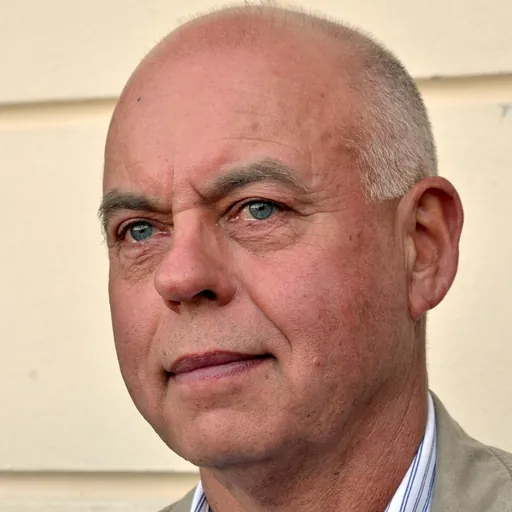
About Jiří Kačer
Born 1952. Jiří Kačer is a Czech sculptor and restorer.
Jiří Kačer (born 9 April 1952) is a Czech sculptor, restorer and academic teacher.
Life Jičí Kačer was born on 9 April 1952 in Prague. From 1967 to 1969, he attended the School of Arts and Crafts in Prague, specializing in stucco work, where he learned the basics of the craft and modeling. In the second half of the 1960s, he had the opportunity to learn about Czech modern art at exhibitions in Prague and to meet the creators of New Figuration. In the period following the Warsaw Pact invasion of Czechoslovakia, when Prague's exhibition halls were dominated by pro-regime normalization artists, he continued his studies at the Secondary School of Stonemasonry and Sculpture in Hořice (1970–1974) under Prof. R. Šrajbr. There he encountered high-quality sculptures from previous International sculpture symposia installed on Gothard Hill. He gained knowledge of working with sandstone and the basics of the procedures necessary for restoring sculptures, which he then used during his studies at the Academy of Fine Arts in Prague.
In 1975, he was accepted to the Academy of Fine Arts in Prague, where in the mid-1970s, conditions were severely affected by normalization. After two years of studying sculpture (preparatory course with Karel Kolumek, sculpture studio of Jiří Bradáček) Jiří Kačer decided to transfer to the studio of stone sculpture restoration and sculpture reproduction under Prof. Antonín Nykl in 1977. This allowed him to escape the tedious modeling lessons for various anniversaries in the style of socialist realism. The stifling conditions at the school provided little incentive for free creativity, and it was important for students to interact outside of school and engage with the entire unofficial art scene, visiting studios and private exhibitions. From 1990 to 1994, he worked at the Academy of Fine Arts as an assistant to Prof. Jan Hendrych. He was a member of the Council of the Association of Restorers (1990–2020, in liquidation).
From 1981 to 1989, he organized summer sculpture meetings in the marlstone quarry in Přední Kopanina and after 1990 he was instrumental in reviving International sculpture symposia in Hořice. and in 2010, he participated in the SmaltArt symposium in Ostrava-Vítkovice. Jiří Kačer created several copies of Baroque sculptures by important artists Antonín Braun, Ferdinand Maxmilián Brokoff), which replaced damaged originals, and restored other sculptures.
Jiří Kačer lives and works in Prague and Hostivice. From 2004, he is a member of Umělecká beseda.
Work As a student at the stonemasonry school in Hořice, Jiří Kačer collaborated on sculptures by Jan Hendrych. The Hořice school also maintained a strong Wagnerian tradition in working with the natural shape of stone. Wagner graduated from the stonemasonry school in Hořice and, after studying with Jan Štursa and Otakar Španiel at the Academy of Fine Arts in Prague and Otto Gutfreund at the School of Applied Arts in Prague, he returned to Hořice. He was one of the leading restorers of stone sculptures by Matyáš Bernard Braun in Kuks. Jan Hendrych, who studied under Wagner, was in fact his only teacher and mentor and had a significant influence on Kačer at the beginning of his sculptural career.
At the Academy of Fine Arts in Prague, he initially focused on figurative art and sought inspiration in the works of representatives of modern European sculpture (Manzù, Marini, Greco), but also in unofficial exhibitions of former graduates of the Academy of Fine Arts and the Academy of Arts, Architecture and Design. His early work was influenced by the 1973 exhibition of sculptures by Giacomo Manzù at the Belvedere in Prague and, for a time, also by the pop artist George Segal with his use of plaster casts of girls' bodies (Marcela, 1980–81). The horizontally hatched stylized relief torsos suppress the relationship to immediate reality and became a turning point towards non-figurative stones with a graphic structure, which are close to fragments of historical architecture, including the point of decay. In 1987–1989, he also devoted himself to medal making. His work in the 1990s finds itself at the intersection of natural objects and artifacts.
The fragment is crafted so that its natural shape blends into soft curves emphasized by longitudinal lines ("Fragment," limestone, 2011). Sometimes the sculptor creates the illusion of bulging or expanding matter using transverse bands ("Fragment," Slivenec limestone, 2001), sometimes spaced at regular intervals ("Fragment," serpentine, 1999, sandstone, 2001, 2006), to constrain and limit its shape. The relief grid of the surface resembles natural organic structures ("Fragment," sandstone, 1995, serpentine, 2001) or, as a regular geometric order, evokes the austerity of architecture ("Fragment (bench)," Slivenec limestone, 2006).
A characteristic feature of the sculptor's work is the careful treatment of the surface, which respects the natural color and structure of the stone and enhances its effect. Kačer does not attempt to "liberate the sculpture hidden inside the stone" (if his Cores cannot be considered such a procedure), but in his sculptural work he responds to the type of material and its shape, brittleness, or pattern (Triptych, granite, marble, 1993). He has thus arrived at a highly personal sculptural expression that does not dazzle with drama and grandeur of form, but speaks through the delicate oscillation of surface modulation that respects the inherent nature and demands of stone. In contrast to older sculptures placed on pedestals, Kačer's sculptures do not fulfill a function related to architecture or a specific environment. He has freed them from these direct connections; his sculptures are within reach, mostly freely placed, allowing direct touch and exploration of the surface.
Thanks to his regular participation in sculpture symposia, he has the opportunity to work with different types of stone and creates his works with respect for the material so as to subtly highlight its specific qualities. Therefore, he sometimes leaves traces of tools to highlight the rough structure (Fragment, granite, 2006), while at other times he polishes the surface to emphasize the pattern in the stone (Blocks, granite, 2006). In 2008, he exhibited stone cores from geological boreholes, which he individualized with restrained interventions of sculpting tools into the surface of the stone.
Kačer's fascination with surface structures is also evident in his monochrome large-scale enamels with low relief, created at the Smalt Art symposium in Vítkovice. He later used them as a base for his frottages, which he exhibited in 2012 at the New Hall in Prague.
Representation in collections National Gallery Prague North Bohemian Gallery of Fine Arts in Litoměřice Gallery of Modern Art in Hradec Králové Rabas Gallery Rakovník Ministry of Culture of the Czech Republic Salon de Tokyo Gallery, Japan Private collections at home and abroad
Public space installations Otisky (Imprints), sandstone, 1993, Hořice Fragment, granite, 1994, Milevsko Otisk (Imprint), sandstone, 1997, 260 cm, Kolín Nutcracker, syenite, 1998, Ondřejov Fragment, syenite, 1998, Jindřichův Hradec Drinking Fountain, granite, 2002 (120 cm), Mladá Boleslav Fragment, granite, 2003 (450 cm), Podvinný mlýn, Prague Monolith, granite, 2004 (460 cm), Hetzmannsdorf Fragment, sandstone, 2005 (350 cm), Uherský Brod Obelisk, sandstone, 2008, (500 cm), Kuks Fragment, sandstone, 2008, (360 cm), Vernéřovice Fragment, granite, 2010, Selb, Germany Sculpture for Cheb, 2013, Cheb Bench, granite, 2019, (400 cm), Mikulov Fragment, granite, 2019, Trojský zámek
Restoration and copies of sculptures During the restoration, Jiří Kačer collaborated with technologists such as Jiří Rathouský. He verified the possibilities and limits of using ethyl silicates and in the 1980s carried out work in artificial marble and stucco in Předklášteří and at Prague Castle. He participated in the restoration of the statues of the Holy Trinity Column on Malá Strana (1992–1997), the statue of St. John of Nepomuk on the Písek Stone Bridge (1996–1997, 2002–2003), the Plague Column in Znojmo (1999), the sculptures on the attic of the Tuscan Palace in Prague (1998), the Monument to Charles VI in Hlavenec (1999–2000), the war memorial in Komárov (2002), and the sculptural decoration of the staircase at Troja Castle.
He also restored sgraffito in Znojmo and at Jakub Krčín's fortress in Křepenice, marble stoups in the Church of the Virgin Mary in Sedlec (2007). In the castle park in Lysá nad Labem, he restored the allegorical statue of Spring, created copies of the statues of Apollo and Venus with Cupid (2006), and restored the vases on the enclosure wall (2008, 2009). and in 2017 St. Francis Borgia (Ferdinand Maxmilián Brokoff).
In Prague, he also restored the statue of the Madonna by Matyáš Bernard Braun on the facade at Celetná 23 (2005) and St. Hubert with a deer by Ferdinand Maxmilián Brokoff at Tomášská st. 4 (2006, with Z. Kačerová), the monumental sculpture Work and Humanity by Jan Štursa on the bridgehead of Hlávka Bridge (2007–2008), and worked on the restoration of Matthias Gate at Prague Castle (2008, with V. Adamec and P. Gláser). He created a copy of the pedestal for the sculpture of Cosmas and Damian (2010) on Charles Bridge and participated in the repair of the figural part (2013). For the pilgrimage site at White Mountain in Prague, he restored the gate and reliefs (after 2010, with Z. Kačerová). Statue of St. Ivo (Matyáš Bernard Braun, 1711), Charles Bridge, Prague, restored in 1996, with Z. Fučík, P. Justa Plague Column in Znojmo (Michael Mandík ?, St. Ludmila with Little Wenceslas (Antonín Braun, 1720), Charles Bridge, Prague, copy by Jiří Kačer, Marcela Kačerová, 1999 Sculptures of Apollo and Venus with Cupid, Lysá nad Labem (2006) Sculpture of St. Francis Borgia, Ferdinand Maxmilián Brokoff, copy by Jiří Kačer, Charles Bridge, Prague 2017
Enamels and frottages 2009-2010 - Symposium Smalt Art Vítkovice
Sculpture symposia 1981–1987 - Sculpture Meetings, Přední Kopanina, Prague 1992 - Džbán 1992. International Sculpture Symposium, Hředle 1993 - International Sculpture Symposium, Hořice 1994 - Cotangens, Adnet, Austria 1994 - Cotangens, Prague 1996 - Boháňka, Hořice 1998–2001 - Stones and Stars, Ondřejov Observatory 1998 - Granite Symposium, Jindřichův Hradec 1999 - Granite Symposium, Milevsko 1999 - Steinbildhauer Symposium, Prägraten am Großvenediger, Austria 2000 - Schüttkasten Klement, Austria 2000 - Džbán 2000. International Sculpture Symposium, Hředle 2001 - Cultural Bridge, Gerlesborg, Sweden 2003 - Sculpture Meeting "At the Wall 2003", Uherský Brod 2003 - The Path of Marble, Dobřichovice 2004 - Kunstfeld Hetzmannsdorf, Austria 2005 - "Sculpture Meeting 'At the Wall 2005'," Uherský Brod 2005 - "Sculpture Summer," Milevsko 2006 - Castellina in Chianti, Italy 2008 - "Baroque and Sandstone," Broumov 2009-2010 - Smalt Art, Ostrava-Vítkovice 2010 - Verknüpfungen, Selb 2011 - "Tusta Lapidaea," Domažlice 2019 - "Mikulov Art Symposium," Mikulov
Solo exhibitions (selection) 1982, 1991 - "Jiří Kačer," Institute of Macromolecular Chemistry (ÚMCH), Prague 1983 - Jiří Kačer, Staré Hrady Castle near Libáň 1992 - Jiří Kačer, Sculpture Gallery, Gotthard Hill, Hořice 1993 - Jiří Kačer: Reliefs and Drawings, Nová síň Gallery, Prague 1997 - "Jiří Kačer: Sculptures," House of Art, České Budějovice 1997 - "Jiří Kačer," Špejchar Gallery, Jindřichův Hradec 1998 - "Jiří Kačer: Sculptures," Gallery in the Garden, Kolín, Vincenc Kramář New Gallery, Prague 2001 - Jiří Kačer: Stones, Central Bohemian Museum, Roztoky u Prahy 2001 - Other Stones by Jiří Kačer, Municipal Museum, Hořice 2002 - Jiří Kačer: Sculptures, Ball Game Hall of Prague Castle and Royal Garden 2006 - Jiří Kačer: Stones, Karlovy Vary Art Gallery 2007 - Jiří Kačer: Sculptures, University of Pardubice Gallery 2007 - Jiří Kačer, Rabas Gallery, Rakovník 2008 - Jiří Kačer: Cores, Czech Museum of Fine Arts, Prague 2009 - Jiří Kačer: Stones, Gallery of Modern Art, Hradec Králové 2010 - Jiří Kačer: Stones, Pilsen City Gallery 2012 - Jiří Kačer: Rudiments, New Hall, Prague 2012 - Jiří Kačer: Sculptures, North Bohemian Gallery of Fine Arts in Litoměřice 2012 - Jiří Kačer: Sediments of Stone Memory, Gallery of Fine Arts in Most 2014 - Jiří Kačer, Ivan Ouhel, Frýštát Castle Gallery, Karviná 2014 - Jiří Kačer, Magna Gallery, Ostrava 2015 - Jiří Kačer, Zuzana Kačerová, Otto Gutfreund Gallery, Dvůr Králové 2016/2017 - "Jiří Kačer: Stones," Tábor 2019 - Jiří Kačer, Aleš Hnízdil, Troja Palace (GHMP) 2023/2024 - Jiří Kačer: Frottages and Stones, Terezín Memorial 2024 - Jiří Kačer: Stone and Paper, Institute of Macromolecular Chemistry (ÚMCH) Gallery, Petřiny
Joint exhibitions (selection) 1982 - Jiří Kačer: Sculptures, Karel Rossí: Paintings, ÚMCH, Prague 1987 - Rockfest 87, Palace of Culture, Prague 1987 - Confrontation VI, Špitálská Street, Prague 1987 - "Contemporary Czech Medals and Plaques," Mánes, Prague 1988 - "Salon of Prague Artists '88," PKOJF, Prague 1989 - "The Art of Restoration 1948–1988," Mánes, Prague 1993 - "Exhibition of Contemporary Czech Sculpture," Mánes, Prague 1993/4 - "Stories Without End, The Principle of Series in Czech Fine Arts," Governor's Palace, Brno, Kinsky Palace, Prague 1994 - "Sculpture in Stone (in honor of Josef Wagner)," Vojanovy sady, Prague 1995 - "Cotangens," Prague Castle 2000 - "Czech Stone Sculpture of the 1990s," Prague Castle 2002 - "III. New Zlín Salon," Zlín 2005 - IV. New Zlín Salon 2005, House of Art, Zlín 2007 - Umělecká beseda Member Exhibition, Museum and Gallery of the Orlické Mountains, Rychnov nad Kněžnou, New Town Hall, Prague, Gallery of Fine Arts in Most 2007 - Umělecká beseda: Awareness of Man, Masné krámy Exhibition Hall, Plzeň, Mánes, Prague 2008 - Born into Space, Sovinec Castle 2009 - Eternal Transience, Church of the Annunciation of the Virgin Mary, Litoměřice 2010 - Enamel Art. Landscape, Body, Radiance, Nostický Palace, Prague 2011 - Terra (non)firma / (Un)solid Ground, Kartografie Gallery, Prague 2020 - The Pilgrim Who Returns, Church of the Annunciation of the Virgin Mary, Litoměřice 2021 - Footprints in the Sand, Prácheň Museum in Písek 2022/2023 - Umělecká beseda, Institute of Macromolecular Chemistry (Makráč Gallery), Prague 2023/2024 - Freedom in Art, Clam-Gallas Palace, Prague 2024 - Central Bohemian Triennial '24, Rabas Gallery, New Hall under the High Gate, Rakovník 2024 - Come Closer: Sculptures, Plastics, Objects, Konojedy Castle, Úštěk
Don’t just read it —
keep it.
Full-length biographies made to live with: read them, listen on the way to work, watch them tonight.
- E-book
- Audio
- Video
Instant download · yours to keep · every purchase keeps this site free
Important facts
People in Jiří Kačer's life
Named in this biography and alive at the same time




Related people
Same field, nearest in time



Contemporaries
People whose lives overlapped Jiří Kačer's

Frequently asked questions
Who is Jiří Kačer?
Czech sculptor
When was Jiří Kačer born?
Jiří Kačer was born on 9 April 1952 in Prague.
What is Jiří Kačer's occupation?
Jiří Kačer is a sculptor and restorer.
What nationality is Jiří Kačer?
Jiří Kačer is Czech.
Sources & further reading
Cite this page
APA: Biography.guide. (2026). Jiří Kačer. https://biography.guide/jiri-kacer/
MLA: "Jiří Kačer." Biography.guide, https://biography.guide/jiri-kacer/.
Chicago: "Jiří Kačer." Biography.guide. https://biography.guide/jiri-kacer/.
Data last updated: 2026-09-20 · Spot an error? Report a correction.
Portrait: Wikimedia Commons · author & licence
Page generated 2026-09-27 04:57 UTC