
About Jersey Joe Walcott
Lived 1914 – 1994 (aged 80). Jersey Joe Walcott was an American boxer and politician.
Boxing career Walcott debuted as a professional boxer at the young age of 16 on September 9, 1930, fighting Eddie "Cowboy" Wallace and winning by a knockout in the first round. After this victory, Walcott fought on and off throughout the rest of the decade (Walcott lacked professional management and a regular training routine, causing him to struggle during his early career). Although he defeated a young Elmer Ray, he lost two bouts to Tiger Jack Fox and was knocked out by heavyweight contender Abe Simon in 1940. After losing to Simon, Walcott was inactive for over four years. During World War II, Walcott secured a wartime job, and did not fight again until 1944, winning two matches against local fighters Felix Del Paoli and Ellis Singleton. left Jersey Joe Walcott in 1937It was during these fights that Walcott was noticed by local boxing manager Felix Bocchicchio, who saw great potential in the fighter. Although Bocchicchio had a criminal history, he was well connected in the boxing scene and was able to provide Walcott and his family with financial stability, so that Walcott could now focus on fighting full time. He also got Walcott professional trainers, Nick and Dan Florio (two brothers who worked with several world champions). Together they got Walcott on a professional routine and diet, while improving his footwork and counter punching to turn him into a very crafty fighter.
Now under professional management, Walcott resumed his boxing career in 1945. He quickly rose through the heavyweight ranks, defeating top contenders including Joe Baksi, Jimmy Bivins, Lee Oma and Tommy Gómez. Despite closing out 1946 with losses to future light heavyweight champion Joey Maxim and a rematch with top ranked heavyweight contender Elmer Ray, he promptly avenged both of those defeats in 1947 and rose to the rank of #1 heavyweight contender.
Walcott vs Louis
Now the top contender, Walcott fought heavyweight champion Joe Louis on December 5, 1947. At 33 years of age Walcott broke the record as the oldest man to fight for the world heavyweight title, although he was only four months older than Louis at the time. At this point, Louis had been champion for over ten years and this would be his 24th title defense.
Walcott fought very well, dropping Louis in round one and again in round four, but lost a highly controversial 15-round split decision. Most boxing writers felt Walcott deserved the win; a debate ensued, and sportswriters carried the topic throughout America. The lone official to vote for Walcott, referee Ruby Goldstein, was cast as a hero. Letters and telegrams poured in to the Goldstein household, praising his judgment. There was talk of an investigation being assembled for rule revisions in judging. Louis went into seclusion for a couple of days, then quieted dissent with the following: "I know Ruby. He calls them as he sees them and that should be good enough for anybody."
What controversy remained was the kind that builds the gate, and Jersey Joe was rightfully granted a rematch on June 25, 1948. The heavily anticipated fight proved to also be competitive. Walcott dropped Louis once again, this time in the third round, but Louis went on to rally, and ultimately prevailed, scoring a knockout in round 11. The bout was Louis' record 25th and final title defense before announcing his first retirement. The rematch was also the world's first closed-circuit telecast (CCTV) sports broadcast, distributed via theatre television.
Walcott vs Charles
On June 22, 1949, Walcott got another chance to become a world champion when he faced the highly skilled Ezzard Charles for the NBA heavyweight title left vacant by Louis. Charles prevailed, winning a unanimous decision over 15 rounds. Walcott, disappointed but eager to see his dream of being a champion come true, fought on, and in 1950 he won four of his five bouts, including a third-round knockout of future world light heavyweight champion Harold Johnson.
On March 7, 1951, he and Charles fought another title fight. Charles had defeated Louis the previous year, and was now the undisputed heavyweight champion. Walcott fought well, but was hurt in the ninth round when he was dropped by a sharp left hook. Walcott survived the round but once again Charles won a 15-round decision to retain his world title.
Despite losing four title shots, only four months later, Walcott joined a small handful of boxers who claimed the world title on their fifth try. Charles fought Walcott in another title fight on July 18, 1951, at Forbes Field in Pittsburgh. This time Walcott gave his best performance of their entire series of fights, winning most of the rounds and knocking out Charles in the seventh round, with a left hook to the jaw, to finally become world heavyweight champion at the age of 37. This made him the oldest boxer ever to win the world heavyweight crown, a distinction he would hold until George Foreman won the title at age 45 in 1994. Walcott retained his title in a fourth and final fight with his arch-rival Charles on June 5, 1952, this time winning a close 15-round decision. The Associated Press (AP) reported, "In the last round, [Charles] was bombing desperately with long right hands that slithered around Walcott's neck. Walcott's ability to spin, to make [Charles]'s punches miss, and counter with those damaging hooks, apparently won him the nod on two ballots. Judges McTieman and Tomasco gave that round to Walcott to win their close decision".
Walcott vs Marciano
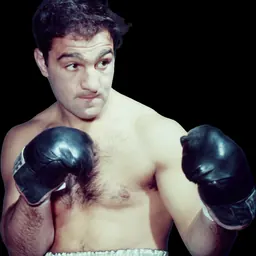
On September 23, 1952, at Municipal Stadium in Philadelphia, Walcott put his title on the line for the second time, and this time his opponent was the undefeated Rocky Marciano. In the first round, Walcott floored Marciano with a left hook; the first time in his career that Rocky had ever been down. After twelve intense rounds, Walcott stood well ahead on two of the three official scorecards, leaving Marciano needing a knockout to win. In the thirteenth round, with Marciano pressuring Walcott against the ropes, simultaneously each threw a right hand. Marciano landed first and flush on Walcott's jaw with a devastating right hook and a powerful left follow-up. The title changed hands in an instant. Walcott collapsed with his left arm hanging over the ropes, slowly sinking to the canvas, where he was counted out. An immediate rematch was set for May 15, 1953, at Chicago Stadium. The second time around Walcott was again defeated by Marciano by a knockout, this time in the first round. It would be Walcott's last bout.
Fighting style
Walcott was known for his defense including his head movement, such as slipping, to avoid being hit. Jersey Joe was especially well known for his use of the shoulder roll. James Toney credits Walcott as the inspiration for his variation of the shoulder roll.
Jersey Joe was also known for his unique footwork such as his "Walcott Shuffle" which involved quickly switching from an orthodox lead to a southpaw lead, and vice versa, to distract his opponents and create angles. This became the inspiration for Muhammad Ali to create the "Ali Shuffle" used for the same purpose.
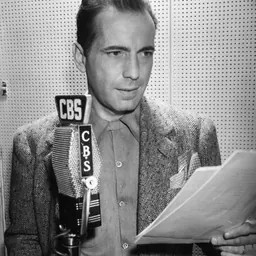
Life after boxing Acting career Walcott did not go away from the celebrity scene after boxing. In 1956, he co-starred with Humphrey Bogart and Max Baer in the boxing drama The Harder They Fall.
Professional Wrestling career He went into professional wrestling in 1956 in New Mexico. In 1963, he lost to Lou Thesz in a boxer vs. wrestler match in Memphis, Tennessee. Thesz pinned Walcott in the fourth round, but has stated that Walcott knocked him (Thesz) down and most likely out in that third round. As he fell to the floor, he relied on instinct, grabbing Walcott's knees, taking him down with him, and stretching him out for the pin. He lost to Thesz again in Florida in 1966. He continued wrestling until 1969.
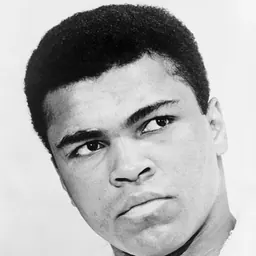
Refereeing Walcott also refereed several notable fights, but in 1965 he oversaw the controversial world heavyweight championship rematch between Muhammad Ali and Sonny Liston. Walcott lost the count as Ali circled around a floored Liston and Walcott tried to get him back to a neutral corner. Walcott then looked outside of the ring (presumably to the ringside count keeper) as Ali and Liston went at each other, before Walcott instructed them to keep on fighting. Walcott then approached the fighters and abruptly stopped the fight. This incident effectively ended his career as a referee, although he eventually returned to officiate two more fights in the late 1970s.
Political career After retiring, Walcott worked for the Camden County corrections department. In 1968, he ran for Sheriff of Camden County, New Jersey, but lost in the Democratic primary to Spencer H. Smith Jr. That same year he was named director of community relations for Camden.
He served as chairman of the New Jersey State Athletic Commission from 1975 until 1984, when he stepped down at the mandatory retirement age of 70. Walcott was inducted into the International Boxing Hall of Fame in Canastota, New York.
Death Walcott died from diabetes-related complications on February 25, 1994 at the age of 80.
Honors In 2013, Walcott was inducted into the New Jersey Hall of Fame.
Partial filmography The Harder They Fall (1956) - George The Super Fight (1970) - Himself (voice)
Professional boxing record
Titles in boxing Major world titles NYSAC heavyweight champion (200+ lbs) NBA (WBA) heavyweight champion (200+ lbs)
The Ring magazine titles The Ring heavyweight champion (200+ lbs)
Undisputed titles Undisputed heavyweight champion
Don’t just read it —
keep it.
Full-length biographies made to live with: read them, listen on the way to work, watch them tonight.
- E-book
- Audio
- Video
Instant download · yours to keep · every purchase keeps this site free
Important facts
People in Jersey Joe Walcott's life
Named in this biography and alive at the same time




Related people
Same field, nearest in time


Contemporaries
People whose lives overlapped Jersey Joe Walcott's

Frequently asked questions
Who was Jersey Joe Walcott?
American boxer (1914-1994)
When was Jersey Joe Walcott born?
Jersey Joe Walcott was born on 31 January 1914 in New Jersey, Merchantville.
When did Jersey Joe Walcott die?
Jersey Joe Walcott died on 25 February 1994 in Camden.
What was Jersey Joe Walcott's occupation?
Jersey Joe Walcott was a boxer and politician.
What nationality was Jersey Joe Walcott?
Jersey Joe Walcott was American.
Sources & further reading
· Wikipedia: Jersey Joe Walcott
Cite this page
APA: Biography.guide. (2026). Jersey Joe Walcott. https://biography.guide/jersey-joe-walcott/
MLA: "Jersey Joe Walcott." Biography.guide, https://biography.guide/jersey-joe-walcott/.
Chicago: "Jersey Joe Walcott." Biography.guide. https://biography.guide/jersey-joe-walcott/.
Data last updated: 2026-09-20 · Spot an error? Report a correction.
Page generated 2026-09-27 05:24 UTC