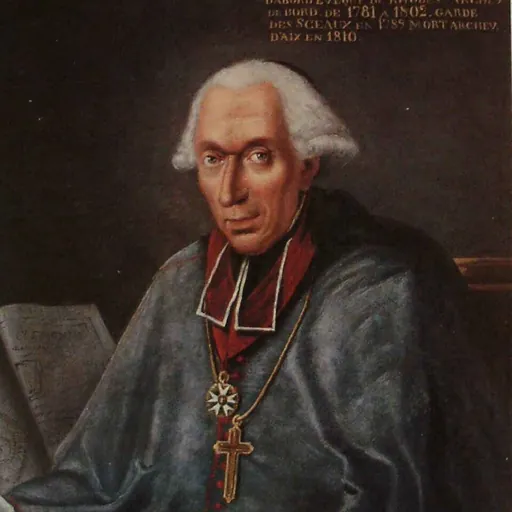
About Jérôme Champion de Cicé
Lived 1735 – 1810 (aged 74). Jérôme Champion de Cicé was a French politician, catholic bishop and archbishop.
Jérôme Marie Champion de Cicé (born in Rennes – died in Aix-en-Provence. ) was a French churchman and politician of the 18th century.
Jérôme Champion de Cicé, Archbishop of Bordeaux, was one of the four prelates who had headed the majority of the clergy estate in their union with the Third Estate (tiers état). Appointed Keeper of the Seals by Louis XVI in succession to Barentin, he was the author of a draft declaration of rights in 24 articles that served as the basis for the Declaration of the Rights of Man and of the Citizen of 1789 and is considered one of its "fathers".
Biography Born in Rennes on , Jérôme Champion de Cicé studied at the Collège du Plessis, where his fellow pupils included Boisgelin de Cucé, Loménie de Brienne, Morellet and Turgot. In , he became a Doctor of Theology at the Sorbonne. He was the grand-nephew of Louis Armand Champion de Cicé, a missionary in Canada, China and later Siam, where he served as apostolic vicar and bishop in partibus infidelium of Sabule from to .
As early as , he was appointed commendatory abbot of Chantemerle Abbey, which provided him with an annual income of 2,000 to 2,500 livres. Ordained a priest in , he became vicar general in Auxerre, where his elder brother Jean-Baptiste-Marie Champion de Cicé had just been appointed bishop.
From to , he served as Agent-General of the Clergy of France and Councillor of State. In , he struck up a friendship with Turgot and, together with César-Guillaume de La Luzerne (his colleague at the agency, later Bishop of Langres), published the Rapports de l'agence, contenant les principales affaires du clergé, qui se sont passées depuis l'année 1765 jusqu'en l'année 1770, in which he recounted his experience as an agent of the clergy.
He was appointed Bishop of Rodez in . In , he launched a large-scale survey throughout his diocese by means of a printed questionnaire sent to all parish priests. Most of the questions concerned the state of the population, its means of subsistence, the economy, health – only one dealt with spiritual matters. In , he published the Procès verbal de l'Assemblée générale du clergé de France tenue à Paris en 1770, a substantial volume of 868 pages. In , the provincial administration of Haute-Guyenne (covering Quercy and Rouergue) was created within the généralité of Montauban, and Champion de Cicé was appointed its president. In this capacity, he oversaw the modernisation of the land registry with a view to reassessing taxes.
Appointed Archbishop of Bordeaux in , he helped to found the National Institute for the Deaf (INJS) of Bordeaux in .
On , he published a Mandement prescrivant des prières pour le succès des États généraux (Mandate prescribing prayers for the success of the Estates-General), which greatly displeased the nobility.
Elected – like his elder brother Jean-Baptiste-Marie, Bishop of Auxerre – as a deputy of the clergy to the Estates-General of 1789, he was tasked with presenting the work of the Committee on the Constitution, including the text of the Declaration of the Rights of Man and of the Citizen of 1789.
In the aftermath of the Night of 4 August, Jérôme Champion de Cicé was appointed Keeper of the Seals by Louis XVI. Just three days after his appointment, on , he went to the National Assembly with seven other ministers, sent by the king "who wishes to be one with his nation" to ask how to restore order. Necker then spoke about the state of finances.
Thereafter, he addressed the Assembly only as Keeper of the Seals, in order to maintain, as far as possible, the link between the king and the deputies. On , after the proclamation of the Civil Constitution of the Clergy, he resigned his office as Keeper of the Seals and decided to resume his duties as a deputy. Having requested leave to rest, he was not present during the debate on the oath and did not take it.
His name having been placed on the list of absentees , he emigrated, first to Brussels, then to the Netherlands. From to , he settled in London, where he found fellow monarchists such as Malouët and Lally-Tollendal, as well as liberal prelates like Boisgelin and Fontanges.
On , he published a 15-page document in London entitled Lettre de Mgr l'archevêque de Bordeaux à ses diocésains (Letter from the Archbishop of Bordeaux to his diocesans), in which he explained to them the reasons for his resignation, submitted at the request of the Pope.
On , he returned to France, and was almost immediately (on ) appointed Archbishop of Aix-en-Provence, a diocese that then encompassed both Bouches-du-Rhône and Var. First page of Champion de Cicé's bilingual French/Provençal edition of Cantiques spirituels (Spiritual Canticles).Jérôme Champion de Cicé was sensitive to the issue of regional languages and published Catechisms in the local idiom in the various dioceses he administered.
On , Jérôme Champion de Cicé was raised to the rank of Officer of the National Order of the Legion of Honour . Three years later, on , he was made a Count of the Empire by Napoleon.
He died of illness in Aix-en-Provence at the archiepiscopal palace on .
Around fifteen draft Declarations were successively presented to the Assembly during the summer of 1789 (drafts by La Fayette, Target, Mounier, Mirabeau, Sieyès, Gouges-Cartou, etc.). On , the Assembly gave priority to the one entitled "Draft Declaration of the Rights of Man and of the Citizen, discussed in the sixth bureau", chaired by Champion de Cicé. It was certainly for its balance that the draft reported by Champion de Cicé was chosen by the deputies to serve as the basis for the Declaration. The moderation of the Archbishop of Bordeaux and his art of consensus won over the deputies . From to , the Assembly debated and amended the draft, article by article . On , the Assembly adopted the 17 articles of the Declaration of the Rights of Man and of the Citizen. Articles 12 to 16 came directly from the sixth bureau's draft.
Notes and references
Don’t just read it —
keep it.
Full-length biographies made to live with: read them, listen on the way to work, watch them tonight.
- E-book
- Audio
- Video
Instant download · yours to keep · every purchase keeps this site free
Important facts
People in Jérôme Champion de Cicé's life
Named in this biography and alive at the same time
Related people
Same field, nearest in time



Contemporaries
People whose lives overlapped Jérôme Champion de Cicé's






Frequently asked questions
Who was Jérôme Champion de Cicé?
French politician
When was Jérôme Champion de Cicé born?
Jérôme Champion de Cicé was born on 3 September 1735 in Rennes.
When did Jérôme Champion de Cicé die?
Jérôme Champion de Cicé died on 19 August 1810 in Aix-en-Provence.
What was Jérôme Champion de Cicé's occupation?
Jérôme Champion de Cicé was a politician, catholic bishop and archbishop.
What nationality was Jérôme Champion de Cicé?
Jérôme Champion de Cicé was French.
Sources & further reading
· Wikipedia: Jérôme Champion de Cicé
· DBpedia: Jérôme Champion de Cicé
Cite this page
APA: Biography.guide. (2026). Jérôme Champion de Cicé. https://biography.guide/jerome-champion-de-cice/
MLA: "Jérôme Champion de Cicé." Biography.guide, https://biography.guide/jerome-champion-de-cice/.
Chicago: "Jérôme Champion de Cicé." Biography.guide. https://biography.guide/jerome-champion-de-cice/.
Data last updated: 2026-09-20 · Spot an error? Report a correction.
Portrait: Wikimedia Commons · author & licence
Page generated 2026-09-27 04:58 UTC