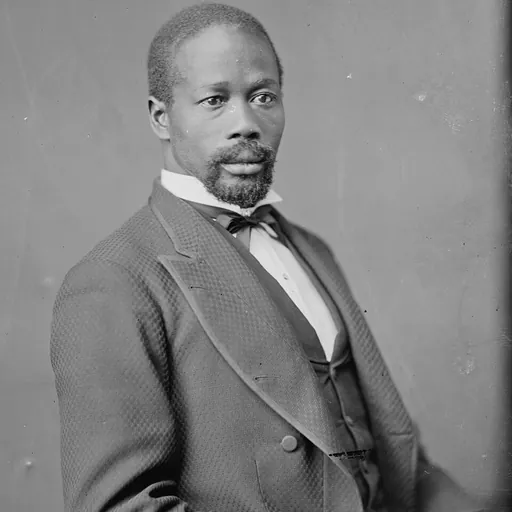
About Jeremiah Haralson
Lived 1846 – 1916 (aged 69–70). Jeremiah Haralson was an American politician.
Jeremiah Haralson (April 1, 1846 – disappeared 25 March 1895) was a politician from Alabama who served as a state legislator and was among the first ten African-American United States congressmen. Born into slavery in Columbus, Georgia, Haralson became self-educated while enslaved in Selma, Alabama. He was a leader among freedmen after the American Civil War.
He became active in politics, being elected as a Republican to the State House and the State Senate from Dallas County, Alabama. He was elected in 1874 and served in the United States House of Representatives, representing Alabama's 1st congressional district in the 44th United States Congress.
The conservative Democrats gained control of the state legislature and gerrymandered several districts. In 1876 Haralson was forced to run from the changed Alabama's 4th congressional district, the only one still having a majority-black population. Running as an independent against the Republican candidate, James T. Rapier, Haralson essentially split the Republican vote. Dallas County Sheriff Charles M. Shelley, a Democrat, won the seat with 38% of the vote.
Although not successful in gaining elective office again, Haralson was appointed to Republican patronage positions in the Customs Service, Department of Interior, and the Pension Bureau in Washington, DC.
After 1884, he returned to the South. He was convicted of pension fraud in 1894. He appeared to vanish from the historical record upon imprisonment in New York. He was sold at auction in Columbus to J.W. Thompson.
When Thompson died, Jeremiah was sold to Judge Jonathan Haralson who later was a president of the Southern Baptist Convention, of Selma, Alabama.
Political career After emancipation, Haralson taught himself to read and write and worked for a time as a farmer. He became involved in politics. In 1868 he campaigned for Democrat Horatio Seymour to defeat Republican Ulysses S. Grant for president. Some ex-Confederates questioned his sincerity, as most freedmen were supporting the Republican Party of Abraham Lincoln, who had gained their emancipation.
Some sources say that Haralson was a candidate for U.S. Congress in 1868. But the official results do not list him as a candidate. He would have been running from the Alabama First District, which reported 100% of votes for one candidate, so they may have conducted a primary in which he was defeated.
In 1870 Haralson allied with the Republican Party, but he maintained a network with some Democratic leaders. Republicans were suspicious of Haralson because of his friendships with Democrats such as Jefferson Davis, former president of the Confederacy; Rep. Lucius Q. C. Lamar of Mississippi, and Georgia Senator John B. Gordon, who was later elected as governor of that state.
In 1876 Haralson ran for reelection. Due to redistricting by the state legislature to accomplish gerrymandering, he was running for Alabama's 4th congressional district, which then had a black majority. Election campaigns in the 1870s had been violent as Democrats sought to regain political control of the state, using fraud, intimidation and physical violence to suppress the black vote, because of the black-majority or near-majority population in many counties, who were voting for Republican candidates.
Former congressman James T. Rapier, who was also African American, had bought a plantation in this district. This was the only remaining Alabama district in which the black population still comprised a majority population. Rapier won the Republican primary and thus the nomination, but Haralson ran as an independent. Their competition split the black Republican vote: Haralson received 33.93% of the vote, more than Rapier's 28%. But the Democratic candidate Charles M. Shelley, former Dallas County Sheriff, won the seat with 38% of the vote.
Haralson ran against Shelley again in 1878. He received 42.57% of the vote, or 6,545 votes, and was defeated again. This was considerably lower than the 8,675 he had received two years before, showing the effects of Democratic suppression of the black Republican vote.
In 1879, Haralson was appointed by President Rutherford B. Hayes to a Federal patronage position in the US customhouse in Baltimore, Maryland.
Later life and death Anecdotal evidence compiled in the Biographical Directory of the United States Congress reported that he moved to Texas, then Oklahoma and Colorado, worked as a coal miner and was killed by wild animals while hunting near Denver, Colorado .
Don’t just read it —
keep it.
Full-length biographies made to live with: read them, listen on the way to work, watch them tonight.
- E-book
- Audio
- Video
Instant download · yours to keep · every purchase keeps this site free
Important facts
People in Jeremiah Haralson's life
Named in this biography and alive at the same time



Related people
Same field, nearest in time






Contemporaries
People whose lives overlapped Jeremiah Haralson's



Frequently asked questions
Who was Jeremiah Haralson?
American politician (1846-1916)
When was Jeremiah Haralson born?
Jeremiah Haralson was born on 1 April 1846 in Columbus.
When did Jeremiah Haralson die?
Jeremiah Haralson died in 1916 in Denver.
What was Jeremiah Haralson's occupation?
Jeremiah Haralson was a politician.
What nationality was Jeremiah Haralson?
Jeremiah Haralson was American.
Sources & further reading
· Wikipedia: Jeremiah Haralson
Cite this page
APA: Biography.guide. (2026). Jeremiah Haralson. https://biography.guide/jeremiah-haralson/
MLA: "Jeremiah Haralson." Biography.guide, https://biography.guide/jeremiah-haralson/.
Chicago: "Jeremiah Haralson." Biography.guide. https://biography.guide/jeremiah-haralson/.
Data last updated: 2026-09-22 · Spot an error? Report a correction.
Portrait: Wikimedia Commons · author & licence
Page generated 2026-09-27 05:04 UTC