About Jemmy Wood
Lived 1756 – 1836 (aged 79). Jemmy Wood was a banker.
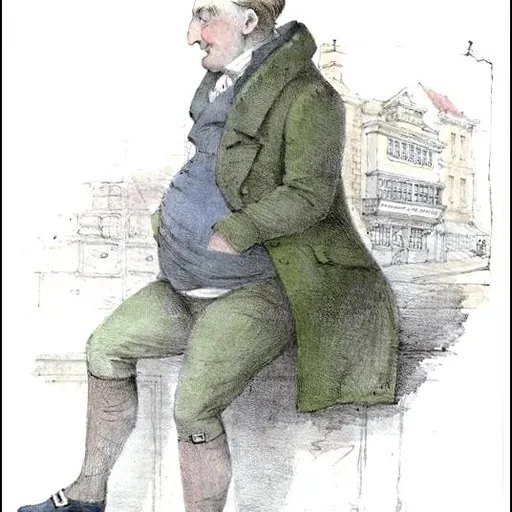
A portrait of James Wood (possibly based on a print by George Rowe). James "Jemmy" Wood (7 October 1756 – 20 April 1836) was the owner of the Gloucester Old Bank who became nationally known as "The Gloucester Miser". His wealth of around £900,000 was stated at the time to have made him "the richest commoner in His Majesty's dominions". in Westgate Street, Gloucester and baptised at St Michael's Church on 19 October 1756. He was the third child and only son of Richard and Elizabeth Wood and he attended either Sir Thomas Rich's School or The King's School.
Gloucester Old Bank Wood inherited the Gloucester Old Bank from his grandfather who had founded it in 1716. The bank was said to have been one of the oldest private banks in Britain, having survived the financial consequences of the Napoleonic Wars when many other banks went out of business. The bank was taken over by the County of Gloucestershire Banking Company in 1838, which eventually became part of Lloyds Bank in 1897.
Wood also owned an undertaking business and extensive land in and around the City of Gloucester.
Gloucester City Wood never appeared in lists of city benefactors and despite serving as City Sheriff for 1811 and 1813, and as an Alderman from 1820 until his death, it is thought that he never became Mayor because the expense of the job was too great for him to bear. He was not averse to spending other people's money, however. In 1818, 47 people dined at the city's expense at a dinner given for the Duke of Gloucester at which they ate a turtle weighing given to the city by Lord Henry Howard-Molyneux-Howard.
In fiction Charles Dickens may have been inspired by the stories about the Gloucester Miser to create the character of Ebenezer Scrooge in his 1843 novella A Christmas Carol. A character by the name of Dismal Jemmy appears in The Pickwick Papers and Jemmy Wood of Gloucester is mentioned in Our Mutual Friend. It has also been speculated that the fictional court case of Jarndyce v Jarndyce in Bleak House may have been based on the case that arose following irregularities in Wood's will, although the court system of the time was so slow and expensive that there are a number of other possible cases on which Jarndyce could just as easily have been based.
Death Wood died in 1836 and was buried in St Mary de Crypt Church in Gloucester where there is a gravestone to his memory in the chancel.
Problems over his will led to a long court case that soaked up much of the funds in the estate. Wood never married and had no children. He left around £900,000 to be shared equally between Sir Matthew Wood, John Chadborn (Solicitor), Jacob Osborne and John S. Surman, who were also his executors. A damaged codicil was found that left money to the City of Gloucester and to other beneficiaries and it was wrangling over the authenticity of the codicil that caused the settlement of the estate to be delayed.
Don’t just read it —
keep it.
Full-length biographies made to live with: read them, listen on the way to work, watch them tonight.
- E-book
- Audio
- Video
Instant download · yours to keep · every purchase keeps this site free
Important facts
People in Jemmy Wood's life
Named in this biography and alive at the same time




Related people
Same field, nearest in time




Contemporaries
People whose lives overlapped Jemmy Wood's




Frequently asked questions
Who was Jemmy Wood?
English banker
When was Jemmy Wood born?
Jemmy Wood was born on 7 October 1756 in Gloucester.
When did Jemmy Wood die?
Jemmy Wood died on 20 April 1836 in Gloucester.
What was Jemmy Wood's occupation?
Jemmy Wood was a banker.
Sources & further reading
Cite this page
APA: Biography.guide. (2026). Jemmy Wood. https://biography.guide/jemmy-wood/
MLA: "Jemmy Wood." Biography.guide, https://biography.guide/jemmy-wood/.
Chicago: "Jemmy Wood." Biography.guide. https://biography.guide/jemmy-wood/.
Data last updated: 2026-09-22 · Spot an error? Report a correction.
Portrait: Wikimedia Commons · author & licence
Page generated 2026-09-27 05:04 UTC