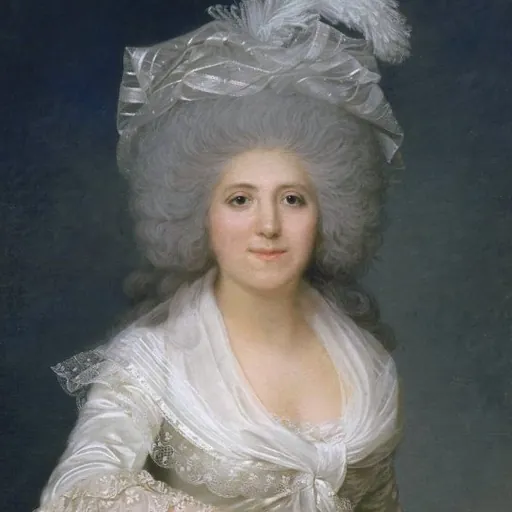
About Jeanne-Louise-Henriette Campan
Lived 1752 – 1822 (aged 69). Jeanne-Louise-Henriette Campan was a French lady's maid, educator, writer and pedagogue, known for Princess Louise Marie of France, Princess Sophie of France and Princess Victoire of France.
Henriette Campan (Jeanne Louise Henriette; née Genet; 2 October 1752 16 March 1822) also known as Madame Campan, was a French educator, writer and Lady's maid. In the service of Marie Antoinette before and during the French Revolution, she was afterwards headmistress of the first Maison d'éducation de la Légion d'honneur, appointed by Napoleon in 1807 to promote the education of girls.
Biography
She was the daughter of Edme-Jacques Genet and Marie-Anne-Louise Cardon. Her father was the highest-ranking clerk in the foreign office (the ambassador Citizen Genet was her younger brother), and, although without fortune, placed her in the most cultivated society.
By the age of fifteen she could speak English and Italian, and had gained so high a reputation for her academic accomplishments as to be appointed reader to Louis XV's daughters (Mesdames Victoire, Sophie, and Louise) in 1768, and Femme de chambre to Marie Antoinette in 1770. Her sister Adélaïde Auguié had the same position.
She was a general favourite at court, and when in 1774 she bestowed her hand upon Pierre-Dominique-François Berthollet Campan, son of the secretary of the royal cabinet, the king gave her an annuity of 5,000 livres as dowry. The marriage was unhappy and the couple separated in 1790. Campan was promoted to Première femme de Chambre by Marie Antoinette in 1786; she shared the office with Julie Louise Bibault de Misery, Marie-Élisabeth Thibault and Louise Quetpée de Laborde, who oversaw the chamber staff of the queen.
She continued to attend on her until the 10 August 1792 storming of the Tuileries Palace, in which she was left behind in the palace when the queen and the royal family left prior to the storming. With her own house pillaged and burned that day, Henriette sought asylum in the countryside.
She survived the Reign of Terror, but after the 9th of Thermidor, finding herself almost penniless, and being thrown on her own resources by the illness of her spouse, Campan determined to support herself by in 1794 establishing a school at Saint-Germain-en-Laye. The institution prospered, and was patronized by Hortense de Beauharnais, whose influence led to the appointment of Campan as superintendent of the academy founded by Napoleon at Écouen for the education of the orphaned daughters of members of his Légion d'honneur in 1807. She held this post until it was abolished at the restoration of the Bourbons in 1814, when she retired to Mantes, where she spent the rest of her life amid the kind attentions of friends, but saddened by the loss of her only son, and by the calumnies circulated on account of her connection with the Bonapartes.
Legacy Henriette Campan died in 1822, leaving valuable Memoirs of the Private Life of Marie Antoinette (published 1823 (posthumously), Paris, 3 vols.), subtitled To which are Added Personal Recollections Illustrative of the Reigns of Louis XIV, Louis XV, and Louis XVI ; a treatise De l'Education des Femmes (pub. 1824); and one or two small didactic works, written in a clear and natural style. The most noteworthy thing in her educational system, and that which especially recommended it to Napoleon, was the place given to domestic economy in the education of girls. At Écouen the pupils underwent a complete training in all branches of housework.
Quotes
Don’t just read it —
keep it.
Full-length biographies made to live with: read them, listen on the way to work, watch them tonight.
- E-book
- Audio
- Video
Instant download · yours to keep · every purchase keeps this site free
Important facts
People in Jeanne-Louise-Henriette Campan's life
Named in this biography and alive at the same time



Related people
Same field, nearest in time


Contemporaries
People whose lives overlapped Jeanne-Louise-Henriette Campan's





Frequently asked questions
Who was Jeanne-Louise-Henriette Campan?
French lady's maid and memoirist (1752-1822)
When was Jeanne-Louise-Henriette Campan born?
Jeanne-Louise-Henriette Campan was born on 6 October 1752 in Paris.
When did Jeanne-Louise-Henriette Campan die?
Jeanne-Louise-Henriette Campan died on 16 March 1822 in Mantes-la-Jolie.
What was Jeanne-Louise-Henriette Campan's occupation?
Jeanne-Louise-Henriette Campan was a lady's maid, educator, writer and pedagogue.
What was Jeanne-Louise-Henriette Campan known for?
Jeanne-Louise-Henriette Campan was known for Princess Louise Marie of France, Princess Sophie of France and Princess Victoire of France.
What nationality was Jeanne-Louise-Henriette Campan?
Jeanne-Louise-Henriette Campan was French.
Sources & further reading
· Wikipedia: Jeanne-Louise-Henriette Campan
Cite this page
APA: Biography.guide. (2026). Jeanne-Louise-Henriette Campan. https://biography.guide/jeanne-louise-henriette-campan/
MLA: "Jeanne-Louise-Henriette Campan." Biography.guide, https://biography.guide/jeanne-louise-henriette-campan/.
Chicago: "Jeanne-Louise-Henriette Campan." Biography.guide. https://biography.guide/jeanne-louise-henriette-campan/.
Data last updated: 2026-09-22 · Spot an error? Report a correction.
Portrait: Wikimedia Commons · author & licence
Page generated 2026-09-27 04:57 UTC