
Jean-Marie Loret
Self-proclaimed alleged illegitimate son of Adolf Hitler
About Jean-Marie Loret
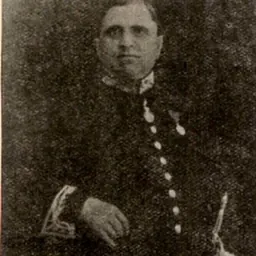
Lived 1918 – 1985 (aged 66). Jean-Marie Loret was a French railway worker, military personnel, entrepreneur, soldier and journalist.
Jean-Marie Loret ( Lobjoie; 18 or 25 March 1918 – 13 February 1985) was a French railway worker who claimed to be Nazi dictator Adolf Hitler's illegitimate son. According to Loret, his mother revealed to him in 1948 (a few years before her death) that Hitler was the "unknown German soldier" with whom she conceived a child during World War I. Hitler's valet Heinz Linge claimed in his memoirs that he witnessed Heinrich Himmler speak over the phone with Hitler, implying he wanted to find a woman and her son in their French village.
Loret's claim was backed by German historian Werner Maser, who first brought the claim to public attention in 1977 following an article in Zeitgeschichte magazine. Loret published his own autobiography, Ton père s'appelait Hitler (Your father was called Hitler) in 1981. However, historians and DNA analysis have shown his claim to be false.
Biography
Jean-Marie Loret was born illegitimately in 1918 in Seboncourt as Jean-Marie Lobjoie. His mother was Charlotte Eudoxie Alida Lobjoie (15 March 1898 – 13 April 1951), daughter of Louis Joseph Alfred Lobjoie, a butcher, and his wife, Marie Flore Philomène Colpin. According to the birth registry of his home town, Loret's father was an "unidentified German soldier" during World War I. Adolf Hitler had stayed in the localities of Seclin, Fournes-en-Weppes, Wavrin, and Ardooie during the years 1916 and 1917, and, according to eyewitnesses, he supposedly had a relationship with Charlotte. As a result, the idea that Hitler could be Loret's father was a perennial topic of discussion.
Lobjoie was a dancer, although she apparently only took up the profession after she moved to Paris, months after the birth of Jean-Marie and the end of World War I. Jean-Marie spent his first seven years with his grandparents, with whom Charlotte had no contact after moving to Paris. On 22 May 1922 Charlotte married Clément Loret, a lithographer, who declared he would support his wife's illegitimate son and would allow him to bear his own last name. According to Jean-Marie, his grandparents had "treated him badly." After their deaths in the mid-1920s, his aunt, Alice Lobjoie, worked to have her nephew adopted by the family of the wealthy construction magnate Frizon from Saint Quentin. From then on, Jean-Marie attended consecutively Catholic boarding schools in Cambrai and Saint Quentin.
During World War II, Loret worked as chargé de mission with the French police in Saint-Quentin, Aisne. Subsequently, Loret, in collaboration with René Mathot, published his autobiography, Ton père s'appelait Hitler [Your father was called Hitler] in 1981.
The Loret–Hitler connection
In his 1980 memoirs, Hitler's valet Heinz Linge states that in mid-1940 Hitler told a number of people that he had associations with a particular French village stemming from World War I but going beyond his duties as a soldier. Then, on 19 July, Linge was in the same room as Heinrich Himmler when the latter took a call from Hitler. Himmler was tasked with finding someone in that village, and after Linge left the room so Himmler could continue the conversation in private, he overheard discussion of a woman and her son. Linge believed that Loret's account corresponded with these implications.
Maser maintained that he had heard of a reputed son of Hitler for the first time in 1965 while doing research in Wavrin and surrounding cities. He followed up on these reports, met Loret in the process, and was able to convince him to let the story be published. Historians, including Anton Joachimsthaler, criticised Maser for pursuing commercial motives and sensationalism. Other historians, such as Timothy Ryback and Ian Kershaw, argued that Hitler's paternity of Loret was unlikely to be proven.
According to Maser's portrayal, a 28-year-old Hitler had met the 19-year-old Charlotte in the city of Lille, in the German-occupied part of France, while stationed there as a soldier. She stated that "One day I was cutting hay with other women when we saw a German soldier on the other side of the street. I was designated to approach him." Maser wrote in his Hitler biography on the relationship of Hitler and Lobjoie:
At the beginning of 1916 the young woman had met the German soldier Adolf Hitler for the first time. She stayed first in Premont, allowed herself to fall into a sexual relationship with him, and followed him until autumn 1917 to, among other places, Seboncourt, Forunes, Wavrin and Noyelles-lès-Seclin in Northern France – and, in May, June and July 1917, also to Ardooie in Belgium.
Despite not being able to speak the same language, Hitler and Charlotte purportedly continued their relationship and frequently went on country walks and shared drinks at night. Loret was ultimately conceived after a ‘tipsy’ evening in the summer of 1917 in Ardooie. Later, Charlotte would recall to her son that the soldier had a short temper and would often rant in German: When your father was around, which was very rarely, he liked to take me for walks in the countryside. But these walks usually ended badly. In fact, your father, inspired by nature, launched into speeches which I did not really understand. He did not speak French, but solely ranted in German, talking to an imaginary audience. Even if I spoke German I would not be able to follow him, as the histories of Prussia, Austria and Bavaria were not familiar to me at all, far from it. My reaction used to anger your father so much that I did not show any reaction.
The critics of this account point out that Maser had no evidence of this beyond Loret's own claims. A genetic certification of his biological inheritance, done at the University of Heidelberg, resulted in the findings that "at best, Loret could be Hitler's son". Maser further claimed that evidence for Hitler's paternity included Charlotte's commitment to a French sanatorium which was allegedly at Hitler's instruction after the German invasion of France, and a protracted interrogation of Loret by the Gestapo in the Hotel Lutetia, the Gestapo headquarters in Paris, as well as Loret's alleged collaboration with the Gestapo as a policeman.
In addition to Alice's assertion, critics of Maser's thesis, such as historian Joachimsthaler, among others, introduced into the debate testimonials from Hitler's war comrades, who, in their recollections of Hitler during World War I, unanimously noted that he was absolutely against any relationships between German soldiers and French women. Balthasar Brandmayer for example, in his 1932 memoir Two Dispatch-Runners, reported that Hitler had reacted in the most violent terms against the intent of his regiment-mates to get involved with French women and had reproached them for having "no German sense of honour".
Furthermore, there were logical inconsistencies in Maser's story: that it is highly improbable that any soldier in the war, let alone a private ranking low in the military hierarchy, would have been able to take a lover with him through all the relocations of his regiment, as Hitler had done with Lobjoie, according to Maser's account. Free movement would scarcely have been possible in the occupied areas, and having Charlotte travel along with the regiment is very doubtful. During the course of the 1979 Aschaffenburger Historians' Moot, Maser at first kept quiet on the matter. Finally, in his own contribution to the discussion, he abruptly declared a possible illegitimate son of Hitler to be a marginal matter. Joachimsthaler designated this to be Maser's "own private end goal".
DNA investigations In 2008, the Belgian journalist Jean-Paul Mulders travelled to Germany, Austria, France and the United States to collect DNA of the last living relatives of Hitler. He also obtained DNA from postcard stamps sent by Jean-Marie Loret. By comparing DNA from the stamps with that of a relative of Hitler's with a common paternal ancestor, Mulders proved that Loret lacked a matching Y chromosome and was thus not Hitler's son.
In 2012, the French magazine Le Point published a news article, reporting that a study enlisted by Loret carried out by the University of Heidelberg showed Hitler and Loret were of the same blood group, and that another enlisted by Loret showed they had similar handwriting. The article also stated that official German Army paperwork proves officers brought envelopes of cash to Lobjoie during World War II occupation, and described a suggestion by the family's lawyer that they may be able to claim royalties from Hitler's Mein Kampf. In 2018, Russian state-owned TV channel NTV interviewed Philippe Loret, the son of Jean-Marie Loret and Muguette Dubecq. The interview was filmed at Loret's home, which was decorated with Nazi relics. Loret spoke of a Rothschild family conspiracy
Don’t just read it —
keep it.
Full-length biographies made to live with: read them, listen on the way to work, watch them tonight.
- E-book
- Audio
- Video
Instant download · yours to keep · every purchase keeps this site free
Important facts
Family & relationships
People in Jean-Marie Loret's life
Named in this biography and alive at the same time




Related people
Same field, nearest in time





Contemporaries
People whose lives overlapped Jean-Marie Loret's


Frequently asked questions
Who was Jean-Marie Loret?
self-proclaimed alleged illegitimate son of Adolf Hitler
When was Jean-Marie Loret born?
Jean-Marie Loret was born on 25 March 1918 in Seboncourt.
When did Jean-Marie Loret die?
Jean-Marie Loret died on 9 February 1985 in Saint-Quentin.
What was Jean-Marie Loret's occupation?
Jean-Marie Loret was a railway worker, military personnel, entrepreneur, soldier and journalist.
What nationality was Jean-Marie Loret?
Jean-Marie Loret was French.
Sources & further reading
Cite this page
APA: Biography.guide. (2026). Jean-Marie Loret. https://biography.guide/jean-marie-loret/
MLA: "Jean-Marie Loret." Biography.guide, https://biography.guide/jean-marie-loret/.
Chicago: "Jean-Marie Loret." Biography.guide. https://biography.guide/jean-marie-loret/.
Data last updated: 2026-09-22 · Spot an error? Report a correction.
Page generated 2026-09-27 05:10 UTC