
About Jean-François Thomas de Thomon
Lived 1760 – 1813 (aged 53). Jean-François Thomas de Thomon was a French architect.
Jean-François Thomas de Thomon ( – ) was a French neoclassical architect who worked in Eastern Europe in 1791–1813. Thomas de Thomon was responsible for the design of Old Saint Petersburg Stock Exchange and Rostral Columns on the spit of Vasilievsky Island in Saint Petersburg and the first building of the Odessa Theatre, destroyed by fire in 1873. Thomas de Thomon, graduate of the French Academy in Rome, "imported" the high classicism practiced by this school in 1780s into Russia and thus contributed to the formation of Russian national variant of neoclassicism practiced during the reign of Alexander I.
Biography
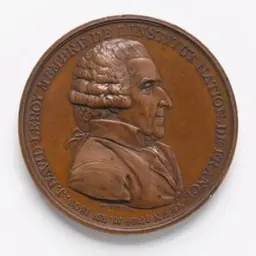
Jean-François Thomas was born in a third estate family in Paris and has demonstrated talents in graphic arts since early childhood. His early works, preserved in the archive of Jean-Claude Richard, were influenced by Jean-Honoré Fragonard and Hubert Robert. At the age of 17 Thomas was admitted to the class of Julien-David Le Roy at the Académie royale d'architecture, and trained there along with Karl von Moreaux, Charles Percier and Pierre François Léonard Fontaine. All his attempts to win a state scholarship for a study tour of Italy failed, and in 1785 he left for Rome on his own account, and attended the classes of the French Academy in Rome as a stowaway along with legitimate students. Dmitry Shvidkovsky wrote that, quite likely, emigration resulted from Thomas's own political allegiance to monarchy(he was "an ardent royalist and a fervent Catholic"
His first tangible work of the period, rebuilding the gallery of Łańcut Castle for the Lubomirski family, instantly elevated him into the circle of leading architects of Eastern Europe. In 1794 he was hired by House of Esterházy in Vienna; at least two of his building, a school in Vienna and a bathhouse in Eisenstadt, survived to date in Austria.
Earlier, most likely in 1792, he met with Russian ambassador to Vienna, prince Dmitry Golitsyn; in 1798 Thomas de Thomon accepted invitation from his brother Alexander, then living in Moscow. Russian Empire at that time was closed to all Frenchmen in fear of revolutionary ideas. Thomas de Thomon sneaked into the country through Hamburg and Riga, assuming a persona of a Swiss citizen, native of Bern.
Thomas de Thomon initially worked for the Golytsins in their country residences and later relocated to Saint Petersburg; on 30 January 1802 he was hired by the Imperial government to rebuild Bolshoi Kamenny Theatre. The buildings were demolished in 1914, Lev Rudnev reused their stone blocks for a monument on the Field of Mars. Another monument by Thomas de Thomon, a column commemorating centennial of the Battle of Poltava, was erected in Poltava in 1805–1811. In 1806–1809 he built three monumental fountains around Pulkovo Heights, one to design by Voronikhin and two of his own.
His best known work, Old Stock Exchange on the spit of Vasilyevsky Island, was completed in 1805–1810 to a design approved shortly before the death of Paul of Russia; Thomon's drafts were preferred to earlier 1781 proposal by Giacomo Quarenghi, that was suspended in 1784. Quarenghi placed his Exchange on the southern side of the island, facing the Palace Embankment. Thomas de Thomon radically moved his building on the island's axis, producing a highly symmetrical ensemble tying together the island and both sides of the Neva River, from the Winter Palace to the Peter and Paul Fortress.
Thomon died in 1813 after an accidental fall from the scaffolding of the Petersburg Bolshoi Theatre, then being restored after a fire.
Critical assessment
Igor Grabar, analyzing the difference between Italian and French versions of neoclassicism in Russia, considered Carlo Rossi and Thomas de Thomon the key figures of these branches of the same style. Thomas de Thomon was the principal source for French classicism in Russia, complementing utopian fantasies of Claude Nicolas Ledoux with "a new trait that never appeared before – a serious, well-considered understanding, perhaps less dexterity but more depth." Grabar noted that Thomas de Thomon apparently "borrowed" the sweeping shape of the Exchange from the stylistic experiments of the French architectural competitions hosted by Académie royale d'architecture. Yet, he continued, original French designs were never intended for execution in stone; even their authors regarded them as nothing more than an exercise in draftsmanship. Unlike them, Thomas de Thomon "retained the sacred gift of insanity for the sake of beauty" and dared to actually build his ideal of beauty in stone. "He was not a colossus as some represent him now, he was not a Palladio and not even a Rastrelli. Russia has seen greater architects before and after him. But he was a Prometheus, who, having stolen the flame of new beauty from the gods in France, brought it to Russia."
In culture In June 2011, Russian artist Alexander Taratynov installed a life-size statue of Thomas de Thomon in Saint Petersburg. The statue is part of The Architects, a bronze sculptural group depicting the great architects of Russian Empire as commissioned by Gazprom and installed in Alexander Park. In 2018, Taratynov admitted he used a picture he found on Wikipedia to base the statue on, and that it was actually an image of the Scottish chemist Thomas Thomson – Taratynov blamed Wikipedia for the error but also himself for not checking with a historian to verify it was accurate.
References and notes
Don’t just read it —
keep it.
Full-length biographies made to live with: read them, listen on the way to work, watch them tonight.
- E-book
- Audio
- Video
Instant download · yours to keep · every purchase keeps this site free
Important facts
more
Jean-François Thomas De Thomon, T. Thomon, ThomonPeople in Jean-François Thomas de Thomon's life
Named in this biography and alive at the same time




Related people
Same field, nearest in time

Contemporaries
People whose lives overlapped Jean-François Thomas de Thomon's




Frequently asked questions
Who was Jean-François Thomas de Thomon?
French architect (1760–1813)
When was Jean-François Thomas de Thomon born?
Jean-François Thomas de Thomon was born on 12 April 1760 in Bern.
When did Jean-François Thomas de Thomon die?
Jean-François Thomas de Thomon died on 4 September 1813 in Saint Petersburg.
What was Jean-François Thomas de Thomon's occupation?
Jean-François Thomas de Thomon was an architect.
What nationality was Jean-François Thomas de Thomon?
Jean-François Thomas de Thomon was French.
Sources & further reading
· Wikipedia: Jean-François Thomas de Thomon
· DBpedia: Jean-François Thomas de Thomon
Cite this page
APA: Biography.guide. (2026). Jean-François Thomas de Thomon. https://biography.guide/jean-francois-thomas-de-thomon/
MLA: "Jean-François Thomas de Thomon." Biography.guide, https://biography.guide/jean-francois-thomas-de-thomon/.
Chicago: "Jean-François Thomas de Thomon." Biography.guide. https://biography.guide/jean-francois-thomas-de-thomon/.
Data last updated: 2026-09-20 · Spot an error? Report a correction.
Page generated 2026-09-27 05:09 UTC