
About Jean-Baptiste Philibert Willaumez
Lived 1763 – 1845 (aged 81). Jean-Baptiste Philibert Willaumez was a French explorer, politician and military personnel.
Vice-Admiral Jean-Baptiste Philibert Willaumez (7 August 1763 – 17 May 1845) was a French Navy officer who served in the French Revolutionary and Napoleonic Wars. Willaumez joined the French navy at the age of 14, and proved to be a competent sailor. Having risen to the rank of pilot, he started studying navigation, attracting the attention of his superiors and Louis XVI. Willaumez eventually became an officer and served under Antoine Bruni d'Entrecasteaux in his expedition to find the comte de Lapérouse and explore the Indian Ocean and Oceania.
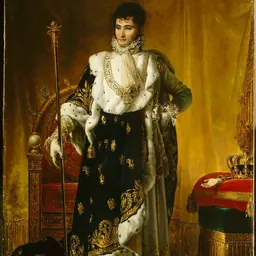
During the French Revolutionary Wars, Willaumez rose in rank and served in Saint-Domingue during the Haitian Revolution, where he commanded the frigate Poursuivante against the Royal Navy during the action of 28 June 1803. In 1806, Willaumez led a French squadron in the Atlantic campaign of 1806, sailing to Brazil and the West Indies and attacking British merchant shipping. However, Jérôme Bonaparte's insubordination led to Willaumez missing the chance to attack a valuable British convoy. Eventually, the 1806 Great Coastal hurricane damaged and dispersed his squadron, which was either sunk or limped back to France.
In May 1808, Willaumez attempted to regroup warships scattered in Brest, Lorient and Rochefort into an eighteen-ship squadron to defend the French West Indies; adverse weather and the poor state of the squadron thwarted the plan and he ended up being blockaded by the British in Rochefort, leading to a catastrophic defeat at the Battle of the Basque Roads and Willaumez falling out of favour with Napoleon. After the end of the Napoleonic Wars Willaumez served at the Council of Naval Constructions and was granted a peerage. He authored a dictionary of naval terms, sponsored a collection of ship models and commissioned the Roux family to paint portraits of all the ships on which he had served, a collection known as the Album de Willaumez.
Career Early life Willaumez was born to an infantry captain who died without fortune at the age of 68, leaving six orphan children.
In 1777, at the age of 14, he enlisted as an apprentice pilot boy on the 74-gun Bien-Aimé, under Captain de Bougainville, in the squadron under Admiral du Chaffault. he transferred to the Louise, on which he was wrecked on the reef off Tamarin. Willaumez eventually returned to France on the corvette Les Amis. which in late 1780 was being overhauled. Weary of his inactivity during the work on Ville de Paris, Willaumez requested a transfer on a departing ship, and was appointed as a pilot to the frigate Amazone, under La Pérouse, in January 1781. met the British frigate HMS Santa Margarita; there again, he saved his ship when she sprang a leak after sailing off harbour, and sailed her to Rochefort.
Service on Recherche in D'Entrecasteaux' expedition
When D'Entrecasteaux was tasked to investigate the fate of Lapérouse's expedition and given command of the Recherche, Willaumez, promoted to Ensign in 1791,
Régénérée was part of a two-corvette and four-frigate naval division under Counter-Admiral Sercey, tasked to sail to Mauritius and prey on British merchantmen in the Indian Ocean. During the campaign, she captured nineteen of the 23 prizes captured by the squadron and took part in the action of 8 September 1796, where she suffered two killed and six wounded. The frigates departed the Indian Ocean theatre in September sailing from Mauritius to Rochefort and escorting two merchantmen of the Spanish Royal Company of the Philippines to Europe.
En route, the two frigates and two merchantmen stopped at Îles de Los to effect repair and gather water; they anchored at Tamara, Vertu disassembling her masts and yards to restore her rigging, while Régénérée sailed to the nearby island of Factori. the squadron counted six ships of the line, six frigates and two corvettes, and was to ferry 3000 soldiers. Rochambeau then ordered all French warships to carry out such executions; only Willaumez refused, stating that "The officers of the French Navy are not executioners. I will not obey!"
Fight of the Poursuivante against HMS Hercules, by Louis-Philippe Crépin. After 18 months, Willaumez transferred his flag on the frigate Poursuivante, on which he served successively at the Western and Southern stations, and carried out a number of raids against the rebel Indigenous Army. under Jean Pierre Bargeau.
In the early morning of 28 June 1803, and opened fire at nine. disengaged,
Goliath captured Mignonne after a brief chase and the exchange of a few token shots. He then left harbour and sailed around the South of Cuba. A few days later, he spotted a British privateer, which he captured and had to scuttle by fire because his lack of food did not allow him to sail her to Charlestown.
In March 1805, Willaumez had been promoted to counter admiral, and he took command of the light squadron of the Naval Army in Brest, under Vice-Admiral Ganteaume. Willaumez set is flag on the 74-gun Alexandre.
In late 1805, eleven ships were readied to set sail in two squadrons, one under Counter-Admiral Leissègues, and the other under Willaumez; the squadrons departed on 13 December and separated on 15. With food supplies now unavailable and many of his men suffering from scurvy, Willaumez set sail for Brazil, where he arrived in early April 1806. He was then informed of the arrival of a squadron under Admiral John Borlase Warren, and another under Admiral Richard Strachan; without marines to attack the British West Indies and reckoning that no convoy would depart for Europe as long as he would be known to lurk in the area, Willaumez decided to position his forces to intercept the convoy from Jamaica. Willaumez fruitlessly searched the missing ship in several directions until he became certain that she was en route for France, and returned to his station; the convoy, however, had already passed. The damage to British shipping was evaluated to 12 to 15 million francs. It departed on 21 February 1809, with orders to make its junction with the division of Lorient that was blockaded in its harbour, attach these ships, attack the British squadron blockading Rochefort, attach the Rochefort squadron under Admiral Jacques Bergeret and, by then totaling 18 ships, sail to the Caribbean to rescue Martinique and Guadeloupe. The arrival of a large British squadron blockaded Willaumez himself in Rochefort, where the concentration of French ships constituted a tempting target for the British. They eventually attacked with fireships at the Battle of the Basque Roads.
Later life Willaumez in 1840, wearing the badge and silver star of Grand Officier on the Legion of Honour. Portrait by Pierre-Victorien Lottin.
In 1811, Willaumez was ordered to Holland to command a division in the fleet under Admiral Jan Willem de Winter. and later presided over the Council of Constructions of the Navy. In 1836, he led an enquiry, along with Baron Rolland, into the destruction by fire of the 120-gun ship Trocadéro.
In 1837, he was made a pair de France, and retired. resulting in the Surveillante-class frigates and similar developments during the Bourbon Restoration.
In his Dictionnaire de marine, Willaumez thus defined the term Marine:
Works
Notes and references
Don’t just read it —
keep it.
Full-length biographies made to live with: read them, listen on the way to work, watch them tonight.
- E-book
- Audio
- Video
Instant download · yours to keep · every purchase keeps this site free
Important facts
People in Jean-Baptiste Philibert Willaumez's life
Named in this biography and alive at the same time

Related people
Same field, nearest in time



Contemporaries
People whose lives overlapped Jean-Baptiste Philibert Willaumez's





Frequently asked questions
Who was Jean-Baptiste Philibert Willaumez?
French admiral
When was Jean-Baptiste Philibert Willaumez born?
Jean-Baptiste Philibert Willaumez was born on 7 August 1763 in Belle Île.
When did Jean-Baptiste Philibert Willaumez die?
Jean-Baptiste Philibert Willaumez died on 17 May 1845 in Suresnes.
What was Jean-Baptiste Philibert Willaumez's occupation?
Jean-Baptiste Philibert Willaumez was an explorer, politician and military personnel.
What nationality was Jean-Baptiste Philibert Willaumez?
Jean-Baptiste Philibert Willaumez was French.
Sources & further reading
· Wikipedia: Jean-Baptiste Philibert Willaumez
· DBpedia: Jean-Baptiste Philibert Willaumez
Cite this page
APA: Biography.guide. (2026). Jean-Baptiste Philibert Willaumez. https://biography.guide/jean-baptiste-philibert-willaumez/
MLA: "Jean-Baptiste Philibert Willaumez." Biography.guide, https://biography.guide/jean-baptiste-philibert-willaumez/.
Chicago: "Jean-Baptiste Philibert Willaumez." Biography.guide. https://biography.guide/jean-baptiste-philibert-willaumez/.
Data last updated: 2026-09-20 · Spot an error? Report a correction.
Portrait: Wikimedia Commons · author & licence
Page generated 2026-09-27 04:58 UTC