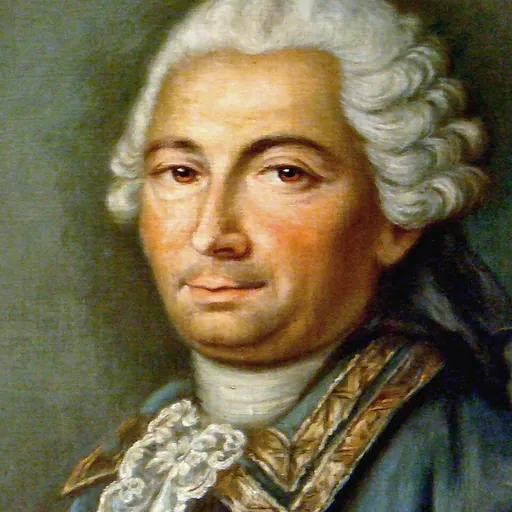
About Jean-Antoine Morand
Lived 1727 – 1794 (aged 66). Jean-Antoine Morand was a French architect and painter.
Jean-Antoine Morand (born in Briançon on ; died in Lyon on ) was an artist, engineer, architect, urban planner, and real estate promoter. He came to Lyon at a young age and studied in Paris and Rome. He is best known for his general plan for the embellishment of Lyon, the circular expansion of the Brotteaux district, and the construction of the wooden bridge over the Rhône that bears his name. He was guillotined for having taken part in the defense of the city during the Siege of Lyon by the troops of the National Convention. Painter and decorator
Born in Briançon on November 10, 1727, Jean-Antoine Morand came from an old famille de robe originally from La Vallouise. He was the son of Étienne Morand, a lawyer at the bailiwick and First Consul of the city, and Éléonore Peralda. He is said to have run away at the age of fourteen to escape an ecclesiastical career and pursue an artistic vocation.
In 1744, he was found in Lyon where he collaborated on the decoration of two festivals "staged" by Étienne Montagnon, ordinary painter and architect of the Chapter of Saint-Jean from 1725 to 1758, who died in 1762, undoubtedly his first master .
From 1748, Morand created his own workshop specializing in interior decoration work in trompe-l'œil, mainly for private individuals. On various occasions, he designed and executed ephemeral architectures. In 1753, he distinguished himself by decorating the Concert Hall and, the following year, the Chapel of the Visitation of Notre-Dame, also known as the artisans' chapel, or the affaneurs, within the Collège de la Trinité, now the collège-lycée Ampère. Approached by Soufflot to produce the sets and machinery for the new theater in Lyon, Morand perfected his skills in Paris under Servandoni . Although his career shifted towards architecture, Morand remained active in the fields of decorative painting and scenography.
Architect and urban planner
From 1757, Morand was part of a group of investors, brought together by Soufflot, for the development of the new Saint-Clair district, gained on an island in the Rhône, north of the Terreaux. He bought three plots on which he erected three buildings himself, thus making his first architectural efforts .
Aware of the need to expand the city beyond the Rhône, Morand thought from the early 1760s about various projects for Les Brotteaux on the left bank of the Rhône. In 1764, he proposed to the Hôtel-Dieu de Lyon a plan for a large park laid out on its vast properties. When this plan was rejected, Morand purchased an enclosed plot of land within the Hôtel-Dieu's vast possessions the following year. This provoked a lengthy and bitter legal battle with the powerful hospital, which sought to protect the rental income of its poor tenants from Morand's urban development. Undeterred, the architect immediately published a subdivision project for the area, which became known as the "Pré Morand" (Morand Meadow). In 1766, he presented to the Consulate of the city his Projet d’un plan général de la ville de Lyon (Project for a general plan of the city of Lyon), or "Circular Plan", a rival to the Perrache project at the Confluence, but significantly more ambitious. This plan was the subject of an engraved plate in 1775 that remained relatively famous .
The creation of a new, vast, and regular district on the left bank of the Rhône was intended to provide spaces for walking and relaxation, but also warehouses for industry. The goal was to enlarge the city, correcting most of its defects (narrow and irregular streets, obstructions of bridges, quays, and squares, lack of hygiene, lack of space, air, and light). The whole was inscribed within a circular enclosure supposed to remove any urban difficulty through the very perfection of its form (superficial influence of the "ideal cities" of classical urbanism) .
The construction of a bridge over the Rhône between the Terreaux and the Brotteaux was decided with the agreement of the city in 1767 and that of the King's Council in 1771. Built between 1771 and 1775, the wooden bridge designed by Morand was inaugurated with a 99-year privilege (the current Pont Morand is the third structure at this location). In 1772, a company was created to operate the bridge, acquiring the cession of all ferries and cable ferries crossing the Rhône between Saint-Clair and the Pont de la Guillotière. After disagreements with the Hospices civils de Lyon, the company obtained the toll concession. The venture was advantageous for both the owners and the citizens, as the toll was one-third cheaper than the previous ferries, and the bridge was exempt from taxes. Following the bridge's construction, the left bank of the Rhône at the Brotteaux developed into a leisure space composed of guinguettes (taverns) and promenades planted with elms. However, despite some constructions and aborted projects, the Brotteaux remained, when the Revolution broke out, primarily a place for walking and leisure.
Career trajectory
Trained as a painter, primarily recognized for his ingenuity in the field of trompe-l'œil and machinery, a true engineer who threw a bridge over the Rhône and proposed a hydraulic machine project to supply the fountains of the Château de Versailles park, Morand was an architect (claiming to be one) who built little. Only the three buildings of the Saint-Clair district, the small prefecture hotel in Roanne, and a few walls of his house on Place Kléber (Restaurant Orsi) currently survive. As an artist and promoter, he may have suffered from an ambiguous status.
Regarding the Brotteaux, the combination of a private project (subdivision of the pré Morand, construction and operation of the bridge) and a general plan oriented towards the public good cast doubt on Morand's intentions, accused by his detractors of wanting to enrich himself at the expense of the public, and in particular the poor, whose interests the Hôtel-Dieu was supposed to represent .
This ambiguity moreover marked Morand's entire career, a private entrepreneur desiring public recognition, particularly in the form of official positions. The function of voyer and ordinary architect of the City eluded him, but in November 1777, Morand obtained the position of architect of the Chapter of the primatial church of Saint-Jean, whose canons held the title of Counts of Lyon. Between 1780 and 1783, Morand was officially a voyer inspector in the jurisdiction of the Cloister (the cathedral district) and the Comté, which allowed him to intervene as an urban planner on the scale of a district of the city. Finally, seeking the patronage of the aristocracy (he worked from the 1770s on several châteaus, including the Château de Montribloud), Morand—already of noble extraction through his father's status—sought formal royal recognition for his artistic merits. He was admitted to the Order of Saint Michael, receiving the rank of chevalier.
The Siege of Lyon in the summer of 1793 brought the Morand family close to ruin. The Brotteaux district was devastated, with trees and buildings burned or destroyed. Morand's bridge, half-destroyed and unusable, suffered heavy fire from Jacobin assaults, though it remained the only means for the besieged to communicate with the road to Italy and bring in vital supplies. Morand chose to partially dismantle the bridge he had built rather than let the Royalist defenders destroy it entirely to block the advancing Convention troops. He was arrested in November 1793, accused of having sabotaged his own bridge to slow the arrival of Republican troops. He was first imprisoned at the maison de sûreté dite des Recluses, before being transferred to the hôtel commun (the current site of Lyon's City Hall). He underwent a first interrogation on December 23, which he transcribed and sent to his wife, Antoinette. Brought before a revolutionary commission, Morand attempted to save himself by denying royalist convictions and vaunting his attachment to the public good. He was nevertheless condemned and perished in Lyon on January 24, 1794. His true loyalties were revealed on his way to the scaffold: according to family tradition, he expressed his regrets at not having been led to the guillotine on January 21, the anniversary of the death of his beloved King. .
Personal life and archives In January 1759, Morand married Antoinette Levet. The couple had two children: Antoine, born in 1760, and Éléonore, born in 1762. Morand's descendants preserved his extensive family papers, known as the Fonds Morand de Jouffrey, which are now held by the Lyon Municipal Archives. This collection, which includes architectural drawings, urban planning projects, and intimate family correspondence—such as letters detailing his imprisonment and interrogation—has been a valuable resource for historians studying family life during the French Revolution and the First French Empire .
In 2017, a commemorative plaque honoring Morand was placed on Place Kléber in Lyon, marking the 150th anniversary of the creation of the 6th arrondissement .
Portraits Pierre Bernard. Bernard. Portrait of Jean-Antoine Morand (1764). Pastel. Private coll. (see photo: Lyon Municipal Archives, 5 PH 8247). Joseph Chinard. Bust of Jean-Antoine Morand (c. 1789). Terracotta. Private coll. (see photo: Lyon Municipal Archives, 5 PH 8249). Joseph Chinard (school of). Bust of Jean-Antoine Morand (c. 1810). Plaster. Musée de Grenoble coll. (MG 384). Couturier and Quenedey. Posthumous portrait of Jean-Antoine Morand (c. 1810). Engraving. Louis Thomassin. Posthumous portrait of Jean-Antoine Morand (c. 1810). Black chalk and stump on vellum paper. Private coll. Aurélie Moreau. The bust of Morand (2006) is located in the underground parking lot, Place Maréchal-Lyautey (Lyon 6th arr.) .
Don’t just read it —
keep it.
Full-length biographies made to live with: read them, listen on the way to work, watch them tonight.
- E-book
- Audio
- Video
Instant download · yours to keep · every purchase keeps this site free
Important facts
People in Jean-Antoine Morand's life
Named in this biography and alive at the same time
Related people
Same field, nearest in time


Contemporaries
People whose lives overlapped Jean-Antoine Morand's






Frequently asked questions
Who was Jean-Antoine Morand?
French architect (1727-1794)
When was Jean-Antoine Morand born?
Jean-Antoine Morand was born on 10 November 1727 in Briançon.
When did Jean-Antoine Morand die?
Jean-Antoine Morand died on 27 January 1794 in Lyon.
What was Jean-Antoine Morand's occupation?
Jean-Antoine Morand was an architect and painter.
What nationality was Jean-Antoine Morand?
Jean-Antoine Morand was French.
Sources & further reading
· Wikipedia: Jean-Antoine Morand
· DBpedia: Jean-Antoine Morand
Cite this page
APA: Biography.guide. (2026). Jean-Antoine Morand. https://biography.guide/jean-antoine-morand/
MLA: "Jean-Antoine Morand." Biography.guide, https://biography.guide/jean-antoine-morand/.
Chicago: "Jean-Antoine Morand." Biography.guide. https://biography.guide/jean-antoine-morand/.
Data last updated: 2026-09-22 · Spot an error? Report a correction.
Portrait: Wikimedia Commons · author & licence
Page generated 2026-09-27 05:03 UTC