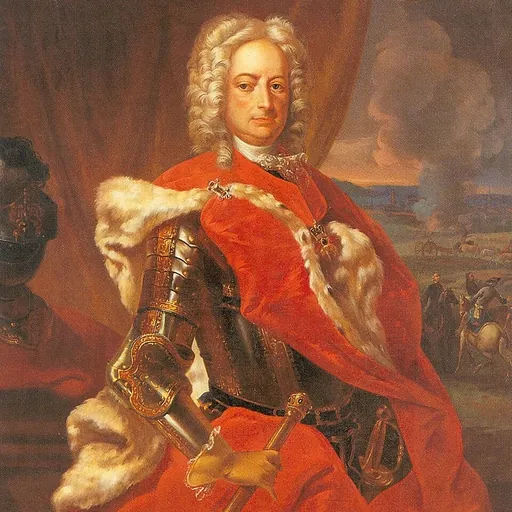
About János Pálffy
Lived 1664 – 1751 (aged 86). János Pálffy was a German and Hungarian politician.
Johann Bernhard Stephan, Graf Pálffy de Erdőd (, ; 20 August 1664 – 24 March 1751) was a Hungarian noble, Imperial Field marshal and Palatine of Hungary.
An accomplished military leader and diplomat during the time of Prince Eugène of Savoy, he was born into one of Hungary's richest families loyal to the House of Habsburg. He joined the Imperial Army in 1681 and rose swiftly through the ranks after distinguishing himself at battles such as Vienna, Párkány and Mohács. He played a key role in Rákóczi's War of Independence, securing victories and negotiating truces with the rebel commander. Beyond his military career, Pálffy took on important diplomatic tasks, helping to secure noble support for the Pragmatic sanction. After the war, he was elected Palatine of Hungary and became a trusted advisor to Empress Maria Theresa until his death in 1751.
Early life and career János (Johann) Pálffy was the third son of Count Miklós IV Pálffy de Erdőd (1619–1679) and his wife, Countess Maria Eleonora von Harrach zu Rohrau (1634–1693). The Pálffys were part of the elite Hungarian nobility, one of Hungary's richest families. The Hungarian baron status was granted to them as early as 1581. In 1599 they became Imperial Counts of the Holy Roman Empire. Following in the footsteps of his father and elder siblings — his brother Miklós Pálffy was also an Austrian field marshal — he dedicated himself to a military career. first in the Neuburg, later Isenburg infantry regiments. He was then a cornet in his cousin Field Marshal Johann Carl's Curassier regiment and as such took part in the Battle of Vienna and the Battle of Párkány in 1683.
The following year, in 1684, he became a captain in the same regiment, taking part as such during the Siege of Buda. His valour shone through in the Battle of Mohács (1687), and in 1688 he was appointed Adjutant general under Charles V, Duke of Lorraine. After the death of his father-in-law, he became the owner of that unit, leading his own regiment through the events of the Great Turkish War.
Great Turkish War and the Treaty of Szatmár
In 1693, he engaged in a fatal duel with John Frederick of Württemberg-Stuttgart, the son of Eberhard III, Duke of Württemberg. As a result, he was court-martialled on 15 October 1693 but acquitted. then Ban of Croatia, Slavonia and Dalmatia and cavalry general in 1704. As the Imperial General in Chief, he negotiated with Francis II Rákóczi's general Sándor Károlyi, which led to a truce and later the Treaty of Szatmár in 1711 in the fields outside of Majtény in Szatmár, where 12,000 men of Rákóczi's army swore allegiance to the Habsburg dynasty.
Austro-Turkish Wars and the Pragmatic Sanction
In the later years, Pálffy actively participated in the Austro-Turkish Wars of 1716–18, exhibiting leadership in various major actions despite sustaining injuries. During the Battle of Petrovaradin he commanded Prince Eugene's cavalry, playing a prominent role in the Imperial victory against the Turks. At the Siege of Temesvár he commanded 16 cavalry regiments before leading the Imperial cavalry at the Siege of Belgrade (1717), where he was wounded.
Post-war, he resumed diplomatic duties while serving as Ban of Croatia, successfully convincing the Hungarian and Croat nobility to embrace the Pragmatic Sanction, assuring the succession of the Emperor to his female descendants in default of male heirs. In the subsequent Austro-Turkish War of 1737–1739, he was sent to Futog after Emperor Charles VI was forced to take part in the dispute between Russia and the Ottoman Empire. Pálffy commanded a 30,000-strong army corps that remained uninvolved in combat as a new peace was signed in Belgrade by the Ottoman Empire on one side and the Habsburg monarchy on the other.
Later years In 1731 he became Lord Chief Justice, a position he held until 1741. In 1741, during the War of the Austrian Succession, he summoned the Hungarian troops. With the invasion of Bohemia by Frederick I of Prussia in 1744, when he was over eighty years old, he again offered to lead the army, which was rejected by Maria Theresa with a letter of thanks and decorations. Pálffy's special importance to Maria Theresa is shown in the letter she sent him alongside gifts (his own riding horse, a golden sword set with diamonds and a diamond ring). The couple had three sons and four daughters, including:
Countess Mária Anna Franziska Pálffy ab Erdõd (1690–1756), who married Count František Karel Přehořovský z Kvasejovic. Countess Maria Szidónia Pálffy ab Erdöd (1690–1743), who married Count Ferenc Esterházy de Galántha, a grandson of Count Nikolaus Esterházy de Galántha (a son of Count Ferenc Esterházy and Zsófia Illésházy), who was Palatine of Hungary from 1625 to 1645, and, his second wife, Baroness Krisztina Nyáry de Bedegh. Count János Antal Pálffy ab Erdöd (1696–1717), who married Countess Amalia Eleonore Esterházy de Galántha, a daughter of Michael I, 2nd Prince Esterházy of Galántha. Count Károly Pál Engelbert Pálffy de Erdõd (1697–1774), who married Josepha von Proskau. After her death in 1748, he married Maria Margaretha von Stubenberg, a daughter of Rudolf von Stubenberg. After her death in 1774, he married Countess Elisabeth Josepha von Starhemberg, a daughter of Count Konrad Sigismund Anton von Starhemberg. Count Miklós Pálffy de Erdőd (1699–1734), who married Countess Maria Josepha Philippine von Schlick zu Bassano und Weißkirchen, a daughter of Count Leopold Schlick zu Bassano und Weißkirchen.
Pálffy died on 24 March 1751 after his health began to decline. His funeral took place with great honours.
Don’t just read it —
keep it.
Full-length biographies made to live with: read them, listen on the way to work, watch them tonight.
- E-book
- Audio
- Video
Instant download · yours to keep · every purchase keeps this site free
Important facts
People in János Pálffy's life
Named in this biography and alive at the same time


Related people
Same field, nearest in time




Contemporaries
People whose lives overlapped János Pálffy's



Frequently asked questions
Who was János Pálffy?
Austrian field marshal (1664-1751)
When was János Pálffy born?
János Pálffy was born on 20 August 1664 in Červený Kameň Castle.
When did János Pálffy die?
János Pálffy died on 24 March 1751 in Bratislava.
What was János Pálffy's occupation?
János Pálffy was a politician.
What nationality was János Pálffy?
János Pálffy was German and Hungarian.
Sources & further reading
Cite this page
APA: Biography.guide. (2026). János Pálffy. https://biography.guide/janos-palffy/
MLA: "János Pálffy." Biography.guide, https://biography.guide/janos-palffy/.
Chicago: "János Pálffy." Biography.guide. https://biography.guide/janos-palffy/.
Data last updated: 2026-09-22 · Spot an error? Report a correction.
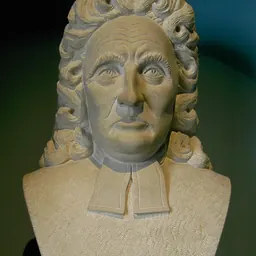
Portrait: Wikimedia Commons · author & licence
Page generated 2026-09-27 05:03 UTC