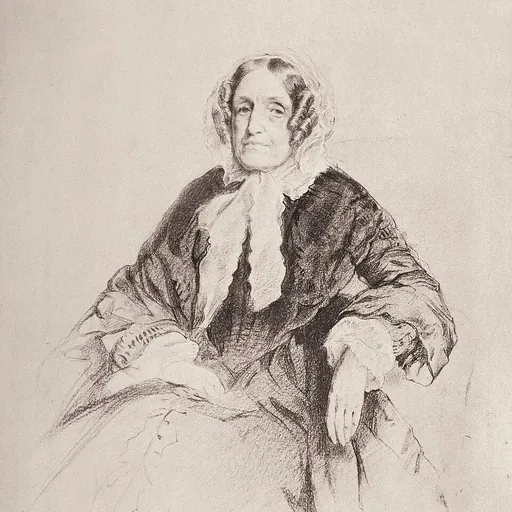
About Jane Marcet
Lived 1769 – 1858 (aged 88–89). Jane Marcet was a British science communicator, salonnière, writer, non-fiction writer and children's writer.
Jane Marcet (; née Haldimand; 1 January 1769 – 28 June 1858) was an English salonnière of Republic of Geneva descent, and an innovative writer of popular, explanatory science books. She also broke ground with Conversations on Political Economy, which explain the ideas of Adam Smith, Thomas Malthus and David Ricardo.
Life Jane Marcet was born in London on 1 January 1769, one of twelve children of a wealthy Genevan merchant and banker, Anthony Francis Haldimand (1740/41–1817), and his wife Jane (died 1785). She was educated at home with her brothers. Her studies included Latin (essential for the sciences), chemistry, biology and history, as well as topics more usual for young ladies in England. She took over the running of the family at age 15, after her mother's death, managing the house and helping to bring up her younger siblings. She also acted as her father's hostess, helping to entertain frequent parties of scientific and literary guests. They had four children, one of whom, François Marcet (1803–1883), became a well-known physicist.
Alexander was strongly interested in chemistry, and became a lecturer at Guy's Hospital in London and a Fellow of the Royal Society.
Marcet and her father were close throughout their lives. He lived with her and her husband after their marriage. When her father died in 1817, she received a substantial legacy that enabled Alexander Marcet to give up his medical practice and devote himself to chemistry full-time. Caroline, the younger, asks flippant questions that still move the dialogue along, while Emily is more controlled and reflective. Mrs. Bryant is a maternal mentoring figure, who leads them to question and examine their ideas. Both the scientific content and the discursive process of sharing scientific knowledge were important to Marcet's readers. The book went into 16 editions in England, where it was an early inspiration for the young Michael Faraday. Marcet's Conversations on Political Economy were an inspiration to Harriet Martineau to introduce economic topics into her writings.
In 1820 the Marcets travelled to Geneva, Switzerland, intending to relocate there. In 1822, Alexander died unexpectedly while on a visit to Britain, to Jane's extreme distress. She went through one of several periods of depression that affected her life, described by her friend Auguste de La Rive as a "shadow enveloping an energetic and active spirit."
Faraday remarked, "When I came to know Mrs. Marcet personally; how often I cast my thoughts backwards, delighting to connect the past and the present; how often, when sending a paper to her as a thank you offering, I thought of my first instructress."
The book aimed to help others who were bewildered by chemistry by explaining better but remaining scientifically accurate. It was a user-friendly book. The subjects were divided into two parts, each of more than 300 pages. It is framed by conversations between an adult teacher and two children. Marcet also added her own figures to explain chemistry in an easy way.
Marcet's active support for teaching chemistry to beginners through an experimental laboratory was recognized by many. After the Civil War, laboratory instruction was becoming the norm in American schools. Despite competition from many other authors and books, Marcet's ruled in the female advancement of knowledge. Having become a standard textbook in Britain and United States, it was translated into German and French. In the United States, Boston's Girls' High School and Normal School became the first school to teach science to women through laboratory experience, in 1865, based on the text of Marcet's Conversations on Chemistry.
Marcet was inspired by the work economists of David Ricardo, Adam Smith and many others. Conversations on Political Economy notably drew attention to the arguments based on notable works by some famous economists. It targeted the general idea of economics with liberating and educating poor people, irrespective of sex. It also embraced general notions of political economy with the distribution of property, taxes, the division of labour, on capital, and on the wages, population and social predicament of the poor.
The book became a popular read, although some later economists like Alfred Marshall showed indifference to it, which damaged her reputation. Joseph Schumpeter mocked it as "economics for schoolgirls". The aim of her book was an important one that went beyond the moneymaking for small markets. It was intended to popularize the lessons of political economy for the self-improving working classes and school curricula. It attempted to simplify the economics for the fewer, privileged audience and educate younger people in the principle of economics by which markets are regulated, using simple tales. Marcet's Conversations on Political Economy inspired Harriet Martineau, a British social theorist and Whig writer often cited as the first female sociologist, to introduce economic topics into her writings. She was inspired to teach the principles of economics not by pressing them into a story, but by displaying their natural workings in selected phases of life. It followed a style resembling that of her previous book and likewise became popular.
Marcet inherited considerable properties from her father in 1817. She and her husband moved to Geneva in the 1820s, but two years later Alexander died. She eventually returned in London, where she again drew together prominent intellectuals and bankers. Her later works largely focus on less-demanding topics and were intended in most cases for a younger audience.
Willie Henderson tried to frame Jane as an educational broker, arguing that to change the perspectives of others' minds was "mere capitalist propaganda" for "sophisticated curriculum development". (first edition published anonymously) 2nd edition in two volumes, London 1817: volume I: On Simple Bodies. volume II: On Compound Bodies. 5th edition, London 1817.
Mary's Grammar (1835) John Hopkins's Notions on Political Economy (1833) Mrs Marcet's Story-Book: Being a Selection from the Stories Contained in Her Books for Little Children (1858) The seasons, stories for very young children, by the author of 'Conversations on chemistry''' (1832) Willy's Grammar Pamphlet Essays: Under the Superintendence of the Society for the Improvement of the Working Population in the County of Glamorgan Mrs Marcet's Story-Book Controlling State Crime Bertha's Visit to her Uncle in England. By Jane Marcet (1830) Conversations on the History of England, for the Use of Children (1842) Conversations on the Evidence of Christianity in Which the Leading Arguments of the Best Authors Are Arranged, Developed, and Connected with Each Other for the Use of Young Persons and Theological Students The Seasons; Stories for Very Young Children; Spring. Vol. II Conversations on Vegetable Physiology: Volume 1: Comprehending the Elements of Botany, with Their Application to Agriculture Lessons on Animals, Vegetables, and Minerals'' (2015)
Don’t just read it —
keep it.
Full-length biographies made to live with: read them, listen on the way to work, watch them tonight.
- E-book
- Audio
- Video
Instant download · yours to keep · every purchase keeps this site free
Important facts
People in Jane Marcet's life
Named in this biography and alive at the same time



Related people
Same field, nearest in time



Contemporaries
People whose lives overlapped Jane Marcet's




Frequently asked questions
Who was Jane Marcet?
British writer of scientific books
When was Jane Marcet born?
Jane Marcet was born in 1769 in London.
When did Jane Marcet die?
Jane Marcet died on 28 June 1858 in London.
What was Jane Marcet's occupation?
Jane Marcet was a science communicator, salonnière, writer, non-fiction writer and children's writer.
What nationality was Jane Marcet?
Jane Marcet was British.
Sources & further reading
Cite this page
APA: Biography.guide. (2026). Jane Marcet. https://biography.guide/jane-marcet/
MLA: "Jane Marcet." Biography.guide, https://biography.guide/jane-marcet/.
Chicago: "Jane Marcet." Biography.guide. https://biography.guide/jane-marcet/.
Data last updated: 2026-09-24 · Spot an error? Report a correction.
Portrait: Wikimedia Commons · author & licence
Page generated 2026-09-27 05:08 UTC