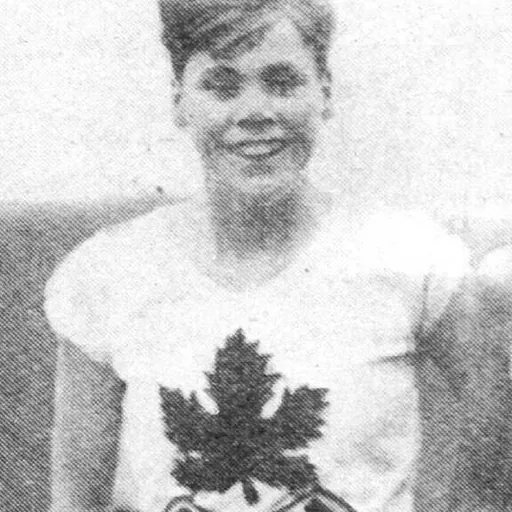
About Jane Bell
Lived 1910 – 1998 (aged 88). Jane Bell was a Canadian sprinter.
Florence Isabel "Jane" Bell (June 2, 1910 – July 1, 1998) was a Canadian track and field athlete and Olympic sprinter who won a gold medal in the 4 × 100 metres relay at the 1928 Summer Olympics in Amsterdam. She competed as a member of Canada's first Olympic women's track and field team, later known as the "Matchless Six", which took part in the first Olympic Games to include women's athletics in 1928. Bell ran the third leg of the relay alongside Fanny "Bobbie" Rosenfeld, Ethel Smith, and Myrtle Cook, and the Canadian team won the event in a world-record time of 48.4 seconds. At eighteen, Bell was the youngest member of the team.
Bell was a versatile competitor who participated in hurdles, javelin, and sprint events during the late 1920s. In 1929 she won Canadian championships in the 60-yard hurdles, javelin throw, and baseball throw, reflecting the broad range of disciplines contested by early women's track athletes in Canada.
After retiring from competition Bell worked as a physical education instructor and later lived in the United States. Her Olympic victory formed part of Canada's strong performance in the inaugural Olympic program for women's athletics, in which members of the Matchless Six won multiple medals and helped establish Canada as a leading nation in early international women's track and field competition.
Early athletic career Florence Isabel Bell grew up in Toronto, Ontario, and began competing in organized sport as a teenager in the mid-1920s. At a time when opportunities for women in athletics were still limited, she joined the Parkdale Ladies' Athletic Club, one of several Toronto organizations that helped develop competitive sport for women during the early twentieth century.
During these years she competed against several athletes who would later become some of Canada's best-known women competitors, including Fanny "Bobbie" Rosenfeld, Myrtle Cook, and Ethel Smith. Their rivalry in Canadian competitions formed the core of the group that would later compete together on Canada's first Olympic women's track and field team.
1928 Summer Olympics At the 1928 Summer Olympics in Amsterdam, women competed in Olympic track and field events for the first time. Their inclusion followed years of debate within international sport over whether women should participate in athletics at all.
Only five events were opened to women: the 100 metres, 800 metres, high jump, discus throw, and the 4 × 100 metres relay. Even this limited program was controversial. Some physicians and sports officials argued that strenuous athletic competition could damage women's health or reproductive capacity, and newspaper commentary of the period often reflected wider anxieties about women participating in competitive sport.
Opposition also came from Pierre de Coubertin, founder of the modern Olympic Games, who believed the Olympics should primarily celebrate male athletic achievement. Coubertin wrote that women's Olympic role should be limited and suggested their participation should consist mainly of "crowning the victors" rather than competing themselves.
Pressure for inclusion came largely from women's sporting organizations. In the early 1920s the French sports leader Alice Milliat organized the Women's World Games, international competitions that demonstrated both the popularity and competitive standard of women's athletics. Their success placed increasing pressure on Olympic officials, who eventually agreed to introduce a limited program of women's athletics events at the 1928 Games.
In the final race Bell ran the third leg of the relay, handing the baton to anchor runner Cook. The Canadian quartet finished ahead of teams from the United States and Germany to win the gold medal, setting a new Olympic and world record with a time of 48.4 seconds. One of the earliest Canadian athletes to secure an Olympic relay gold medal, as documented by the Canadian Olympic Committee's official profile.
Recognition and honours Inducted into the Canadian Olympic Hall of Fame. Inducted into Canada's Sports Hall of Fame. Included in national histories of women's sport in Canada, such as those published in The Canadian Encyclopedia.
Don’t just read it —
keep it.
Full-length biographies made to live with: read them, listen on the way to work, watch them tonight.
- E-book
- Audio
- Video
Instant download · yours to keep · every purchase keeps this site free
Important facts
People in Jane Bell's life
Named in this biography and alive at the same time
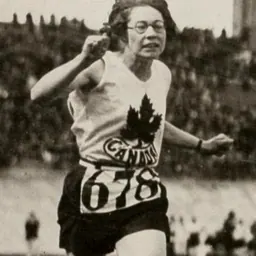



Related people
Same field, nearest in time



Contemporaries
People whose lives overlapped Jane Bell's






Frequently asked questions
Who was Jane Bell?
athletics competitor (1910-1998)
When was Jane Bell born?
Jane Bell was born on 2 June 1910 in Toronto.
When did Jane Bell die?
Jane Bell died on 1 July 1998 in Fort Myers.
What was Jane Bell's occupation?
Jane Bell was a sprinter.
What nationality was Jane Bell?
Jane Bell was Canadian.
Sources & further reading
· DBpedia: Jane Bell (athlete)
Cite this page
APA: Biography.guide. (2026). Jane Bell. https://biography.guide/jane-bell/
MLA: "Jane Bell." Biography.guide, https://biography.guide/jane-bell/.
Chicago: "Jane Bell." Biography.guide. https://biography.guide/jane-bell/.
Data last updated: 2026-09-23 · Spot an error? Report a correction.
Portrait: Wikimedia Commons · author & licence
Page generated 2026-09-27 05:06 UTC