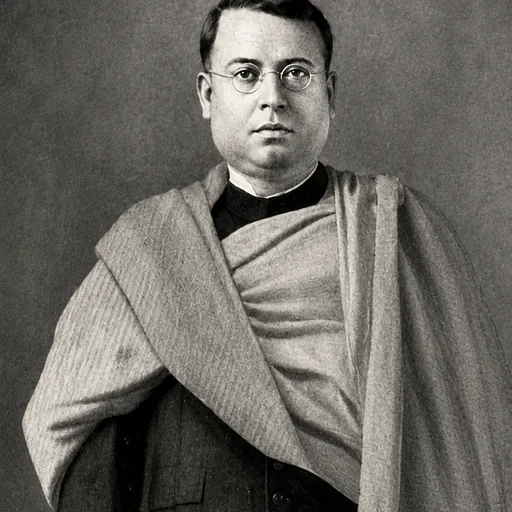
About Jamini Bhushan Ray
Lived 1879 – 1926 (aged 47). Jamini Bhushan Ray was an Indian ayurveda practitioner, medical faculty, writer and philanthropist.
Jamini Bhushan Ray (; 1 July 1879 (17 Asharh 1286 BS) – 11 August 1926 (26 Srabon 1333 BS)) was an Indian Ayurvedic physician, Sanskrit scholar, educator and philanthropist. He founded the Ashtanga Ayurveda College and Hospital in Calcutta in 1916 and established the Vaidyaraj Pharmacy, both of which formed part of his efforts to modernise Ayurvedic education and pharmaceutical practice during the late colonial period. Contemporary scholarship identifies him as an important figure in the revival of Ayurveda in Bengal through the development of educational institutions, pharmaceutical enterprises and professional organisations.
Trained in both Sanskrit scholarship and Western medicine, Ray advocated the systematic study of Ayurveda and helped promote its transition from a predominantly hereditary and apprenticeship-based tradition to one supported by formal educational institutions, hospitals and scholarly publications. His work contributed to the broader movement for the institutionalisation of Ayurvedic medicine in twentieth-century India. After receiving his early education in his native village, he moved to Calcutta for higher studies and attended South Suburban School in Bhowanipore.
Ray later obtained an M.A. degree in Sanskrit, for which he received a medal. The enterprise, located at 46 Beadon Street in Calcutta, sought to manufacture and distribute Ayurvedic medicines using more systematic methods of preparation and quality control than had previously been common.
Historians of Ayurveda regard such efforts as part of the broader modernisation of indigenous medicine during the colonial era. Through pharmaceutical production, standardisation of formulations and dissemination of Ayurvedic literature, Ray and his contemporaries attempted to position Ayurveda as a disciplined medical system capable of operating within an increasingly institutional and scientific environment.
The institution was initially established in a rented house at 29 Fariapukur Street in north Calcutta. Besides teaching students, it also provided free medical treatment for poor patients, with Ray himself reportedly attending daily to treat indigent patients.
alt=Present-day view of the courtyard of J. B. Roy State Ayurvedic Medical College and Hospital in Kolkata Present-day view of the Raja Dinendra Street campus of the J.B. Roy State Ayurvedic Medical College and Hospital, which evolved from the Ashtanga Ayurveda Vidyalaya o Ayurvediya Arogyashala founded by Jamini Bhushan Ray in 1916 with twelve students in a rented house at 29 Fariapukur Street.
Ray organised the institution under a small executive committee, serving as principal, while Krishna Das Bandyopadhyay acted as secretary. Biraja Charan Gupta served as vice-principal and Surendra Kumar Kavyatirtha supervised the charitable dispensary. The charitable dispensary reportedly treated more than 100 patients daily. In recognition of its public service, the Calcutta Corporation later approved an annual grant of ₹2,500 to support its charitable medical work. His election reflected his growing national stature within the Ayurvedic community and his prominence among advocates of educational and institutional reform.
Contemporary commentary on Ray's presidential address described him as a physician who combined the teachings of the East and the West and praised his efforts to reconcile classical Ayurvedic learning with modern scientific medicine.
In his evidence, Ray argued that the decline of Ayurvedic surgery resulted partly from the inaccessibility of Sanskrit medical texts and the scarcity of competent teachers, but maintained that the discipline could be revived through research and systematic investigation. He described Ayurvedic diagnosis as combining observation through the senses and patient interrogation with consideration of a patient's constitution, environment, season and the progression of disease.
The occasion became historically significant because Gandhi used his address to call for greater humility, honesty and scientific inquiry among Ayurvedic and Unani practitioners. Although Gandhi criticised exaggerated medical claims and commercial exploitation within indigenous medicine, he distinguished such criticisms from the value of Ayurveda itself. The title page of his 1920 work Prati Sanskrita Roga Binischaya identifies the Ayurvedic Medical College at 29 Fariapukur Street as its publisher.
In addition to his medical work, Ray was a Sanskrit scholar and author. His books on diagnosis, paediatrics, toxicology and diseases of the ear, nose and throat were regarded as authoritative by later writers. A Treatise on Diseases of Ear, Nose, Throat and Mouth. The Care of Infants and the Diseases of Children. Prasutitantram (obstetrics).
These books drew upon several branches of the classical Ayurvedic Tantras, namely Shalakya Tantra (otorhinolaryngology), Prashuti Tantra (gynaecology), Bish Tantra (toxicology) and Kumar Tantra (paediatrics). He also founded and edited the Bengali monthly journal Ayurveda, which sought to promote Ayurvedic scholarship and education in Bengal.
Death and legacy
alt=Portrait of physician and statesman Dr. Bidhan Chandra Roy Dr. Bidhan Chandra Roy, who laid the foundation stone of the Patipukur Tuberculosis Hospital on land bequeathed by Jamini Bhushan Ray.
Ray died in Calcutta on 11 August 1926 at the age of forty-seven.
Modern scholarship emphasises Ray's role as an institution builder, particularly his creation of educational, pharmaceutical and research structures that helped integrate Ayurveda into the modern academic environment. This institutional legacy reflected Ray's broader efforts to bridge traditional Ayurvedic practice with organised medical education and clinical institutions, a transition emphasised in modern scholarship on his career.
Ray has also been included in the Central Council for Research in Ayurvedic Sciences (CCRAS) Documentation of Life Profiles of Luminaries in the Field of Ayurveda. As part of this initiative, CCRAS hosts a biographical profile of Ray and supported the publication of the research paper Kaviraj Jamini Bhusan Ray: The man who led the Ayurveda renaissance in Bengal.
Don’t just read it —
keep it.
Full-length biographies made to live with: read them, listen on the way to work, watch them tonight.
- E-book
- Audio
- Video
Instant download · yours to keep · every purchase keeps this site free
Important facts
People in Jamini Bhushan Ray's life
Named in this biography and alive at the same time
Related people
Same field, nearest in time





Contemporaries
People whose lives overlapped Jamini Bhushan Ray's



Frequently asked questions
Who was Jamini Bhushan Ray?
Indian doctor (1879-1926)
When was Jamini Bhushan Ray born?
Jamini Bhushan Ray was born on 1 July 1879 in Khulna.
When did Jamini Bhushan Ray die?
Jamini Bhushan Ray died on 11 August 1926 in Kolkata.
What was Jamini Bhushan Ray's occupation?
Jamini Bhushan Ray was an ayurveda practitioner, medical faculty, writer and philanthropist.
What nationality was Jamini Bhushan Ray?
Jamini Bhushan Ray was Indian.
Sources & further reading
· Wikipedia: Jamini Bhushan Ray
Cite this page
APA: Biography.guide. (2026). Jamini Bhushan Ray. https://biography.guide/jamini-bhushan-ray/
MLA: "Jamini Bhushan Ray." Biography.guide, https://biography.guide/jamini-bhushan-ray/.
Chicago: "Jamini Bhushan Ray." Biography.guide. https://biography.guide/jamini-bhushan-ray/.
Data last updated: 2026-09-20 · Spot an error? Report a correction.
Portrait: Wikimedia Commons · author & licence
Page generated 2026-09-27 04:57 UTC