
James Warren Doyle
Roman Catholic Bishop of Kildare and Leighlin
About James Warren Doyle
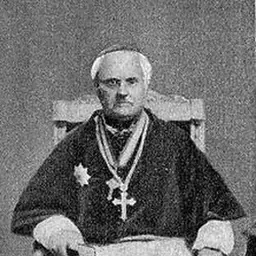
Lived 1786 – 1834 (aged 47). James Warren Doyle was a catholic priest and catholic bishop.
Statue of JKL in Carlow Cathedral, encouraging Hibernia to stand.
James Warren Doyle, OESA (1786–1834) was a Roman Catholic Bishop of Kildare and Leighlin in Ireland, who used the signature "JKL", an acronym from "James Kildare and Leighlin." Doyle was active in the Anti-Tithe movement. A campaigner for Catholic Emancipation until it was attained in 1829, he was also an educator, church organiser and the builder of Carlow cathedral.
Early life Doyle was born close to New Ross, County Wexford in 1786, the posthumous son of a respectable Catholic farmer, James Doyle; his mother (Anne Warren, of Quaker extraction) was living in poverty at the time of his birth. At the age of eleven he witnessed the horrors of the Battle of New Ross between the United Irishmen and British Crown forces supplemented by the militia and yeomanry.
He received his early education at Clonleigh, at Rathconrogue at the school of a Mr. Grace, and later at the Augustinian College, New Ross under the care of an Augustinian friar, John Crane.
Doyle joined the Augustinian friars in 1805 at Grantstown, County Wexford and then studied for his doctorate at Coimbra in Portugal (1806–08). His studies were disturbed by the Peninsular War, during which he served as a sentry in Coimbra. Later, he accompanied the British Army with Wellington's forces to Lisbon as an interpreter.
Following Doyle's return to Ireland, he was ordained to the priesthood on 1 October 1809, at Enniscorthy. He taught logic at the Augustinian College, New Ross. In 1813, Doyle was appointed to a professorship at Carlow College, holding the Chair of Rhetoric and in 1814, the Professorship of Theology.
In 1827, Doyle engaged the liberal lawyer (and secularist) George Ensor to investigate reports of hundreds of conversions to Protestantism on the estate in Cavan of proselytising Orangeman, Lord Farnham. Ensor's reports assured the bishop that, such as they were, the conversions were a case of "souperism"and would not survive the then near-famine conditions. These Ensor followed up with Letters showing the inutility, and exhibiting the absurdity, of what is rather fantastically termed "the new Reformation" (1828). This was a broadside against the new evangelicalism and its requirement that "the Bible without note or comment to be a schoolbook," a demand by Protestant church leaders that upended the government plans, Doyle broadly supported, for non-denominational primary education.
Tithe War In 1830, the new tithe-proctor of Graigue (a parish of 4,779 Catholics and 63 Protestants) decided to break with the tradition of his predecessor and to enforce seizure orders for the collection of arrears of Tithes. Tithes provided financial support of the established Anglican Church of Ireland. Some of the recalcitrant Catholics had habitually transferred ownership of their livestock to Doyle in order to avoid seizure at the town fair. The new proctor requested their priest's cooperation in handing over the assets. Doyle refused, and the proctor, aided by the Irish Constabulary, seized some of the livestock. A mass riot broke out at the fair and there were several casualties. A civil disobedience campaign followed, peppered with sporadic violence mostly at country fairs over the seizure of livestock. A period of instability that would become known as the Tithe War followed.
Doyle was a leader of nonviolent resistance to the Tithe, devoting himself both to strengthening the nonviolent resistance and to discouraging like paramilitary secret societies who had taken to using violence to drive out tithe-collectors and to intimidate collaborators. He said: "I maintain the right which [Irish Catholics] have of withholding, in a manner consistent with the law and their duty as subjects, the payment of tithe in kind or in money until it is extorted from them by the operation of the law."
The ministers of the Church of Ireland, Doyle concluded, are
On another occasion he said:
Doyle was invited to give evidence on the state of Ireland to parliamentary enquiries in London in 1825, 1830 and 1832. Asked at one such inquiry to explain his urging his countrymen to resist the tithes, and why he should not feel himself responsible for the violence that accompanied the Tithe War, he replied:
o man ought to be condemned for exhorting people to pursue justice in a certain line, though he may foresee that in the pursuit of that justice the opposition given to those who are proceeding in a just course may produce collision, and that collision lead to the commission of crime; but our duty, as I conceive, is to seek for the injustice, and there to impute the crime… It is to that injustice, and not to those who pursue a just course for the attainment of a right end, that the guilt is to be ascribed.
Seeing his readiness and resource, the Duke of Wellington remarked that Doyle examined the committee rather than was examined by them.
Several biographies were written on Doyle before 1900 and his influence on the later Irish Catholic bishops in the period 1834-1900 was considerable. He had proved that negotiations with government could be beneficial to his church, his congregation, and its finances.
Works A Vindication of the religious and civil principles of the Irish Catholics (1823) Letter on the state of Ireland (1825) An essay on the Catholics claims (1826) Letter to Thomas Spring Rice, Esq. M.P. &c: on the establishment of a legal provision for the Irish poor, and on the nature and destination of church property (1831)
Don’t just read it —
keep it.
Full-length biographies made to live with: read them, listen on the way to work, watch them tonight.
- E-book
- Audio
- Video
Instant download · yours to keep · every purchase keeps this site free
Important facts
People in James Warren Doyle's life
Named in this biography and alive at the same time

Related people
Same field, nearest in time

Contemporaries
People whose lives overlapped James Warren Doyle's


Frequently asked questions
Who was James Warren Doyle?
Roman Catholic Bishop of Kildare and Leighlin
When was James Warren Doyle born?
James Warren Doyle was born on 1 September 1786.
When did James Warren Doyle die?
James Warren Doyle died on 15 June 1834.
What was James Warren Doyle's occupation?
James Warren Doyle was a catholic priest and catholic bishop.
Sources & further reading
· Wikipedia: James Warren Doyle
Cite this page
APA: Biography.guide. (2026). James Warren Doyle. https://biography.guide/james-warren-doyle/
MLA: "James Warren Doyle." Biography.guide, https://biography.guide/james-warren-doyle/.
Chicago: "James Warren Doyle." Biography.guide. https://biography.guide/james-warren-doyle/.
Data last updated: 2026-09-20 · Spot an error? Report a correction.
Page generated 2026-09-27 05:12 UTC