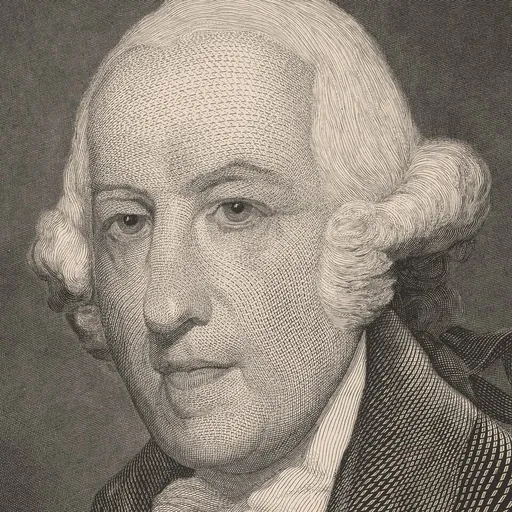
About James Rivington
Lived 1724 – 1802 (aged 77–78). James Rivington was an American and British printer, publisher, editor, journalist and bookseller, known for Culper Ring.
James Rivington (1724 – July 4, 1802) was an English-born American journalist who published a Loyalist newspaper in the American colonies called Rivington's Gazette. He was driven out of New York by the Sons of Liberty, but was likely a member of the American Culper Spy Ring, which provided the Continental Army with military intelligence from British-occupied New York.
Early life James Rivington was born in London in 1724. One of the sons of the bookseller and publisher Charles Rivington, he inherited a share of his father's business, which he lost at the Newmarket races. In 1760, he sailed to North America. He resumed his occupation in Philadelphia and the next year opened a printshop at the foot of Wall Street, New York.
In 1773, he began to publish a newspaper "at his ever open and uninfluenced press, Hanover Square."
His initially-impartial stance shifted as a revolution loomed, and public opinion polarized, By late 1774, he was advocating the restrictive measures of the British government with such great zeal and attacking the Patriots so severely that in 1775, the Whigs of Newport, Rhode Island, resolved to hold no further communication with him. The Sons of Liberty hanged Rivington in effigy, and the Patriot poet Philip Freneau published a mock speech of Rivington's supposed contrition at his execution, which Rivington reprinted. He infuriated Captain Isaac Sears, the prominent patriot and Son of Liberty:
He would appear as a leading man amongst us, without perceiving that he is enlisted under a party as a tool of the lowest order; a political cracker, sent abroad to alarm and terrify, sure to do mischief to the cause he means to support, and generally finishing his career in an explosion that often bespatters his friends
Family His son Jonx was a lieutenant in the 83rd Regiment of Foot (Royal Glasgow Volunteers) and died in England in 1809. His son James was born in 1771 and was commissioned an Ensign in the 42nd or Royal Highland Regiment in 1783.
Rivington's great-nephew was Percy Rivington Pyne I, who emigrated from England in 1835 and became president of City National Bank in New York, a predecessor to Citigroup.
Revolutionary War In 1775, immediately after the opening of hostilities, Rivington's shop was burned and looted by the Sons of Liberty. On the day that Major John André was taken prisoner, his poem "Cow Chase" was published by Rivington.
Role in Culper Spy Ring Rivington, who opened a drug shop, would have been the last New Yorker suspected of playing the part of a spy for the Continentals, but he furnished General George Washington with important information. Rivington's silent partner in the coffeehouse was Robert Townsend, alias "Samuel Culper, Jr.," one of the principal agents of the American Culper Spy Ring. Rivington was recruited by Townsend in late summer 1779 and was given the code name "726."
The date of Rivington's secret change of heart is disputed, but when New York was evacuated in November 1783, Rivington remained in the city, much to the general surprise and anger of New Yorkers, who believed that "those who have been enriching themselves under the... government of George III shall never live peacably in New York." Removing the royal arms from his masthead, he changed the name of his business to Rivington's New York Gazette and Universal Advertiser. However, his business rapidly declined, and he was beaten up by the Sons of Liberty. His paper ceased to exist at the end of 1783, and he passed the remainder of his life in comparative poverty.
Later life Rivington, like other Loyalists, was denounced by the first generation of American chroniclers of the revolution. Ashbel Green described Rivington as "the greatest sycophant imaginable; very little under the influence of any principle but self-interest, yet of the most courteous manners to all with whom he had intercourse."
Alexander Graydon, in his Memoirs, wrote of Rivington: "This gentleman's manners and appearance were sufficiently dignified; and he kept the best company, He was an everlasting dabbler in theatrical heroics. Othello was the character in which he liked best to appear." His portrait, painted by Gilbert Stuart, was formerly in the possession of William H. Appleton, New York.
Death and legacy Rivington died in New York on July 4, 1802.
Rivington's name is commemorated in Rivington Street, Manhattan.
A complete set of his journal is conserved by the New-York Historical Society.
In popular culture James Rivington is portrayed by actor John Carroll Lynch on the AMC period drama Turn: Washington's Spies. In the series he is portrayed as a staunch loyalist whose newspaper mocks the Patriot cause and makes light of the Continental losses.
Don’t just read it —
keep it.
Full-length biographies made to live with: read them, listen on the way to work, watch them tonight.
- E-book
- Audio
- Video
Instant download · yours to keep · every purchase keeps this site free
Important facts
People in James Rivington's life
Named in this biography and alive at the same time



Related people
Same field, nearest in time




Contemporaries
People whose lives overlapped James Rivington's



Frequently asked questions
Who was James Rivington?
American journalist (1724–1802)
When was James Rivington born?
James Rivington was born in 1724 in England.
When did James Rivington die?
James Rivington died in 1802 in New York City.
What was James Rivington's occupation?
James Rivington was a printer, publisher, editor, journalist and bookseller.
What was James Rivington known for?
James Rivington was known for Culper Ring.
What nationality was James Rivington?
James Rivington was American and British.
Sources & further reading
Cite this page
APA: Biography.guide. (2026). James Rivington. https://biography.guide/james-rivington/
MLA: "James Rivington." Biography.guide, https://biography.guide/james-rivington/.
Chicago: "James Rivington." Biography.guide. https://biography.guide/james-rivington/.
Data last updated: 2026-09-23 · Spot an error? Report a correction.
Portrait: Wikimedia Commons · author & licence
Page generated 2026-09-27 05:06 UTC