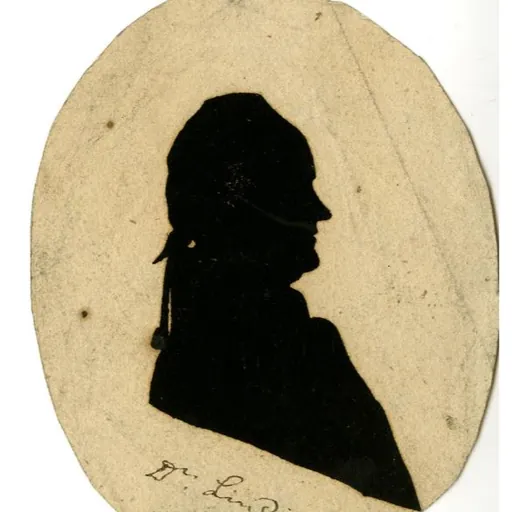
About James Lind
Lived 1736 – 1812 (aged 76). James Lind was a British physician and surgeon.
James Lind FRS FRSE FRCPE (May 17, 1736 – October 17, 1812) was a Scottish natural philosopher and physician.
Life James Lind was born in Gorgie, Edinburgh on 17 May 1736.
He studied medicine at Edinburgh University under William Cullen and Joseph Black, and graduated in 1768. In 1766, he then joined the East India Company as surgeon. In 1768 he received his doctorate (MD) from Edinburgh upon completing a dissertation on marsh fever (malaria) in Bengal. On 6 November 1770 he was admitted a Fellow of the College of Physicians, Edinburgh. Lind was also a corresponding member of the Lunar Society.
Personality Lind is widely regarded as having an eccentric personality, and considered to be reckless with spending money as captured by the following dialogue: "Why, Dr. Lind, you spend a whole seas of gold", to which Lind replied, "Madam, 'tis true, my very name, behold, Begins with pounds and ends, alas, with pence" and Fanny Burney cast doubt whether he obtained much of a private medical practice: "his taste for trickes, conundrums and queer things makes people fearful of his trying experiments on their constitutions, and think of him a better conjuror than a physician; though I don't know why the same man should not be both".
Family James Lind was the son of Alexander Lind of Gorgie, FRSE, (who was the son of George Lind of Gorgie, Sheriff Deputy of Edinburgh, and Jean Montgomery of Smithton ) Lind's great-grandfather was John Lind IV (who was the son of Mary Boyd of Pittfinde). and George Lind (who was Lord Provost of Edinburgh, and Member of Parliament for Edinburgh), and John Lind (barrister), and Sir James Grant. Lind's mother, Helen Allardice (1697 - 1746) was daughter of Sir George Allardice, Member of Parliament and Master of the Mint of Scotland, through whom James Lind was 10th in descent from James II of Scotland.
Lind married Ann Elizabeth Mealy on 07 Nov 1778. She is mentioned in Burney's Diary, she mentioned his wife as "a fat handsome wife who is as tall as himself and about six times as big". who was the Dean of Bangor in 1399. Ann died at the age of 48 from an apoplectic fit. Their notable children included: Lucy Maria Lind (1783-1858), later Sherwill, who profiled Princess Amelia of the United Kingdom; Dorothea Sophia Banks Lind (1786 - 1863), who married Isaac Gosset (1782 – 1855), and whose daughter Helen Dorothea or Dorothy Gosset married William Driscoll Gosset; Alexander Francis Lind (1797 - 1832), who was a civil servant for Lord Ailesbury and for Queen Charlotte, and who was Judge of Mirzapur, and who married Anna Maria Macan (1802 - 1862) who was the daughter of Robert Macan High Sheriff of Armagh in 1814.
The Revolt of Islam and Frankenstein James Lind taught at Eton College while in semi-retirement. Around 1809, he tutored Percy Bysshe Shelley, husband of Mary Shelley. Percy alluded to Lind in two poems from 1817, the old man or Hermit who rescues Laon in The Revolt of Islam, and Prince Athanase, where he appears as the wise old teacher magus Zonoras.
Percy was fascinated with Lind's experiments and demonstrations of galvanism (e.g. using electricity to animate the muscles of dead frogs causing them to jump, or causing the jerking of reptile muscles), hence Lind has been suggested to have been an inspirational origin of Frankenstein. Specifically, it is thought Mary Wollstonecraft Shelley had a nightmare while staying with Percy Shelley at Byron's House in Lake Geneva due to Percy reminiscing about Lind's bizarre experiments. as well as Doctor M. Waldman
Lind is also thought to be a trace influential origin of Dracula.
Freemasonry Lind was involved in freemasonry in Scotland. He was initiated in the Canongate Kilwinning, Lodge No. 2, on 2 August 1758. He was also active in the Grand Lodge of Scotland, of which he was Senior Grand Warden between 1769 – 1771.
Death Late in life, a portrait of Lind was painted by John Keenan in 1807.
Lind died at the house of his son-in-law, William Burnie, in Russell Square, London, on 17 October 1812.
Career In addition to medicine, Lind was interested in a variety of sciences (botany, astronomy, meteorology, geology, chemistry, etc.), collected antiques and drawings, and was a silhouette artist and played the bassoon and flute.
As a member of the Society, Lind was closely acquainted with many prominent scientists of his era exemplified by James Watt. Watt confided in Lind in discussing his steam engine, and in Watt's publication, Description of a New Perspective Machine, he opens by referring to Lind: "The perspective machine was invented about 1765, in consequence of my friend Dr. James Lind having brought from India a machine [...] invented by Mr. Hurst."
In A Sketch of My Life, Lind's son, Alexander Francis Lind, described Lind's laboratory as, "resembling a wizard’s or alchemist’s laboratory, crammed with telescopes, galvanic batteries, electrical machines, chemical apparatus, and even antique daggers"
Career highlights
Astronomy and Naval Voyages
Lind's wife, Ann Elizabeth Mealy, was suggested to have been the first to observed volcanic activity on the moon despite Herschel receiving credit for the observation.
As a naturalist, Lind collected plant specimens during voyages aboard Drake (1762-1763) and Hampshire (1765-1767) with significant collections made at the Cape and the Comoros en route to India and south-east Asia. in 1789 Lind would visit Joseph Banks at Soho Square to draft a remarkable manuscript that cross-referenced, in tabular form, Chinese plants from Chinese and Latin texts in Banks' library (Lind spoke Chinese in addition to his knowledge of Latin, used for his dissertation), thus enabling botanists to place accurate orders of exotic flora. Lind also contributed to Fanny Burney's efforts to develop a chapter on Chinese music in the fifth volume of the History of Music. Iceland in 1772 with Joseph Banks, Uno von Troil and Daniel Solander where they were among the first to reach the summit of Hekla volcano, and Lind measured the height of Geysir in Haukadalur with a quadrant. however there is no doubt regarding the identity of James Lind (1736-1812) as noted in his son's memoirs A Sketch of My Life It was not really Cook but Joseph Banks who wanted Lind as part of his large entourage, and after Banks had failed to get his will with regards to the expedition ships of Cook's second voyage and decided not to go, they went to Iceland, the Hebrides and the Orkney Islands together instead in 1772.
Lind is likewise credited with being the first to determine the latitude of Islay.
In 1774, Lind applied to professorship at Edinburgh competing against Andrew Duncan, William Buchan, Daniel Rutherford and others, but Lind was not selected for the position.
Lind invented the Lind Type Tube Anemometer (portable wind gauge) in 1775, a prototype of which he had sent to Sir John Pringle. which he took to the summit of Arthur's Seat in collaboration with William Roy. It fired a special one pound led shot and was equipped with a telescopic sight. It was not successfully adopted, although the technologies described became widely used in future weapons.
Windsor alt=Neat and organised handwritten page from William Godwin's journal. NE corner of the terrace at Windsor Castle, study for a print; with figures including Tiberius Cavallo, Dr James Lind, Dr Lockman, Caroline Herschel, Thomas Sandby looking out towards the meteor on 18 Aug 1783 (background not shown), one pointing. 1783 Watercolour, over graphite
Lind was elected a Fellow of the Royal Society of London 18 December 1777. Around the same time he seems to have settled at Windsor, where he later became physician to the royal household for King George III. Lind also advised Joseph Banks, who was George III's adviser for the Royal Botanic Gardens, and Major William Price on agricultural projects such as growing mangelwurzel and lima beans. Lind corresponded with Carl Linnaeus pertaining to plant classification and specimens from his previous voyages. He helps Queen Charlotte curate and expand scientific collections at the Frogmore House in collaboration with Kew's head gardener William Aiton. Additionally, specimens Lind collected during voyages to Cape of Good Hope, Comoros Islands, St. Helena, China, Iceland and South Africa were pressed and deposited into the British Museum herbarium.
Lind was interested in forensics. When the coffin of Edward IV was opened and remains examined at Windsor in 1789 or 1799,
Publishing While at Windsor, Lind also had a private press where he published numerous works including Sir Robert Douglas's Peerage of Scotland and The Genealogy of the Families of Lind and the Montgomeries of Smithson, as well as miscellaneous other books, pamphlets, and experimented with typography. Furthermore, Lind collected autographs and may have been interested in phantasmagoria. Lind made profiles of Frederick the Great, Thomas Paine, Benjamin West, David Hume, Mary Delany, Daniel Solander, Sir Joseph Banks and others. Topics he discussed with Cavallo included paper thickness and black/gold varnish for verre églomisé frames.
Scientific and medical experiments Lind suggested the use of electroshock therapy to treat insanity (particularly in the context of treating George III's mental illness) as he had extensively studied and experimented with galvanism, Lind may have designed a primitive cardiopulmonary resuscitation machine to revive a patient. In a letter to James Watt, Lind references an electric machine that treats ophthalmia. which repeated and verified Benjamin Franklin's lightning rod experiments, and he also attached a long rod to his chimney with a long chain connected to the ground, with a wire connected to the chain entering him room to charge electric Leyden jars and also to make to bells ring. The relationship between Lind and Franklin is documented in letters to James Watt, as well as letters between David Hume and Franklin where Lind is referred to as Brother Lin. Lind also experimented with Franklin's sparking electrostatic machine to animate reptile muscles. which Hugh Davies Griffith of Chester inquired if Lind detected seismic activity after an 1801 earthquake. Lind had a general interest in geology and mineralogy having regularly communicated with James Hutton. Hutton once wrote to Lind and proclaimed, "a bag of gravel is a history to me."
Lind also experimented with distillation. He conducted "Experiments upon the Waters at His Majesty's Dog-Kennel". Lind's discovery for the beneficial effects of carbon monoxide to treat inflammation is regarded as a piece of historical irony since Lind is considered to be the inspiration of Dr. Frankenstein, yet, throughout the 1920s (due to widespread cases of carbon monoxide poisoning from civilization's expanding industrial activities, illuminating gas leaks, automobile exhaust exposure, etc.) several medical scientists condemned carbon monoxide as "Frankenstein's monster".
Inspired by Cavallo, Lind was also interested in ballooning and aerial aerostation flight in the late 1790s. He wrote extensively to James Watt and Joseph Black about hydrogen gas, Antoine Lavoisier's chemistry, and practical balloon improvements such as Boulton's exploding balloon trials. Along these lines, in 1783 George III also sent Lind with Jean-André Deluc to Barnet to inspect a "Machine in the shape of a Bird, which was supposed to be capable of carrying a weight of 800 lbs. thro' the air". 1772 - Lind produced a translation of dissertation, Treatise on the Fever of 1762 at Bengal. 1787 - An Account of the Efficacy of Mercury in the Cure of Inflammatory Diseases, and the Dysentery. 1789 - A catalogue of such Chinese and Japanese plants whose Chinese characters are known and are botanically described. 1798 - A letter from Lind appears in Tiberius Cavallo's An Essay on the Medicinal Properties of Factitious Airs. 1800 - A Sketch for medical education, emphasized importance of mathematics and scientific rigor in British medical training 1803 - Copy of a Letter to the late Thomas Pennant of Downing on Typhus Fevers
Letters "Unpublished Remains of Eminent Persons", p. 239-246, "Thirteen letters, never before published, from the late James Watt, esq. FRS, the celebrated Mechanician, to Dr. James Lind, FRS of Windsor." The Monthly Magazine, Volume 50, Part 2, 1820. "A Letter from Dr. James Lind to Mr. Cavallo", p. 475-476, 1784. "A bag of gravel is a history to me", p. 56, letter from James Hutton to James Lind, 1772 "a new machine to pump water", letter from George Dempster of Dunnichen to Lind, 1787 Miscellaneous letters between Lind and residents of Birmingham, such as John Carmichael of Birmingham General Hospital (who was formerly engaged to Anne Boulton), are stored in the archives of the Library of Birmingham
Miscellaneous "The Real Shelley: New Views of the Poet's Life, Volume 1", alternative perspective on Lind's mischievous behavior and use of profanity, p. 94-113. "Proceedings of the Society of Antiquaries of Scotland, Volume 12", account disputing Lind's appointment as physician to George III, potentially case of mistaken identity with James Lind M.D. of Haslar, 1817, p. 214 "James Lind, M.D., of Windsor", biography; clarifies distinction from James Lind M.D. of Haslar, p. 626-628. Account suggesting Lind was injured by George III "The Influence of James Lind MD, FRS on the Scientific and Philosophical Thought of Percy Bysshe Shelley and his circle" by Christopher Goulding (PhD thesis, University of Newcastle upon Tyne, 2002)"" "An old, old man with hair of silver white: a more scientific image of Shelley's mentor at Eton" by Christopher Goulding, Keats-Shelley Review 14.1 (2000) "" "Shelley's Cosmological Sublime: William Herschel, James Lind and 'The Multitudinous Orb" by Christopher Goulding, Review of English Studies 57.232 (Nov 2006) ""
Don’t just read it —
keep it.
Full-length biographies made to live with: read them, listen on the way to work, watch them tonight.
- E-book
- Audio
- Video
Instant download · yours to keep · every purchase keeps this site free
Important facts
People in James Lind's life
Named in this biography and alive at the same time




Related people
Same field, nearest in time


Contemporaries
People whose lives overlapped James Lind's





Frequently asked questions
Who was James Lind?
Scottish physician (1736-1812)
When was James Lind born?
James Lind was born on 7 May 1736 in Midlothian.
When did James Lind die?
James Lind died on 17 October 1812 in London.
What was James Lind's occupation?
James Lind was a physician and surgeon.
What nationality was James Lind?
James Lind was British.
Sources & further reading
· DBpedia: James Lind (naturalist)
Cite this page
APA: Biography.guide. (2026). James Lind. https://biography.guide/james-lind/
MLA: "James Lind." Biography.guide, https://biography.guide/james-lind/.
Chicago: "James Lind." Biography.guide. https://biography.guide/james-lind/.
Data last updated: 2026-09-24 · Spot an error? Report a correction.
Portrait: Wikimedia Commons · author & licence
Page generated 2026-09-27 05:09 UTC