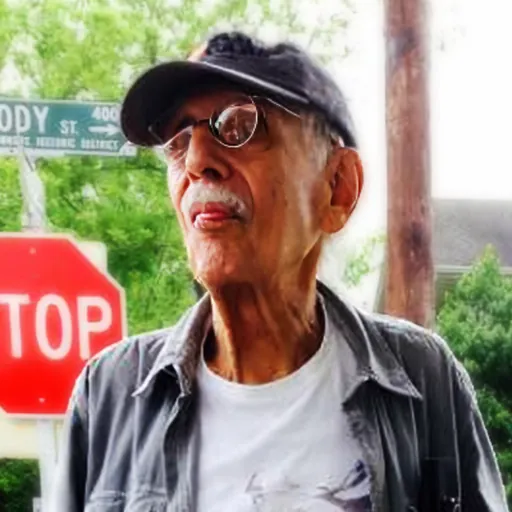
About James Harithas
Lived 1932 – 2023 (aged 90). James Harithas was a curator.
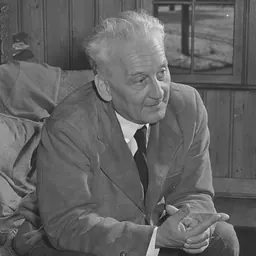
James Harithas (December 1, 1932 – March 23, 2023) was an American museum curator, director, and founder.
Early life and education
Menelaus James "Jim" Harithas was born in Lewiston, Maine, the eldest of three children. His father Nikolaus was a lawyer and county judge, who had immigrated from Greece to attend Yale University. His mother, Terpsichore Seferlis, was the grandniece of a Greek Prime Minister. She painted in oils and played piano and violin.
Nikolaus served in the U.S. Army. The family moved frequently. After World War II, they were stationed in Occupied Germany, a chaotic and lawless environment. James returned to the U.S. in 1953.
He enrolled at the University of Maine at Orono, but left after three semesters. He quit school and hitchhiked to New York City to become a painter While he pursued an art career, he worked as a dishwasher in a 72nd St. establishment and as a baggage handler at the Hotel New Yorker.
He finished his undergraduate degree at the University of Maine.
Early career
Harithas landed a curatorial position with the De Cordova Museum in 1962. Although it was largely a regional museum, he was able to show work by Andy Warhol and Hans Haacke.
The following year, Harithas was appointed Curator of Collection of the Phoenix Art Museum. His notable achievements there included a Paolo Soleri exhibition that was later shown at the Corcoran Gallery and the Whitney Museum, as well as a Contemporary Mexican exhibition that received national attention.
In 1967, Scale as Content brought three monumental sculptures to locations outside the Corcoran. Barnett Newman's piece, 3-tons of Cor-Ten steel shaped like an inverted obelisk balanced on the point of a pyramid, was placed on a corner between the museum and the National Mall with a view of the Washington Monument. Broken Obelisk stirred up considerable controversy since it appeared to allude to broken, upside-down government policies during a time of civil unrest.
In 1969, Harithas initiated a new approach to the Corcoran Biennial. The 31st Biennial changed the tone, direction, and process that would govern subsequent biennials. He ended the former juried selection process, taking full responsibility for inviting all participants. He also reconfigured the exhibition format, creating twenty-three separate solo exhibitions stationed throughout the museum. The show continued to focus on abstract color painting, but Harithas concentrated on younger artists who had rarely been seen in a museum context and artists who had made significant contributions to American painting but had received little recognition.
After nine months as director, Harithas wore out his welcome at the Corcoran and went back to New York, where he taught at Hunter College and the School of Visual Arts."
Also notable was the 1973 solo exhibition of Elaine Sturtevant, Sturtevant: Studies done for Beuys’ Action and objects, Duchamps’ etc. Including film. Of Sturtevant, Harithas is attributed to have said, “She's as much a mystic and as mysterious a character as you'd want to find in the art world.”
Upon arrival in Syracuse, Harithas hired David Ross, a recent university graduate, as the Everson's Curator of Video Art. The job was the first such position anywhere in the country. Harithas and Ross turned the Everson into a hub of video art. Nam June Paik and Charlotte Moorman performed an early version of Paik's iconic Video Cello in 1972. (Ross went on to helm the Boston Institute of Contemporary Art, the Whitney Museum, and the San Francisco Museum of Modern Art.) In 1973, the Everson hosted a month-long, solo exhibition featuring the work of video artist Frank Gillette. Part of Harithas’ endeavor to make the museum a pioneer institution for the medium, the show was the first to devote all four upper galleries to a video artist.
Harithas also spent considerable time working with Central New York's prison population. During the Attica riots, he taught classes at Auburn Correctional Facility, mentoring artists such as Juan Alberto Cruz. Harithas believed a prison fine arts program could offer a "creative framework within which the student can explore his visual and intellectual relationship to the ‘inside’ as well as the ‘outside’ and dispel or deal with irrational or unaccountable fantasies." A 1973 Smithsonian exhibition titled From Within grew out of the program. But he saw it as a challenge that also fulfilled a need to escape New York City's sphere of influence and to think of art “as a fundamental activity rather than a geopolitical hustle.”
The first show he organized was Art of the Lower Crust, an exhibition of work by museum staff members. Texas artists receiving solo shows, frequently their first in the context of a museum, included: Dick Wray, James Surls, Dorothy Hood, Luis Jimenez, Terry Allen, John Alexander, and Mel Casas. The show Dále Gas, organized by artist and CAMH curator Santos Martinez Jr. at Harithas' request, was the first major museum exhibition of Chicano art in Texas.
In February 1976, Harithas presented transplanted Texan Julian Schnabel's first solo show in the CAMH's Lower Gallery. In June of that year, a flash flood filled the lower level with nine feet of water, damaging gallery and office spaces, and destroying artwork on display and in storage. Harithas and artist John Alexander donned scuba gear in an attempt to salvage artwork, but dozens of paintings, sculptures, and artifacts were irreparably damaged.
Miralda's CAMH installation Breadline included photographs of food, as well as videos of the preparation and consumption of food at local restaurants. (Similarly to his tenure at the Everson, Harithas had hired a CAMH videographer.) The Kilgore Rangerettes drill team were brought in for opening night to perform their high-kicks routine and carry trays of rainbow-hued bread loaves from the CAMH's lower level to a 175-ft. long row of benches in the main gallery. As soon as a troublemaker threw a loaf, the event descended into a massive food and fist fight that spilled into the street. The pair would be the Houston art scene's power couple for decades to come, devoting themselves to local and regional artists as well as those working with politically- and socially-engaged content.
The couple were early supporters of the Art Car Movement. Curated by Ann Harithas, the Collision show at Lawndale Art Center (1984), showcased Larry Fuente's Mad Cad, a beaded, sequined 1960 Cadillac Sedan de Ville commissioned by Ann. She later constructed the art car Swamp Mutha, from a 1982 Monte Carlo, with Jesse Lott. This interest would ultimately manifest in the Art Car Museum and an annual Art Car Parade.
Without a governing board, Harithas was free to follow his curatorial passions: the work of local artists or groups of outsider artists, often that of underrepresented or undiscovered voices of protest.
Most Station Museum shows took a strong political stand, which Harithas sought to merge with imagery that went beyond mere illustration. In the best of these, Harithas said, the work becomes "a window to a world where politics and the aesthetic dimension [are] unified."
Five Points Museum of Contemporary Art
In 2016, the couple opened a third private museum. The Five Points Museum in Victoria, Texas, also focuses on contemporary art and hosts its own Art Car Parade. Community outreach and arts education are part of the institution's mission.
Exhibitions at the Five Points largely involve art cars, but the museum has hosted work by some of Harithas' favorite activist artists, including Mel Chin and Clark V. Fox. Live theater and film screenings are also offered.
Later years
Harithas remained fully engaged with the Station Museum until his death. He gave a 2022 interview and produced a catalog for Clark V. Fox: Subversion and Spectacle, the last show in the space. In November 2022, the museum staff announced the facility would be on hiatus from public exhibitions and programming until further notice (effectively closing the museum).
Late in life, he told a reporter, "I like to show things that are way out on the edge and see what the result is...If you follow the history of art, you see that contributions are made very often at the edges by somebody who has kind of broken through with a different idea... Modern Art has moved away from the idea that you have to draw a certain way or illustrate a certain way in order to be an artist. An artist is just somebody that expounds something passionately as far as I'm concerned. You know, visually through his art, using whatever materials he wants."
Harithas died in Houston on March 23, 2023, at the age of 90.
Don’t just read it —
keep it.
Full-length biographies made to live with: read them, listen on the way to work, watch them tonight.
- E-book
- Audio
- Video
Instant download · yours to keep · every purchase keeps this site free
Important facts
People in James Harithas's life
Named in this biography and alive at the same time





Related people
Same field, nearest in time


Contemporaries
People whose lives overlapped James Harithas's


Frequently asked questions
Who was James Harithas?
American museum director
When was James Harithas born?
James Harithas was born on 1 December 1932 in Lewiston.
When did James Harithas die?
James Harithas died on 23 March 2023 in Houston.
What was James Harithas's occupation?
James Harithas was a curator.
Sources & further reading
Cite this page
APA: Biography.guide. (2026). James Harithas. https://biography.guide/james-harithas/
MLA: "James Harithas." Biography.guide, https://biography.guide/james-harithas/.
Chicago: "James Harithas." Biography.guide. https://biography.guide/james-harithas/.
Data last updated: 2026-09-24 · Spot an error? Report a correction.
Portrait: Wikimedia Commons · author & licence
Page generated 2026-09-27 05:09 UTC