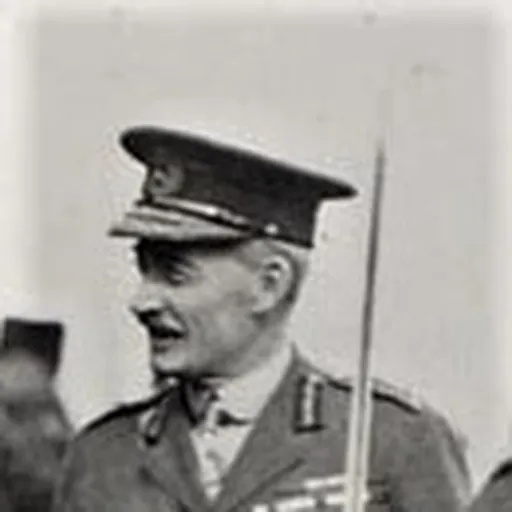
About James H. Elmsley
Lived 1878 – 1954 (aged 75). James H. Elmsley was a Canadian military personnel.
Major-General James Harold Elmsley, (October 13, 1878 January 3, 1954) was a Canadian military officer who served with the Royal Canadian Dragoons in the Canadian Expeditionary Force during the First World War. Later in the war, he would command the 8th Canadian Infantry Brigade, as well as the Canadian Siberian Expeditionary Force during the Allied intervention in the Russian Civil War.
Early life and military career Elmsley was born in Toronto in 1878, and was the great-grandson of John Elmsley, who had been in turn Chief Justice of Upper Canada during 17961802 and then Chief Justice of Lower Canada in 18021805. He received his education first in Toronto, followed by time spent at Cardinal Newman’s College in Birmingham, England, and The Oratory School at Edgbaston. and was aide-de-camp to MGen Sir Edward Hutton of the 1st Mounted Infantry Brigade. In his service there, he was awarded the following decorations:
Queen's South Africa Medal (5 clasps)1900 King's South Africa Medal (2 clasps)1902
Between the wars After returning home, Elmsley was named as aide-de-camp to then Lieutenant Governor of Ontario Sir Oliver Mowat, and soon became a member of the Toronto Hunt and Polo Club (gaining a reputation as an avid polo player) and the Toronto Club.
Elmsley remained with the Dragoons,
Allied intervention in Siberia
Elmsley was later found by a Medical Board to be once more fit for service, and was appointed to command the Canadian Siberian Expeditionary Force in August 1918, and the force arrived in Vladivostok two weeks before Armistice was declared in Europe. The various Allied forces did not function well together, because of the underlying chaos and suspicion. In a letter to Minister of Militia and Defence Sydney Mewburn, he gave a description of the situation:
The greatest friction he experienced was with Major General Sir Alfred Knox, the head of the British Military Mission. This was despite instructions that placed Elmsley in charge of all British forces in Siberia, under the command of Otani Kikuzo, the commanding officer of all Allied forces in the Russian Maritime Provinces, while Knox was only in the role of liaison officer. Elmsley's instructions required him to "keep in touch with [Knox]," while "in political matters you will keep in touch with Sir Charles Elliott [sic]."
The tension between Elmsley and Knox became so great that Elmsley felt compelled to express his views directly to the War Office, thereby bypassing Prime Minister Robert Borden, in which he declared that he would side with the American Expeditionary Force if conflict broke out between them and the Imperial Japanese Army. Borden seized upon this to demand that the Canadian contingent return home, and he received Lloyd George's support in bringing it about.
During the Force's time there, Elmsley felt that his instructions essentially constrained his authority to act by holding his troops in Vladivostok, thus leaving his soldiers generally available only for sentry duty and administrative tasks. On several occasions, he did allow missions to take place for guards on supply trains, as well as a party of 55 men to be sent to Omsk to act as headquarters staff to two British battalions stationed there. The only potential military action the Canadians faced was in April 1919, when a company was sent from the 259th Battalion to rescue some Russians loyal to Alexander Kolchak that were being threatened by Bolsheviks at Shkotovo. This had been done under Otani's orders, which conflicted with Ottawa's previous instructions. The Canadian forces were withdrawn from Siberia later that month, followed by the British forces that summer.
He was awarded the following decorations for his service there:
Croix de guerre (Czechoslovakia) 1920 Order of the Sacred Treasure, 2nd Class (Japan) 1921
Postwar Elmsley was adjutant general of the Canadian Militia during the period 19201922, afterwards commanding various military districts, and retired with pension in November 1929. He died in Toronto in January 1954.
Don’t just read it —
keep it.
Full-length biographies made to live with: read them, listen on the way to work, watch them tonight.
- E-book
- Audio
- Video
Instant download · yours to keep · every purchase keeps this site free
Important facts
People in James H. Elmsley's life
Named in this biography and alive at the same time



Related people
Same field, nearest in time





Contemporaries
People whose lives overlapped James H. Elmsley's



Frequently asked questions
Who was James H. Elmsley?
Canadian military personnel
When was James H. Elmsley born?
James H. Elmsley was born on 13 October 1878 in Toronto.
When did James H. Elmsley die?
James H. Elmsley died on 3 January 1954 in Toronto.
What was James H. Elmsley's occupation?
James H. Elmsley was a military personnel.
What nationality was James H. Elmsley?
James H. Elmsley was Canadian.
Sources & further reading
· DBpedia: James Harold Elmsley
Cite this page
APA: Biography.guide. (2026). James H. Elmsley. https://biography.guide/james-h-elmsley/
MLA: "James H. Elmsley." Biography.guide, https://biography.guide/james-h-elmsley/.
Chicago: "James H. Elmsley." Biography.guide. https://biography.guide/james-h-elmsley/.
Data last updated: 2026-09-20 · Spot an error? Report a correction.
Portrait: Wikimedia Commons · author & licence
Page generated 2026-09-27 04:58 UTC