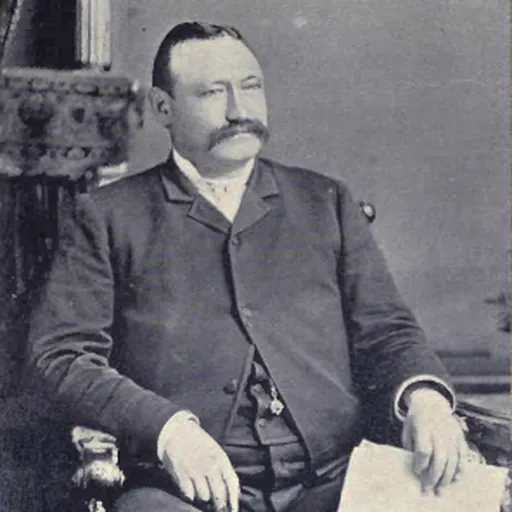
About James Conmee
Lived 1848 – 1913 (aged 64). James Conmee was a Canadian politician and building contractor.
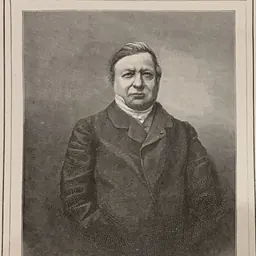
James Conmee (October 13, 1848 – July 23, 1913) was an Ontario businessman and political figure. He represented Algoma West from 1885 to 1902 and Port Arthur and Rainy River from 1902 to 1904 in the Legislative Assembly of Ontario and Thunder Bay and Rainy River in the House of Commons of Canada from 1904 to 1911 as a Liberal member.
Biography
He was born in Sydenham Township, Canada West in 1848, the son of Irish immigrants Matthew Conmee and Rosanna O'Shaughnessey, the youngest of four children (three boys, one girl). Although his education was rudimentary and better educated political enemies mocked his grammatical skills, he became over time a skilled and formidable debater. James was underage when he and his brother John sought adventure and joined the 8th New York Cavalry Regiment 21 March 1865 at Rochester, New York. From about 1886, biographical sources like the Canadian Parliamentary Guide state that he served under General George Armstrong Custer, but the commander of the 8th New York Cavalry in 1865 was Colonel Edmund Mann Pope (1837-1906). The regiment was part of the 2nd Brigade, 3rd Cavalry Division, commanded by Brevet Major-General George A. Custer, from March 1865, and was disbanded 27 June 1865. In 1872, at the age of 22 he moved to Fort William to work at a sawmill on the Kaministiquia River. In 1874, he married Emily Florence Cox. From 1876 to 1877, he held the contract to deliver mail between Silver Islet and Pigeon River. He was a contractor involved in laying track for the Canadian Pacific Railway in northern Ontario, later working on contracts for the Port Arthur, Duluth and Western Railway, Algoma Central Railway and other railways in the region. Both parties to the lawsuit hired the best lawyers available. The success and visibility of this case led to his meeting with Sir Wilfrid Laurier and they became best friends and confidants. Sir Wilfred introduced him on the floor of the House of Commons stating to the many lawyers elected that "here is a true lawyer". Laurier is said to have asked "Where did this Conmee come from, and how is it he can come here and teach the lawyers law?" Their friendship and collaboration continued until Conmee's death.
Political career
In 1878, he became a tax collector for the Municipality of Shuniah. In 1879, Conmee was elected to the municipal council representing Prince Arthur's Landing ward in the Municipality of Shuniah. In 1885 he served as the second mayor of Port Arthur, Ontario, the same year the provincial constituency of Algoma was split into Algoma East and Algoma West. He was elected to represent Algoma West in the Legislative Assembly of Ontario and won every subsequent provincial election until 1904 when he switched to federal politics. Conmee ran unsuccessfully in 1896 for the Nipissing seat in the House of Commons before being elected in 1904 on a platform of supporting Sir Wilfrid Laurier's transcontinental railway policy which would bring enormous benefits to his constituency. He could see the handwriting on the wall when Laurier and the Liberal Party lost the election of 1911. The younger and more dynamic John James Carrick was sure to win the seat for the Conservatives. Conmee died in Prescott, Arizona in 1913 and was buried at Port Arthur. He purchased Nun's Island near Montreal on sight recognizing the potential of the Lachine Rapids for hydro electricity. He also explicitly requested and was given title to all the waters that fed into the Falls and Rapids in order to protect the potential hydro development. This extremely valuable asset was sold for a song when he believed that the purchaser could promote and develop hydro power quicker than he could and he did not want to stand in the way.
St. Joseph's Hospital in Port Arthur (now Thunder Bay) was established on land donated in the backyard of his homestead. He also provided or arranged all funding for the construction of the hospital. In a show of respect, the only portion of the hospital funded by the Nuns who ran it at the time is the entrance and plaque which still bears his name as of 2007. The heritage homestead was destroyed in 1968 to increase parking space - ironically about the same time as the popular tune about destroying paradise to put up a parking lot.
Conmee was able to secure federal funding to support the development of the Port Arthur harbour which played an important role in the later development of the city's economy.
Conmee Township west of Thunder Bay was named after him.
Don’t just read it —
keep it.
Full-length biographies made to live with: read them, listen on the way to work, watch them tonight.
- E-book
- Audio
- Video
Instant download · yours to keep · every purchase keeps this site free
Important facts
People in James Conmee's life
Named in this biography and alive at the same time




Related people
Same field, nearest in time






Contemporaries
People whose lives overlapped James Conmee's




Frequently asked questions
Who was James Conmee?
Canadian politician (1848-1913)
When was James Conmee born?
James Conmee was born on 13 October 1848 in Sydenham.
When did James Conmee die?
James Conmee died on 23 July 1913 in Prescott.
What was James Conmee's occupation?
James Conmee was a politician and building contractor.
What nationality was James Conmee?
James Conmee was Canadian.
Sources & further reading
Cite this page
APA: Biography.guide. (2026). James Conmee. https://biography.guide/james-conmee/
MLA: "James Conmee." Biography.guide, https://biography.guide/james-conmee/.
Chicago: "James Conmee." Biography.guide. https://biography.guide/james-conmee/.
Data last updated: 2026-09-20 · Spot an error? Report a correction.
Portrait: Wikimedia Commons · author & licence
Page generated 2026-09-27 04:58 UTC