
About James Christie
Lived 1773 – 1831 (aged 57–58). James Christie was a British businessperson.
James Christie the Younger (1773–1831) was an English antiquarian, auctioneer, and eldest son of James Christie, founder of Christie's.
Though his family didn't originally intend for him to go into the business, Christie followed in his father's footsteps to become an auctioneer. He gained a good reputation in this profession, even if considered a less careful dealer and a more solitary businessman than his father. Through his work at Christie's, he "consolidated its dominance of the London fine art auctioneering scene", continuing his father's work there. He oversaw several notable sales at the auction house, and passed the business along to his son, ultimately ensuring it remained in the family until 1889.
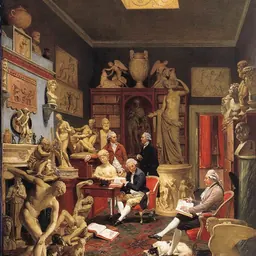
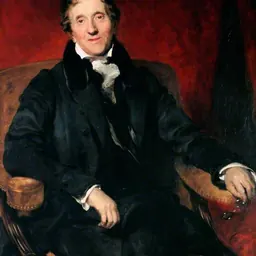
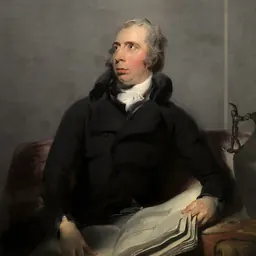
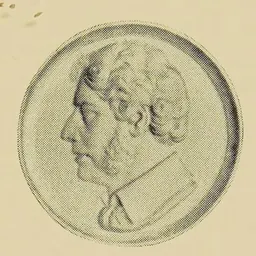
Aside from his work as a businessman, Christie was an amateur classical scholar. He produced works on the Greek origins of Chess, Etruscan vase painting, elemental themes in Paganism, and Ancient Greek sculpture, for which he received generally favourable reviews. He befriended several notable contemporary scholars, such as Sir John Soane and Charles Townley, who encouraged his studies and provided him with rare antiquities.
Early life Portrait of James Christie the Elder by Thomas Gainsborough, 1778.
James Christie was born in 1773, in Pall Mall, London, as the eldest son to James Christie the Elder, a prominent and successful auctioneer of London. (2019) He was educated at Eton College, where his family planned for him to take up an ecclesiastical career. Here, he entertained classical interests and his obituary reported that "he passed through that school with a reputation honourable". After his father's death in 1803, he abandoned the church, and took over the family business.
Auctioneering
He treads in shoes of great Papa, And tells alike — untruths comme ça: For Auctioneer would give emetic That was not vers'd in prose-poetic; — Satiricus Sculptor — 'Chr—st—e', Chalcographimania (1814) His obituary claimed he "raised the business he followed to the dignity of a profession", through his diligent study and "undisputed" taste in fine art.
Scholarship and antiquarianism Outside from his family business, Christie was a committed historical and classical scholar. His first publication was An Inquiry Into the Ancient Greek Game (1801), a study on the origins of Chess claiming to find its origins in Ancient Greece, specifically the game of Petteia, and of "pastoral origin", i.e. the product of gradually improved folk tradition rather than one man's invention. Charles Tomlinson, in his brief history in Amusements in Chess (1845), quotes Christie at length and refers to his arguments as "ingenious".
The next work Christie produced concerned pagan religions, entitled An Essay on that Earliest Species of Idolatry: The Worship of the Elements (1814). This book surveyed elemental themes from many early European and Asian religions, notably including Chinese conceptions of the elements, which were the subjects of two coloured plates. The essay received a mixed review from The Monthly Review, praised as "generally founded on arguments that are at least plausible, and often on convincing facts", but criticised for Christie's "disposition to refer everything in Pagan antiquity to a scriptural origin". In 1822, Christie's considerations on a massive vase found in Hadrian's Villa, 'Dissertation on the Lanti Vase', were published in Outline Engravings, and Descriptions of the Woburn Abbey Marbles (1822) as an appendix. This vase was an exemplary piece of Greek pottery, decorated with classical masks and theatrical scenes, which had formerly been owned by the Lanti family.
Alongside these historical interests, Christie had interests in fine art, poetry, and biblical studies. These fine interests were recognised, with his election into the Society of Dilettanti in 1824, a society of well-to-do classical scholars, and the Athenaeum in 1826. He was also the registrar of the Royal Literary Fund for several years, a society which he contributed to considerably, and a member of the Society of Antiquaries of Newcastle upon Tyne, one of the oldest societies of its kind.
Posthumously, his work on the history of Ancient Greek sculpture, An Inquiry into the Early History of Greek Sculpture (1833), was published by his son, James Stirling. The book was printed in 50 copies, for private circulation, though it had originally been intended as an introduction for the Dilettanti Society's Specimens of Ancient Sculpture, Vol. 2 (1836). After Christie's death, the society's committee had decided against such a speculative essay for the volume's introduction, so it was scrapped in favour of an essay by another member, Richard Payne Knight.
Personal life and death According to Ireland, "in private life his character will stand the test of the most minute inquiry". Two contemporary portraits were made of Christie, an 1826 bust by William Behnes, which both Henry Corbould and Robert Graves sketched, and a 1821 drawing by E. Turner, now stored at the Victoria and Albert Museum.
In 1824 he moved to 8 King Street, St James's Square, London, where Christie's "Great Rooms" had moved in the fall of 1823. After a prolonged illness, Christie died at his house on 2 February 1831, at the age of fifty-eight. His obituary was published in The Gentleman's Magazine. He left two sons George Henry Christie (d. 1887) and James Stirling (d. 1834). The eldest, George, took over Christie's business, partnering with Thomas H. Woods (d. 1906) and William Manson. James Christie the Younger's grandson, James H. B. Christie, was the last Christie to have a connection with the firm, and retired in 1889. From thereon, Christie's was no longer a family business.
Don’t just read it —
keep it.
Full-length biographies made to live with: read them, listen on the way to work, watch them tonight.
- E-book
- Audio
- Video
Instant download · yours to keep · every purchase keeps this site free
Important facts
People in James Christie's life
Named in this biography and alive at the same time




Related people
Same field, nearest in time



Contemporaries
People whose lives overlapped James Christie's



Frequently asked questions
Who was James Christie?
English antiquary and auctioneer 1773-1831
When was James Christie born?
James Christie was born in 1773.
When did James Christie die?
James Christie died on 2 February 1831.
What was James Christie's occupation?
James Christie was a businessperson.
What nationality was James Christie?
James Christie was British.
Sources & further reading
· DBpedia: James Christie the Younger
Cite this page
APA: Biography.guide. (2026). James Christie. https://biography.guide/james-christie-businessperson/
MLA: "James Christie." Biography.guide, https://biography.guide/james-christie-businessperson/.
Chicago: "James Christie." Biography.guide. https://biography.guide/james-christie-businessperson/.
Data last updated: 2026-09-20 · Spot an error? Report a correction.
Page generated 2026-09-27 05:18 UTC