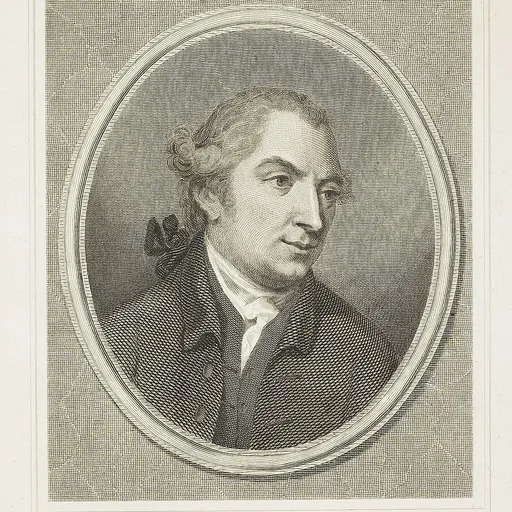
About James Basire
Lived 1730 – 1802 (aged 71). James Basire was a British draftsperson, printmaker and copper engraver.
James Basire (1730–1802 London), also known as James Basire Sr., was a British engraver. He is the most significant of a family of engravers, and noted for his apprenticing of the young William Blake.
Early life His father was Isaac Basire (1704–1768), a cartographer, his son (1769–1822) and grandson (1796–1869) were also named James; these four generations of Basires were all engravers. Their longevity produced overlapping careers, which has led to difficulties in attribution of some works.
Career
A member of the Society of Antiquaries, James Basire specialized in prints depicting architecture. His studio was on Great Queen Street in London. His appointment as engraver to the society, as were all three generations, and much of his finest work is found in Vetusta Monumenta. A major piece was his copperplate for Field of the Cloth of Gold, an exquisitely detailed translation of a watercolour by Edward Edwards; this oversize historical print was issued on 'Antiquarian' paper. Excellent work also appeared in Richard Gough's Sepulchral Monuments.
Legacy and work Work by Basire is held in museums and galleries around the world, including the Fine Arts Museums of San Francisco, the Museum of Fine Arts, Boston, Christchurch Art Gallery, New Zealand, the National Library of Australia in Canberra, and the National Portrait Gallery, London.
On 4 August 1772, William Blake was apprenticed to Basire for the term of seven years. There is no record of any serious disagreement or conflict between the two during the period of Blake's apprenticeship. However, Peter Ackroyd's biography notes that Blake was later to add Basire's name to a list of artistic adversaries – and then crossed it out.
He assisted in the production of Stuart's Athens and engraved several good portraits of eminent men. He died in London. Among his other works were:
Captain Cook; after Hodges. Lady Stanhope, as the Fair Penitent; after B. Wilson. Lord Camden; after Joshua Reynolds. The Field of the Cloth of Gold: Henry VIII and Francis I; after the picture at Hampton Court. Interview between Orestes and Pylades before Iphigenia; after Benjamin West.
Amongst Basire's apprentices were Thomas Ryder (1746–1810), George Cooke (1781–1834), and John Roffe (1769–1850).
Don’t just read it —
keep it.
Full-length biographies made to live with: read them, listen on the way to work, watch them tonight.
- E-book
- Audio
- Video
Instant download · yours to keep · every purchase keeps this site free
Important facts
more
James Basire Sr., James Basire IPeople in James Basire's life
Named in this biography and alive at the same time







Related people
Same field, nearest in time


Contemporaries
People whose lives overlapped James Basire's





Frequently asked questions
Who was James Basire?
British engraver (1730-1802)
When was James Basire born?
James Basire was born on 6 October 1730 in London.
When did James Basire die?
James Basire died on 6 September 1802 in Lincoln's Inn Fields.
What was James Basire's occupation?
James Basire was a draftsperson, printmaker and copper engraver.
What nationality was James Basire?
James Basire was British.
Sources & further reading
Cite this page
APA: Biography.guide. (2026). James Basire. https://biography.guide/james-basire/
MLA: "James Basire." Biography.guide, https://biography.guide/james-basire/.
Chicago: "James Basire." Biography.guide. https://biography.guide/james-basire/.
Data last updated: 2026-09-21 · Spot an error? Report a correction.
Portrait: Wikimedia Commons · author & licence
Page generated 2026-09-27 05:00 UTC