
About James Altham
Lived 1555 – 1617 (aged 61–62). James Altham was an English judge, politician and barrister.
Sir James Altham (about 1554 - 1617), of Oxhey, Hertfordshire, was an English judge, briefly a member of the Parliament of England, and (from 1607) a Baron of the Exchequer. A friend of Lord Chancellor Francis Bacon, Altham opposed Edward Coke but advanced the laws of equity behind the fastness of the Exchequer courts, so long considered almost inferior. Through advanced Jacobean royalism he helped to prosecute the King's enemies and centralise royal power of taxation. With Sir Edward Bromley, he presided at the Lancashire witch trials in 1612.
Early life James Altham was descended from Christopher Altham of Girlington, in the West Riding of Yorkshire. He was the third son (of five) of citizen and Clothworker James Altham (died 1583) of Mark Hall, Latton, in Essex, Sheriff of London in 1557–58, and sheriff of Essex in 1570, by his first wife. Alderman Altham was himself the son of Edward Altham (died 1548), a Master of the Fullers' Company, which had merged with the Shearmen in c. 1528–1530 to form the Worshipful Company of Clothworkers: Edward, although never an alderman, served a term as Sheriff of London in 1531-32 together with Richard Gresham, in the mayoralty of Sir Nicholas Lambert. Edward, who requested burial at St Martin Outwich, in Bishopsgate, left his properties in Dagenham and Barking to his son James and to the heirs of his body. daughter of Thomas Blancke of London, Haberdasher (died 1562), and sister of Sir Thomas Blanke, Lord Mayor of London in 1583. The elder Blanke had built for himself the mansion of "Abbottes Inne", on the historic site of the Abbot of Waltham's house in the London parish of St Mary-at-Hill. Elizabeth Altham died in childbirth in 1558 and received a public funeral at St Martin's church. After this alderman Altham became the fourth husband of Mary Matthew, successively the wife of one Woolley, of the citizen and Skinner Thomas Langton (died c. 1550), and of Sir Andrew Judde (died 1558).
As a consequence of this marriage, James Altham junior became the step-brother of Mary Langton, wife of Admiral Sir William Wynter. His stepmother, Dame Mary Judd, was, together with James and his brothers Thomas and Edward, the alderman's executor in March 1582/83: she lived down to 1602. The eldest brother becoming Roman Catholic, Mark Hall at Latton was inherited by the second brother Edward (died 1605), and descended to his heirs. On 16 June 1584, James Altham married his first wife Margaret Skynner at St Dunstan-in-the-East. With the death of Sir Thomas Blancke in 1588, the Blancke properties in London devolved in remainder upon Thomas Altham (then of Oxford, aged 38) or Edward Altham, subject to a lifetime occupancy for the widow Dame Margaret Blancke. Following his marriage, he is mentioned in Croke's reports for the first time as arguing a case in the Queen's Bench in 1587. Shortly before he entered the Commons, he was made an Ancient of Gray's Inn, granting superior status over juniors at the all-important dinners. In 1589, he was elected M.P. for Bramber in Sussex. whom we have great experience of, and think very able to do us service in this behalfe. His name is Mr. James Altham, son of Mr. Altham, late of Essex, Esq., he is a Bencher of Gray's Inn, and one of our ordinary Sworn Counsellors of the City, well acquainted with our customes, and very well thought of for his honestie and skill in law, both throughout the whole City, and elsewhere, and being in election last time, did very narrowly miss it: in which respects, and for the good hope we have of him, myself and many others do, only for the good of the City, earnestly wish him the place, if her Majesty shall please to remove the other; nothing doubting, but that her most excellent Majesty, and your good Lordship, and my other Lords, will take very good liking of him..." Altham, however, was passed over a second time, in favour of John Croke.
Serjeant-at-law (1603), Baron of the Exchequer (1607) He was appointed reader at Gray's Inn in 1600, and in 1603 double reader (duplex lector): in the latter year he was made serjeant-at-law. He was one of eleven called to that degree at that time by writ of Queen Elizabeth, which on occasion of the monarch's death almost immediately afterwards was renewed by writ of James I, so that they and three others were sworn on 17 May 1603. On 1 February 1607 he was appointed one of the barons of the exchequer, in succession to Sir John Savile, and knighted.
Case of Proclamations (1610) In 1610, a question having arisen concerning the power of the crown to impose restrictions on trade and industry by proclamation, the two chief justices, the chief baron, and Baron Altham were appointed to consider the matter. The result of their consultation was that they unanimously resolved "that the king by his proclamation cannot create any offence which was not an offence before ... That the king hath no prerogative but that which the law of the land allows him ... and lastly, that if an offence be not punishable in the Star Chamber, the prohibition of it by proclamation cannot make it punishable there."
Heretics (1611)
Altham was one of the judges whose opinion was taken in 1611 by Lord Chancellor Ellesmere on the case of the heretics Bartholomew Legate and Edward Wightman, whom Archbishop Abbot wanted burned. Altham was reputed hostile to Edward Coke, who was deliberately not consulted. The two men were burned, one at Smithfield, the other at Burton-upon-Trent.
Power of Commendam (1616) Altham's signature, together with those of the other twelve judges, is appended to the letter to the king relative to his action in the commendam case of 1616, in which the power of the crown to stay proceedings in the courts of justice in matters affecting its prerogative is denied. A serjeant-at-law, in arguing a case involving the right of the crown to grant commendams, i.e. licences to hold benefices that otherwise would be vacated, had in the performance of his duty disputed, first, the existence of any such prerogative except in cases of necessity; secondly, the possibility of any such case arising. They thereupon wrote by his attorney-general, Francis Bacon, a letter addressed to Lord Coke requiring that all proceedings in the cause should be stayed. This letter having been communicated to the judges, they assembled, and after consultation the letter already mentioned was sent to the king. The king replied by convening a council and summoning the judges to attend thereat. They attended, and, having been admonished by the king and the attorney-general, all, with the exception of Coke, fell upon their knees, acknowledged their error, and promised amendment.
Oxhey: estate and chapel The manor of Marks, in Leyton and Walthamstow (Essex), was granted to Paul Withypoll and his son Edmund in 1544. Descending in that family, it passed to Edmund's grandson Edmund, who sold it in 1601 to Sir James Altham. Sir James was in possession of the manor of Le Marke in Leyton in 1616, and also of the manor of Bohun's Hall (Boones Hall) at Tollesbury, Essex. Both descended through his son James to the co-heirs, Elizabeth and Frances.
Oxhey Chapel, built by Sir James Altham in 1612 (since modified). Image: John Salmon The estate of Oxhey, near Watford, Hertfordshire was imparked during the Middle Ages, and disparked in 1598, with licence granted to Francis Heydon to fell the timber and turn the land to tillage. In 1601 Heydon sold an estate of 500 acres to Henry Fleetwood of Gray's Inn, consisting of the capital messuage of St Cleer's in Oxhey, "and the impaled or warren ground with the Warren house or lodge called Edeswick or Oxhey Lodge, and also part of the old park called Oxhey Park, and the house called Merry Hill House or Hamonds lying near Oxhey Wood, in the tenure of William Hamond by lease of Francis Heydon".
A piece of glass with the arms of Altham, dated 1611, is or was preserved in the vestry of the church of Bushey nearby. In 1612 Altham constructed a private chapel at Oxhey, which is still standing although modified and restored at various times. It contains fine later 17th-century furnishings. A dedicatory inscription reads:"This Chappel Was Bvilt For A Hovse Of Prayer Ao Dni 1612 By Sr Iames Altham Knight One Of Ye Barons Of Ye Escheqver. Take Heede, To Thy Foote, When Thou Entrest Into The Hovse Of God And Bee More Neere To Heare Then To Give The Sacrifice Of Fooles. - Eccles. V" The Altham religious stance leant towards the Puritan, as is suggested by the dedication of the translation by Robert Vaux from Martin Chemnitz's Examen Concilii Tridentini to Sir James's father, "M. James Altham, Esq.; and the lady Iudde his wife", in 1582. More exactly contemporary with the chapel was Japhets first publique Perswasion into Sems Tents, by the Calvinist Thomas Taylor, published in 1612 with dedications to Sir James Altham and Sir Charles Morrison, of Watford.
Death and monument Altham died on 21 February 1617, and the Lord Keeper, Sir Francis Bacon, in appointing his successor, characterised the late baron as "one of the gravest and most reverend of the judges of this kingdom." His will was proved on 10 March 1616/17. In making his bequests he did not follow the London custom, observing: "Although I was born free of London yet in respect I never was tradesman nor have lived as a Citizen and freeman I hope neither my wife nor any of my children will be so contentious or unkinde as to quarrell aboute any customarie division of my goodes...", and so making his own division of a considerable quantity of plate, property and goods between them.
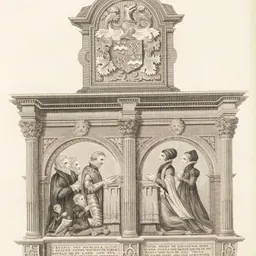
He was buried in Oxhey Chapel, where he is commemorated by a wall monument to himself and his last wife which he prepared during his lifetime. However, as this person must have been born c. 1540, he is too old to be the third son of James Altham and Elizabeth Blancke, who married in 1548/49.
Family By his first wife, Margaret, daughter of Oliver Skinner, Altham had issue one child only, a son: James Altham, afterwards Sir James Altham of Oxhey, knight. of London, and had issue a boy, who died in infancy, and two daughters, Elizabeth and Frances: Elizabeth Altham married Arthur Annesley, second Viscount Valentia and first Earl of Anglesey, whose second son, Altham Annesley, was created in 1680 Baron Altham of Altham, with limitation in default of male issue to his younger brothers. His only son dying in infancy, the title devolved upon the younger branch of the Annesley family, who subsequently succeeded to the earldom of Anglesey. The earldom lapsed in 1771, when the English House of Lords decided against the legitimacy of the last claimant. Frances Altham, the second daughter, married Richard Vaughan, 2nd Earl of Carbery. The title lapsed in 1713.
By his second wife, Mary, daughter of Richard Stapers, Esq., Altham had three children, a son and two daughters: and Melton Constable, knight; secondly, Robert Digby, 1st Baron Digby (c. 1599–1642) (Irish peerage); and lastly, Sir Robert Bernard, 1st Baronet, serjeant-at-law. Elizabeth died 3 January 1662 and was buried at the church of Covent Garden. Mary Altham married Sir Francis Stydolph of Mickleham and Norbury Park, Surrey (d. 1655), and was the mother of Sir Richard Stydolph, Baronet.
By his third wife, Helen daughter of John Saunderson, merchant of London, Altham had no children. Helen was the widow of John Hyde, citizen and Grocer of London, by whom she had seven sons and ten daughters.
Robert Altham, currently a circuit judge is one of his descendants.
Don’t just read it —
keep it.
Full-length biographies made to live with: read them, listen on the way to work, watch them tonight.
- E-book
- Audio
- Video
Instant download · yours to keep · every purchase keeps this site free
Important facts
People in James Altham's life
Named in this biography and alive at the same time




Related people
Same field, nearest in time
Contemporaries
People whose lives overlapped James Altham's



Frequently asked questions
Who was James Altham?
English politician; (1555-1617)
When was James Altham born?
James Altham was born in 1555.
When did James Altham die?
James Altham died in 1617.
What was James Altham's occupation?
James Altham was a judge, politician and barrister.
What nationality was James Altham?
James Altham was English.
Sources & further reading
Cite this page
APA: Biography.guide. (2026). James Altham. https://biography.guide/james-altham/
MLA: "James Altham." Biography.guide, https://biography.guide/james-altham/.
Chicago: "James Altham." Biography.guide. https://biography.guide/james-altham/.
Data last updated: 2026-09-20 · Spot an error? Report a correction.
Page generated 2026-09-27 05:16 UTC