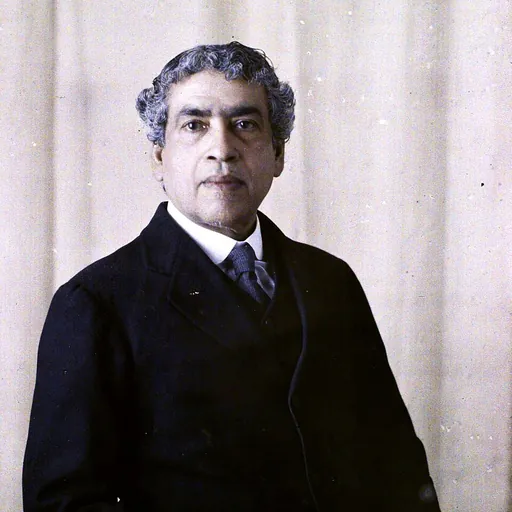
Jagadish Chandra Bose
Bengali polymath, physicist, and biologist
About Jagadish Chandra Bose
Lived 1858 – 1937 (aged 78). Jagadish Chandra Bose was an Indian botanist, university teacher, physicist, archaeologist, writer and chemist, known for Crescograph, Crystal detector and Crystal radio.
Sir Jagadish Chandra Bose (; ; 30 November 1858 – 23 November 1937) He was a pioneer in the investigation of radio microwave optics, made significant contributions to botany, and was a major force behind the expansion of experimental science on the Indian subcontinent. Bose is considered the father of Bengali science fiction. A crater on the Moon was named in his honour. He founded the Bose Institute, a premier research institute in India and also one of its oldest. Established in 1917, the institute was the first interdisciplinary research centre in Asia. He served as the Director of Bose Institute from its inception until his death.
Born in Mymensingh, Bengal Presidency (present-day Bangladesh), during British governance of India, Bose graduated from St. Xavier's College, Calcutta (now Kolkata, West Bengal, India). Prior to his enrollment at St. Xavier's College, Calcutta, Bose attended Pabna Zilla School and Dhaka Collegiate School, where he began his educational journey. He attended the University of London to study medicine, but had to give it up due to health problems. Instead, he conducted research with Nobel Laureate, Lord Rayleigh at the University of Cambridge. Bose returned to India to join the Presidency College of the University of Calcutta as a professor of physics. There, despite racial discrimination and a lack of funding and equipment, Bose carried on his scientific research. He made progress in his research into radio waves in the microwave spectrum and was the first to use semiconductor junctions to detect radio waves.
Bose made pioneering discoveries in plant physiology. He used his own invention, the crescograph, to measure plant response to various stimuli and proved parallelism between animal and plant tissues. Bose filed for a patent for one of his inventions because of peer pressure, but he was generally critical of the patent system. To facilitate his research, he constructed automatic recorders capable of registering extremely slight movements; these instruments produced some striking results, such as quivering of injured plants, which Bose interpreted as a power of feeling in plants. His books include Response in the Living and Non-Living (1902) and The Nervous Mechanism of Plants (1926). In a 2004 BBC poll to name the Greatest Bengali of All Time, Bose placed seventh. His family was originally from the village of Rarhikhal in Munshiganj, Dacca district. His father was a leading member of the Brahmo Samaj and worked as a civil servant with the title Deputy Magistrate and Assistant Commissioner of Police (ACP) in several places, including Faridpur and Bardhaman.
Bose's father sent Bose to a Bengali-language school for his early education, as it was important to him that his son should study in his native language and culture before studying in English. Speaking at the Bikrampur Conference in 1915, Bose described the effect this early education had on him: At that time, sending children to English schools was an aristocratic status symbol. In the vernacular school, to which I was sent, the son of the Muslim attendant of my father sat on my right side, and the son of a fisherman sat on my left. They were my playmates. I listened spellbound to their stories of birds, animals, and aquatic creatures. Perhaps these stories created in my mind a keen interest in investigating the workings of Nature. When I returned home from school accompanied by my school fellows, my mother welcomed and fed all of us without discrimination. Although she was an orthodox old-fashioned lady, she never considered herself guilty of impiety by treating these 'untouchables' as her own children. It was because of my childhood friendship with them that I could never feel that there were 'creatures' who might be labeled 'low-caste', I never realized that there existed a 'problem' common to the two communities, Hindus and Muslims. He received a BA from the University of Dhaka in 1879. Bose went to England to study medicine at the University of London, but had to quit because of ill health, possibly worsened by the chemicals used in the dissection rooms. , in 1883 and a BA (Natural Sciences Tripos) from the University of Cambridge
Professorship at Presidency College
After obtaining a degree from the University of Cambridge Bose returned to India. Henry Fawcett had given Bose an introduction to Lord Ripon, the Viceroy of India, who recommended him for a post to the Director of Public Instruction in Kolkata. In those days such posts in the Imperial Education Service were usually reserved for Europeans. Bose was appointed as an officiating professor of physics at Presidency College. Although the principal Charles Henry Tawney and Director of Education Alfred Woodley Croft were reluctant to appoint him, Bose took up his post in January 1885.
At that time, an Indian professor was paid two-thirds the salary of a European, and since his appointment was considered temporary, this was further halved, leaving him with one-third the pay of his European peers. As a protest, Bose declined his salary and worked without remuneration for the first three years at Presidency College.
He was popular among the students for his teaching style and demonstration of experiments. He got rid of the roll call. After three years in this temporary post, the value of his professorial work was recognized by Tawney and Croft, who made Bose's appointment permanent with retrospective effect. Bose received his full pay for the last three years in a lump sum. However, another source states that his appointment was made permanent on 21 September 1903, some 8 years after his joining the college.
Bose used his own money to fund his research projects as well as receiving funding and support from the social activist nun Sister Nivedita.
Microwave radio research Bose's 60 GHz microwave apparatus at the Bose Institute, Kolkata, India. His receiver (left) used a galena crystal detector inside a horn antenna and galvanometer to detect microwaves. Bose invented the crystal radio detector, waveguide, horn antenna, and other apparatus used at microwave frequencies. Diagram of microwave receiver and transmitter apparatus, from Bose's 1897 paper.
Bose became interested in radio following the 1894 publication of British physicist Oliver Lodge's demonstrations on how to transmit and detect radio waves. He began his own research in the new field in November 1894, setting up his equipment in small 20 ft sq room at Presidency College. The paper described Bose's plans for a coherer, a term coined by Lodge referring to radio wave receivers, which he intended to "perfect" but never patented. The paper was well received by The Electrician and The Englishman, which in January 1896 (commenting on how this new type of wall and fog penetrating "invisible light" could be used in lighthouses) wrote:
Wanting to meet other scientists in Europe, Bose was given a six month scientific deputation in 1896. Bose went to London on a lecture tour and met Italian inventor Guglielmo Marconi, who had been developing a radio wave wireless telegraphy system for over a year and was trying to market it to the British post service. He was also congratulated by William Thomson, 1st Baron Kelvin and received an honorary Doctor of Science ( DSc) from the University of London.
In 1900, he presented his research at the first International Congress of Physics in Paris.
Place in radio development Bose's work in radio microwave optics was specifically directed towards studying the nature of the phenomenon and was not an attempt to develop radio into a communication medium. His experiments took place during the same period (from late 1894 on) when Marconi was making breakthroughs on a radio system specifically designed for wireless telegraphy and others were finding practical applications for radio waves, such as Russian physicist Alexander Stepanovich Popov's radio wave based lightning detector, also inspired by Lodge's experiment. Bose was not interested in patenting his work, and openly revealed the operation of his galena crystal detector in his lectures. A friend in the US persuaded him to take out a US patent on his detector, but he did not actively pursue it and allowed it to lapse. pioneered the study of chiral media, and preceded the fields of artificial dielectrics and metamaterials by decades and a century, respectively.
Development of the Mercury Coherer Detector
Sir Jagadish Chandra Bose developed the self-recovering mercury coherer, a pioneering solid-state diode detector, which significantly advanced early wireless telegraphy. On 27 April 1899, Bose presented a paper to the Royal Society describing an iron-mercury-iron or iron-mercury-carbon contact device, later recognized as the first patented solid-state diode detector (British Patent No. 7555, 1901; U.S. Patent 755840, 1904). This apparatus, capable of detecting radio signals without mechanical decohering, was integral to Guglielmo Marconi’s transatlantic wireless transmission on 12 December 1901, which successfully received the Morse code letter "S" at Signal Hill, St. John's, Newfoundland.
In mid-1901, Marconi obtained a modified version of Bose’s detector from Lieutenant Luigi Solari of the Royal Italian Navy. Solari’s adaptation encased a mercury droplet between carbon or iron electrodes within a glass tube. Marconi filed a British patent (No. 18105, September 1901), subsequently amended to acknowledge Solari’s contribution. The use of this device led to the "Italian Navy Coherer" controversy when Professor Angelo Banti, editor of L’Elettricista, claimed in May 1902 that naval signalman Paolo Castelli was its inventor. This assertion prompted debates in British publications, including The Electrician and Saturday Review. Solari countered that his design drew from English scientific literature, likely referencing Bose’s 1899 paper.
In 1903, Emilio Guarini attributed priority to Professor Tommaso Tommasina of Genoa, citing his 1899–1900 experiments with mercury-based coherers. Marconi’s lecture at the Royal Institution on 13 June 1902 distinguished Tommasina’s work from the detector used, and Solari confirmed he was unaware of Tommasina’s research until after the lecture. A detailed examination by Probir K. Bondyopadhyay, published by the Institute of Electrical and Electronics Engineers (IEEE), clarifies the historical and technical significance of Bose’s contribution to the development of wireless communication.
Plant research
Bose conducted most of his studies in plant research on Mimosa pudica and Desmodium gyrans plants. His major contribution in the field of biophysics was the demonstration of the electrical nature of the conduction of various stimuli (e.g., wounds, chemical agents) in plants, which were earlier thought to be of a chemical nature. In order to understand the heliotropic movements of plants (the movement of a plant towards a light source), Bose invented a torsional recorder. He found that light applied to one side of the sunflower caused turgor to increase on the opposite side. He was also the first to study the action of microwaves in plant tissues and corresponding changes in the cell membrane potential. He researched the mechanism of the seasonal effect on plants, the effect of chemical inhibitors on plant stimuli and the effect of temperature.
Study of metal fatigue and cell response
Bose performed a comparative study of the fatigue response of various metals and organic tissue in plants. He subjected metals to a combination of mechanical, thermal, chemical, and electrical stimuli and noted the similarities between metals and cells. Bose's experiments demonstrated a cyclical fatigue response in both stimulated cells and metals, as well as a distinctive cyclical fatigue and recovery response across multiple types of stimuli in both living cells and metals.
Bose documented a characteristic electrical response curve of plant cells to electrical stimulus, as well as the decrease and eventual absence of this response in plants treated with anaesthetics or poison. The response was also absent in metal treated with oxalic acid.
Science fiction
In 1896, Bose wrote Niruddesher Kahini (The Story of the Missing One), a short story that was later expanded and added to Abyakta (অব্যক্ত) collection in 1921 with the new title Palatak Tuphan (Runaway Sea-Storm). It was one of the first works of Bengali science fiction.
Bose Institute
In 1917 Bose established the Bose Institute in Kolkata, West Bengal, India. Bose served as its director for its first twenty years until his death. Today it is a public research institute of India and also one of its oldest. Bose in his inaugural address on 30 November 1917 dedicated the institute to the nation saying:
Later life He spent the last years of his life in Giridih. Here he lived in the house located near Jhanda Maidan. This building was named Jagdish Chandra Bose Smriti Vigyan Bhavan. It was inaugurated on 28 February 1997 by then Governor of Bihar Akhlaqur Rahman Kidwai.
Personal views Philosophical views Jatras, which were popular ancient plays, sparked his interest in the stories of the Mahabharata and Ramayana. In the latter, he was particularly impressed by the character of Rama and even more so by the soldierly devotion of his brother Lakshmana. However, he found that most of the characters in these stories seemed too good and perfect. It was the elderly warriors of the Mahabharata, with their flaws and qualities that were both human and superhuman, who appealed more to his imagination as a boy.
Impressed by Karna, Bose said: Always in struggle for the uplift of the people, yet with so little success, such frequent failures, that to most he seemed a failure. All this too gave me a lower and lower idea of all worldly success - how small its so-called victories are! - and higher and higher idea of conflict and defeat; and of true success born of defeat. In such ways I have come to feel one with the highest spirit of my race; with every fibre thrilling with the emotion of the past. That is its noblest teaching - that the only real and spiritual advantage is to fight fair, never to take crooked ways, but keep to the straight path, whatever be in the way.
Legacy and honors
Acharya Bhavan, the residence of J C Bose built in 1902, was turned into a museum.
Bose's place in history is now being re-evaluated. His work may have contributed to the development of radio communication.
Many of his instruments are still on display and remain largely usable over 100 years later. They include various antennas, polarisers, and waveguides.
To commemorate his birth centenary in 1958, the JBNSTS scholarship programme was started in West Bengal. In the same year, India issued a postage stamp bearing his portrait. The same year Acharya Jagdish Chandra Bose, a documentary film directed by Pijush Bose, was released. It was produced by the Government of India's Films Division. Films Division also produced another documentary film, again titled Acharya Jagdish Chandra Bose, this time directed by the prominent Indian filmmaker Tapan Sinha.
On 14 September 2012, Bose's experimental work in millimetre-band radio was recognised as an IEEE Milestone in Electrical and Computer Engineering, the first such recognition of a discovery in India.
On 30 November 2016, Bose was celebrated in a Google Doodle on the 158th anniversary of his birth.
In 2018, the Bank of England decided to redesign the 50 pound note with a prominent scientist. Jagadish Chandra Bose was featured in that nomination list for his pioneering work on technology that would enable later development of Wi-Fi. However, he was not shortlisted.
Honors Companion of the Order of the Indian Empire (CIE) – 1903 – in the 1903 Durbar Honours. Companion of the Order of the Star of India (CSI) – 1912 Knight Bachelor (1917) Fellow of the Royal Society (FRS, 1920) Member of the Vienna Academy of Sciences, 1928 President of the 14th session of the Indian Science Congress in 1927. Member of Finnish Society of Sciences and Letters in 1929. Member of the League of Nations' Committee for Intellectual Cooperation (from 1924 to 1931) Founding fellow of the National Institute of Sciences of India (now the Indian National Science Academy)
Legacy 2025: The Institute of Electrical and Electronics Engineers (IEEE) instituted IEEE Jagadish Chandra Bose Medal in Wireless Communications to recognize contributions to wireless communications technologies with a global impact. The medal is funded by donations from the Indian-American physicist Mani Lal Bhaumik. One of the 12 donor levels of the IEEE Heritage Circle is named after Bose. The J.C. Bose University of Science and Technology, YMCA was named in his honour. The Indian Botanic Garden was renamed in his honour as the Acharya Jagadish Chandra Bose Indian Botanic Garden on 25 June 2009. In 2004, Bose was ranked number 7 in BBC's poll of the Greatest Bengali of all time.
Publications
Journals Nature published about 27 papers.
Books Response in the Living and Non-living, 1902 Plant response as a means of physiological investigation, 1906 Comparative Electro-physiology: A Physico-physiological Study, 1907 Researches on Irritability of Plants, 1913 Life Movements in Plants (vol.1), First Published 1918, Reprinted 1985 Life Movements in Plants, Volume II, 1919 Physiology of the Ascent of Sap, 1923 The physiology of photosynthesis, 1924 The Nervous Mechanism of Plants, 1926 Plant Autographs and Their Revelations, 1927 Growth and tropic movements of plants, 1929 Motor mechanism of plants, 1928
Other
Don’t just read it —
keep it.
Full-length biographies made to live with: read them, listen on the way to work, watch them tonight.
- E-book
- Audio
- Video
Instant download · yours to keep · every purchase keeps this site free
Important facts
Family & relationships
People in Jagadish Chandra Bose's life
Named in this biography and alive at the same time





Related people
Same field, nearest in time


Contemporaries
People whose lives overlapped Jagadish Chandra Bose's



Frequently asked questions
Who was Jagadish Chandra Bose?
Bengali polymath, physicist, and biologist (1858–1937)
When was Jagadish Chandra Bose born?
Jagadish Chandra Bose was born on 30 November 1858 in Bikrampur.
When did Jagadish Chandra Bose die?
Jagadish Chandra Bose died on 23 November 1937 in Giridih.
What was Jagadish Chandra Bose's occupation?
Jagadish Chandra Bose was a botanist, university teacher, physicist, archaeologist, writer and chemist.
What was Jagadish Chandra Bose known for?
Jagadish Chandra Bose was known for Crescograph, Crystal detector, Crystal radio, Extremely high frequency, Plant biology and Radio.
What nationality was Jagadish Chandra Bose?
Jagadish Chandra Bose was Indian.
Sources & further reading
· Wikipedia: Jagadish Chandra Bose
· DBpedia: Jagadish Chandra Bose
Cite this page
APA: Biography.guide. (2026). Jagadish Chandra Bose. https://biography.guide/jagadish-chandra-bose/
MLA: "Jagadish Chandra Bose." Biography.guide, https://biography.guide/jagadish-chandra-bose/.
Chicago: "Jagadish Chandra Bose." Biography.guide. https://biography.guide/jagadish-chandra-bose/.
Data last updated: 2026-09-21 · Spot an error? Report a correction.
Portrait: Wikimedia Commons · author & licence
Page generated 2026-09-27 04:59 UTC