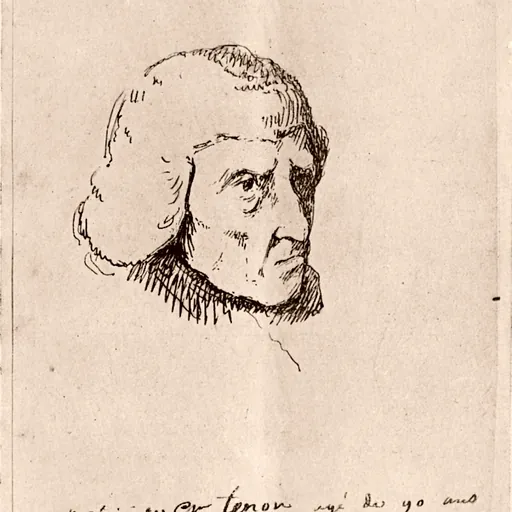
About Jacques-René Tenon
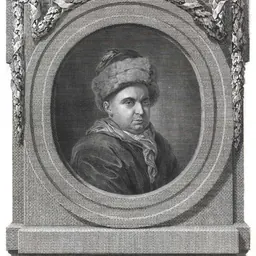
Lived 1724 – 1816 (aged 91). Jacques-René Tenon was a French surgeon, politician and physician, known for Capsule of Tenon.
Jacques-René Tenon (, 21 February 1724 – 16 January 1816) was a French surgeon born in Sépeaux in northern Burgundy.
During his studies, Tenon earned the favour of Jacques-Bénigne Winslow, He also launched a rigorous study of mercury poisoning among workers in the hat production industry and militated against the use of mercury in the preparation of animal skins in this industry. This was the context in which he would, in 1788, publish his conclusions as his famous Memoir on the hospitals of Paris. which provided a well documented and detailed account of Parisian hospitals. Using evidence and scientific analysis, the treatise dealt with such subjects as hygiene, patient care, management of staff, the keeping of patient records and case histories and environmental conditions.
Context
The development of Tenon's treatise took place in the context of public debate on what was to be done about the Hôtel-Dieu of Paris, an ancient hospital located in central Paris near Notre Dame. In the 18th century, the Hôtel-Dieu was notoriously overcrowded, unsanitary, and susceptible to fire. It was used almost exclusively by destitute patients who had no other options. It had a reputation of being a "death-trap" because of its sordid conditions and high death rate. Two serious fires had occurred in 1737 and 1772.
In 1785, thirteen years after the 1772 fire, the project of the architect Bernard Poyet (1742–1824) was presented in a memoir entitled "On the need to transfer and rebuild the Hôtel-Dieu," written by Claude Coquéau (1755–1794). Poyet proposed to build a circular hospital on an island on the Seine. Its exterior was to be a replica of the Colosseum in Rome, with over 5,000 beds and an efficient system of air circulation (constant renewal of the air).
The Baron de Breteuil (1730–1807), acting for Louis XVI, instructed the Royal Academy of Sciences to evaluate the Poyet project. For this purpose, a hospital commission of 9 members was created. Its members included Tenon and other renowned scientist such as Antoine-Laurent de Lavoisier (1743–1794), Charles-Augustin de Coulomb (1736–1806), and Pierre-Simon Laplace (1749–1827).
The outbreak of the French Revolution radically altered the political and institutional landscape in which the commission's work was evolving, though it remained influential. In 1788, Tenon published his Mémoire sur les hôpitaux de Paris (Memoirs on the Hospitals of Paris), the most comprehensive work of its time on hospital organisation.
Coverage of Tenon's Mémoire The memoir contains 5 chapters: :5–7
Overview of the Hospitals of Paris. Architecture, organisations and outcomes of the main hospitals in Paris. Location, area and best locations. Description and organization of the Hôtel-Dieu de Paris. Architecture and organization that could replace the Hôtel-Dieu. For Tenon, the hospital was the "conscience of a civilisation whose worth ... would be measured not by articles of faith and lofty doctrine, but by the way it nurtured life, succoured distress, righted injustice and transformed misery, frailty and want into hope, dignity and sufficiency." in his own words. His hospital is a quantifiable structure that is subject to management and evaluation. The operation of this healing machine is to be based on principles such as visibility (the sick must be distributed so that they can be seen, evaluated and compared), sufficiency and convenience in terms of resting space, quantity of fresh air, distribution of patients and diseases (isolation of the contagious). still carries his name. He provided a description of the "capsule of Tenon" in 1805.
Don’t just read it —
keep it.
Full-length biographies made to live with: read them, listen on the way to work, watch them tonight.
- E-book
- Audio
- Video
Instant download · yours to keep · every purchase keeps this site free
Important facts
People in Jacques-René Tenon's life
Named in this biography and alive at the same time


Related people
Same field, nearest in time


Contemporaries
People whose lives overlapped Jacques-René Tenon's



Frequently asked questions
Who was Jacques-René Tenon?
French surgeon
When was Jacques-René Tenon born?
Jacques-René Tenon was born on 21 February 1724 in Sépeaux.
When did Jacques-René Tenon die?
Jacques-René Tenon died on 16 January 1816 in Paris.
What was Jacques-René Tenon's occupation?
Jacques-René Tenon was a surgeon, politician and physician.
What was Jacques-René Tenon known for?
Jacques-René Tenon was known for Capsule of Tenon.
What nationality was Jacques-René Tenon?
Jacques-René Tenon was French.
Sources & further reading
· Wikipedia: Jacques-René Tenon
Cite this page
APA: Biography.guide. (2026). Jacques-René Tenon. https://biography.guide/jacques-rene-tenon/
MLA: "Jacques-René Tenon." Biography.guide, https://biography.guide/jacques-rene-tenon/.
Chicago: "Jacques-René Tenon." Biography.guide. https://biography.guide/jacques-rene-tenon/.
Data last updated: 2026-09-23 · Spot an error? Report a correction.
Portrait: Wikimedia Commons · author & licence
Page generated 2026-09-27 05:08 UTC