
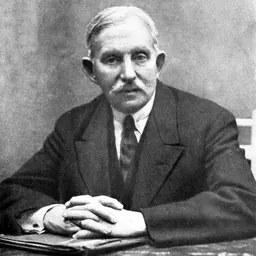
Jacques Benoist-Méchin
French far right politician and writer
About Jacques Benoist-Méchin
Lived 1901 – 1983 (aged 81). Jacques Benoist-Méchin was a French politician, journalist, musicologist, historian, translator and military historian.
Jacques Michel Gabriel Paul Benoist-Méchin (1 July 1901 – 24 February 1983) was a French far right politician and writer. He was born and died in Paris. Well known as a journalist, he later became prominent for his collaborationism under the Vichy regime. After his conviction in 1947 and release in 1954, in the second part of his life he became a historian, with a focus on the Arab world, and in 1981 won the Prix Broquette-Gonin.
Early years Benoist-Méchin was educated at leading schools in Switzerland and the United Kingdom as well as the Lycée Louis-le-Grand before attending the Sorbonne. He subsequently served in the French Army, spending the period from 1921 to 1923 as part of the forces involved in the occupation of the Rhineland. He then became a journalist, working for the International News Service from 1924 to 1927 and was appointed editor of L'Europe Nouvelle in 1930 by Louise Weiss. He served as an undersecretary in François Darlan's cabinet and, along with Pierre Pucheu and Paul Marion, became part of the so-called "young cyclists" group of pro-German Darlan loyalists. Despite this loss of face Benoist-Méchin was an enthusiastic collaborator who claimed that France was working with Germany rather than opposing her and risking further defeat or working for her and thus becoming subservient. He was briefly the official ambassador for the collaborationist government in occupied Paris although early on this role passed to fellow Germanophile Fernand de Brinon.
A minister without portfolio in Vichy France, Benoist-Méchin's influence grew when he, along with his allies Paul Marion and Joseph Darnand, was appointed to the controlling committee of the Légion des Volontaires Français in June 1942. In this position he suggested renaming the group Légion Tricolore and converting it into a professional military unit, an idea soon adopted. Increasingly sidelined by Pierre Laval, Benoist-Méchin was involved in plotting with Darnand and Jacques Doriot for the three men to form a pro-Nazi triumvirate to administer Vichy France but the plan came to nothing. He benefited from a remission of sentence on 24 September 1953 and was released on parole in November 1954, when he was freed from Clairvaux.
Immediately before and following his release, Benoist-Méchin wrote for a number of right-wing journals, notably Écrits de Paris and Paroles Françaises, the organ of the Republican Party of Liberty. Shortly before the Second World War, he produced a History of the German Army in ten volumes, and in 1939 Éclaircissements sur Mein Kampf d'Adolphe Hitler, an interpretation of Hitler's Mein Kampf. After the fall of France came La Moisson de Quarante, a memoir of his time as a prisoner-of-war. ), Napoleon (in Egypt), Lawrence of Arabia, and Hubert Lyautey. His De la Défaite au désastre, memoirs of the Vichy period, was published in 1984. He befriended James Joyce and made an early French translation of Molly Bloom's monologue from Ulysses, and also provided the musical transcription of "Little Harry Hughes" photographed for episode 17. He also corresponded with Ernst Jünger during the German scholar's residence in occupied France. He also developed a close friendship with Union Movement leader Oswald Mosley whilst the latter lived in France after the war.
Publications Histoire de l'armée allemande (1936) : De l'Armée impériale à la Reichswehr (1918–1919); De la Reichswehr à l'Armée nationale (1919–1938); De Vienne à Prague (1938–1939). Éclaircissements sur Mein Kampf d'Adolphe Hitler, le livre qui a changé la face du monde (1939). La Moisson de quarante – Journal d’un prisonnier de guerre (1941). L'Ukraine, des origines à Staline (Albin Michel, 1941). Ce qui demeure – Lettres de soldats tombés au champ d’honneur, 1914–1918 (1942). A series with the title Rêve le plus long de l'Histoire (Éditions Perrin) : Lawrence d'Arabie – Le rêve fracassé (1961), which in 2008 appeared in a paperback edition. Cléopâtre – Le rêve évanoui (1964); Bonaparte en Égypte – Le rêve inassouvi (Lausanne: La guilde du livre, 1966; Perrin, 1978); Lyautey l'Africain ou Le rêve immolé (1966); L'empereur Julien – Le rêve calciné (1969); Alexandre le Grand – Le rêve dépassé (1976). Later edition by Clairefontaine and La guilde du livre, Lausanne, 1964; Frédéric de Hohenstaufen – Le rêve excommunié (1980), which in 2008 appeared in a paperback edition. Le Loup et le Léopard : Mustapha Kemal – La mort d’un Empire (1954); Ibn Séoud – La naissance d’un Royaume (1955); Le Roi Saud, ou l'Orient à l'heure des relèves (1960). Soixante jours qui ébranlèrent l'occident (1956, three volumes). Published in abridged form in one volume as 60 days that shook the West (London: Jonathan Cape, 1963). La Bataille du Nord – 10 mai-4 juin 1940; La Bataille de France – 4 juin 1940– 25 juin 1940; La Fin du Régime – 26 juin 1940 – 10 juillet 1940. Un printemps arabe (1959). Deux étés africains (1972). À destins rompus (1974). Fayçal, roi d'Arabie (1975). L'Homme et ses jardins – Les métamorphoses du paradis terrestre (1975). La Musique et l'immortalité dans l'œuvre de Marcel Proust (1977). La Turquie se Dévoile 1908–1938 (1980). De la défaite au désastre (1984–1985, posthume). À l'épreuve du temps (1989–1993, posthume) (new revised edition by Perrin, 2011). Histoire des Alaouites (1994, posthume).
Don’t just read it —
keep it.
Full-length biographies made to live with: read them, listen on the way to work, watch them tonight.
- E-book
- Audio
- Video
Instant download · yours to keep · every purchase keeps this site free
Important facts
People in Jacques Benoist-Méchin's life
Named in this biography and alive at the same time




Related people
Same field, nearest in time





Contemporaries
People whose lives overlapped Jacques Benoist-Méchin's

Frequently asked questions
Who was Jacques Benoist-Méchin?
French far right politician and writer (1901-1983)
When was Jacques Benoist-Méchin born?
Jacques Benoist-Méchin was born on 1 July 1901 in 17th arrondissement of Paris.
When did Jacques Benoist-Méchin die?
Jacques Benoist-Méchin died on 24 February 1983 in 18th arrondissement of Paris.
What was Jacques Benoist-Méchin's occupation?
Jacques Benoist-Méchin was a politician, journalist, musicologist, historian, translator and military historian.
What nationality was Jacques Benoist-Méchin?
Jacques Benoist-Méchin was French.
Sources & further reading
· Wikipedia: Jacques Benoist-Méchin
· DBpedia: Jacques Benoist-Méchin
Cite this page
APA: Biography.guide. (2026). Jacques Benoist-Méchin. https://biography.guide/jacques-benoist-mechin/
MLA: "Jacques Benoist-Méchin." Biography.guide, https://biography.guide/jacques-benoist-mechin/.
Chicago: "Jacques Benoist-Méchin." Biography.guide. https://biography.guide/jacques-benoist-mechin/.
Data last updated: 2026-09-20 · Spot an error? Report a correction.
Page generated 2026-09-27 05:27 UTC