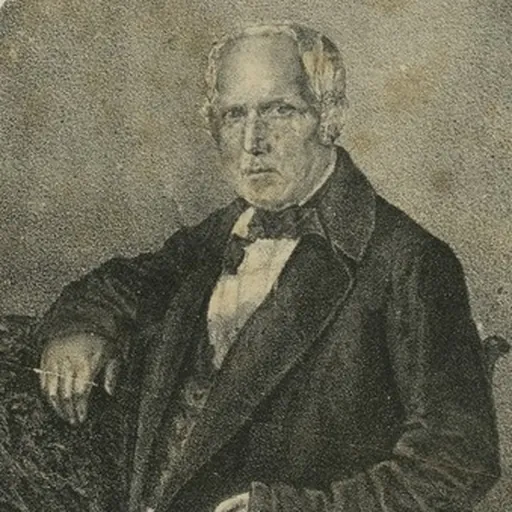
Jacob Eichenbaum
Galician-Jewish maskil, educator, poet and mathematician
About Jacob Eichenbaum
Lived 1796 – 1861 (aged 65). Jacob Eichenbaum was a Russian mathematician, translator, pedagogue, poet and teacher.
Jacob Moiseyovych Eichenbaum (, ; 12 October 1796 – 27 December 1861), born Jacob Gelber, was a Galician Jewish maskil, educator, poet and mathematician.
Biography Jacob Gelber was born in the Galician city of Krystynopil, on 12 October 1796, in the year following the Third Partition of Poland by the Habsburg monarchy.
By the age of eleven, he was already in his first marriage, but it didn't last long until the divorce, as his father-in-law suspected that he was a secularist. In 1815, when he was eighteen, he remarried, adopted the name "Eichenbaum" and settled in Zamość. There he encountered a progressive Jewish youth circle, and began studying Hebrew, German, philosophy, and (in particular) mathematics. In 1819, he translated Euclid's Elements from German into Hebrew.
He worked as a travelling private tutor, teaching Hebrew subjects and mathematics in wealthy households throughout Ukraine. In 1835, Eichenbaum opened a private school for Jewish children in Odesa, which had become an important educational centre for Ukrainian Jews. In 1836, he published Kol Zimrah, one of the first books of Modern Hebrew poetry published in the Haskalah period. In 1840, he published Ha-Kerav, a poetry book describing a variety of chess moves in verse.
Eichenbaum's educational and literary work attracted the attention of the Russian government, which advanced his position in the Jewish education system of the Russian Empire. In 1844, Eichenbaum was appointed as director of the Bessarabian Jewish school in Chișinău, and in 1850, he was appointed as chief inspector of a Yeshiva in Zhytomyr, a position which he maintained until his death.
During his final years, he continued to publish works of mathematics and poetry. In 1857, he published a Hebrew arithmetic textbook, Ḥokhmat ha-Shi'urim, which he had adapted from a work in the French language. In 1861, he wrote an allegorical poem, Ha-Kosem, which he published in the Hebrew newspaper Ha-Melitz.
On 27 December 1861, Jacob Eichenbaum died in Kiev.
Don’t just read it —
keep it.
Full-length biographies made to live with: read them, listen on the way to work, watch them tonight.
- E-book
- Audio
- Video
Instant download · yours to keep · every purchase keeps this site free
Important facts
Related people
Same field, nearest in time





Contemporaries
People whose lives overlapped Jacob Eichenbaum's





Frequently asked questions
Who was Jacob Eichenbaum?
Galician-Jewish maskil, educator, poet and mathematician
When was Jacob Eichenbaum born?
Jacob Eichenbaum was born on 12 October 1796 in Sheptytskyi.
When did Jacob Eichenbaum die?
Jacob Eichenbaum died on 27 December 1861 in Kyiv.
What was Jacob Eichenbaum's occupation?
Jacob Eichenbaum was a mathematician, translator, pedagogue, poet and teacher.
What nationality was Jacob Eichenbaum?
Jacob Eichenbaum was Russian.
Sources & further reading
Cite this page
APA: Biography.guide. (2026). Jacob Eichenbaum. https://biography.guide/jacob-eichenbaum/
MLA: "Jacob Eichenbaum." Biography.guide, https://biography.guide/jacob-eichenbaum/.
Chicago: "Jacob Eichenbaum." Biography.guide. https://biography.guide/jacob-eichenbaum/.
Data last updated: 2026-09-22 · Spot an error? Report a correction.
Portrait: Wikimedia Commons · author & licence
Page generated 2026-09-27 05:02 UTC