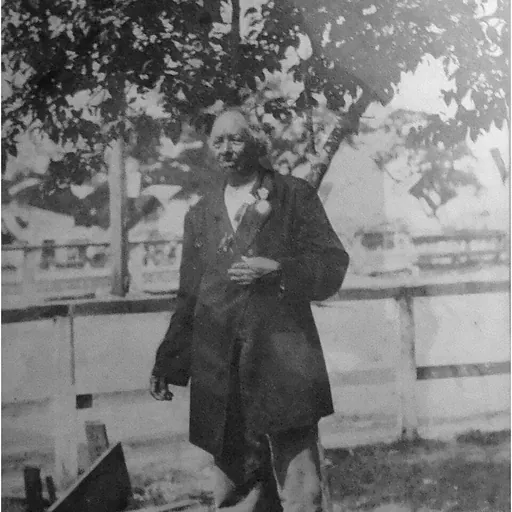
Jack Amos
American Indian and Confederate soldier
About Jack Amos
Lived 1828 – 1906 (aged 77–78).
Jack Amos (c. 1828 - March 1906) was an American Indian and Confederate soldier. His American Indian name was Eahantatubbee ("He Who Goes Out And Kills"). During the American Civil War, Amos served as an interpreter in John W. Pierce's 1st Choctaw Battalion and in Samuel G. Spann's Independent Scouts. In his later years, Amos filed a federal suit which rendered a U.S. Supreme Court decision years after his death.
Background
Amos was born in the Choctaw Nation before the nation removed west of the Mississippi River. His birthplace is near present-day Marion, Mississippi. Amos' parents were Apatomby and Nahhatema. His family moved to the Indian village called Chunky Chitto when he was an infant. He is listed as "Mississippi Choctaw Identified" with a "Full" blood quantum on the Dawes Rolls.
Amos likely attended a missionary school where he gained some mastery of the English language. He was known to be an English to Indian language interpreter.
In Alfred J. Brown's History of Newton County from 1834 to 1894, Brown described Amos as being about 60 years old, having a wife, and in poor health.
Quote|text=Jack has seen the Choctaw Indian in all his wild, untutored state. He grew up as a devotee to all their wild ideas and shrank from all civilization. He engaged in all their time-honored customs, games and dances, believed in all their superstitions and participated in everything the Indian called pleasure and dissipation. In his more than mature manhood he became a convert to the Christian religion and a preacher of righteousness to his fallen race. He was the first preacher among them, and no doubt he has done good and is trying to live a Christian life and persuade others to do so. Yet his speech is slow, his frame is bowing, his noble manhood is gone and he now looks forward to the reward of hereafter. He is reverenced and respected by his people and will be missed when he is gone.|author=A. J. Brown |title=History of Newton County from 1834 to 1894, 1894
Amos reported in his pension that he first enrolled in April 1861. By 1863, he was acting as an interpreter for Major John W. Pierce and for Major Samuel G. Spann. Amos was likely with the 1st Choctaw Battalion at the Battle of Ponchatoula. Amos surrendered at Meridian, Mississippi in 1865.
Final years
Amos lived the remainder of his life in Newton County, Mississippi. Amos did not own a home, so he boarded with several Newton County families during his lifetime. According to census and pension data, Amos resided with Thomas J. Reynolds and Evan S. Gilbert.
In 1901, Amos became a member of U.C.V. Camp Dabney H. Maury, No. 1312 which was based in Newton, Mississippi. He attended the 1903 reunion held at New Orleans. A Louisiana journalist wrote an article about him.
Jack Amos died in March 1906.
Amos' Legacy
The Treaty of Dancing Rabbit Creek was agreed to and signed by leaders of the Choctaws in September 1830. Article 14 allowed any member of the tribe to remain in Mississippi, become a citizen of the United States, and given 640 acres of land. Federal authorities failed to implement article 14 properly leaving tribal members landless. For decades after 1830, petitions were created to address article 14 concerns.
Dawes Commission The Dawes Commission was designed to transfer tribe-controlled lands in Indian Territory and to privatize those lands for the benefit of tribal members. The Mississippi Choctaws were originally ignored in these transactions, but they soon were included in the proceedings. The Dawes Commission saw 25,000 applications for enrollment as Mississippi Choctaws. A little over 2,500 were identified as Mississippi Choctaws.
Appeals and lawsuits Jack Amos led a class action lawsuit and petitioned for lands in Mississippi rather than lands in Indian Territory.
Amos and several Mississippi Choctaws filed a lawsuit called Jack Amos et al vs. The Choctaw Nation, U. S. Court of Central District of Indian Territory, No 158.
Supreme Court's Decision WINTON v. AMOS, 255 U.S. 373, was argued in January 1919, and re-argued April 1920. A decision was reached on March 7, 1921. Justice Mahlon R. Pitney delivered the opinion of the court.
Don’t just read it —
keep it.
Full-length biographies made to live with: read them, listen on the way to work, watch them tonight.
- E-book
- Audio
- Video
Instant download · yours to keep · every purchase keeps this site free
Important facts
People in Jack Amos's life
Named in this biography and alive at the same time

Contemporaries
People whose lives overlapped Jack Amos's






Frequently asked questions
Who was Jack Amos?
American Indian and Confederate soldier (c. 1828–1906)
When was Jack Amos born?
Jack Amos was born in 1828.
When did Jack Amos die?
Jack Amos died in 1906 in Newton County.
Sources & further reading
Cite this page
APA: Biography.guide. (2026). Jack Amos. https://biography.guide/jack-amos/
MLA: "Jack Amos." Biography.guide, https://biography.guide/jack-amos/.
Chicago: "Jack Amos." Biography.guide. https://biography.guide/jack-amos/.
Data last updated: 2026-09-21 · Spot an error? Report a correction.
Portrait: Wikimedia Commons · author & licence
Page generated 2026-09-27 05:00 UTC