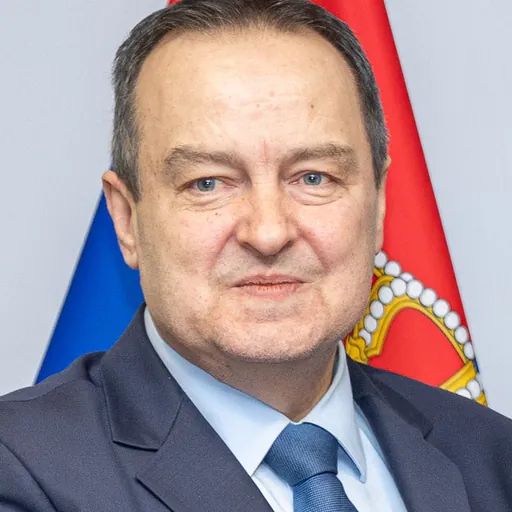
About Ivica Dačić
Born 1966. Ivica Dačić is a Serbian and Yugoslav politician.
Ivica Dačić (born 1 January 1966) is a Serbian politician who has served various governmental positions since 2008. He has been deputy prime minister of Serbia since 2022, having previously served that role from 2008 to 2012 and again from 2014 to 2020, and the minister of internal affairs since 2024, having previously served that role from 2008 to 2014. The leader of the Socialist Party of Serbia (SPS) since 2006, he was the prime minister of Serbia from 2012 to 2014 and president of the National Assembly of Serbia from 2020 to 2022.
Dačić graduated from the University of Belgrade in 1989 and joined SPS in 1991. He quickly rose up the ranks of the party, becoming its spokesman in 1992, under his mentor, Slobodan Milosević, President of Serbia and FR Yugoslavia. After the fall of Milošević, he served as the minister of information in a transitional government from 2000 to 2001. Dačić became SPS party leader in 2006. Like his predecessor Milošević, he is regarded as a pragmatic leader willing to change views based on circumstance and has worked to reform the party. Dačić led SPS into a government with the Democratic Party (DS) in 2008, after which he became the first deputy prime minister and minister of internal affairs, roles which he served until 2012. The DS–SPS government reached an EU candidate status. After the 2012 parliamentary election, SPS formed a coalition government with the Serbian Progressive Party (SNS); Dačić was elected prime minister. The SNS–SPS government pursued the European Union to start formal negotiations for the accession of Serbia and he signed the Brussels Agreement on the normalisation of relations of governments of Serbia and Kosovo.
In 2014, he returned to being the first deputy prime minister and also became the minister of foreign affairs, roles which he served until 2020. Dačić was elected president of the National Assembly after the 2020 parliamentary election and was succeeded by Vladimir Orlić in 2022. Commentators described his political positions as populist and nationalist.
Early life Dačić was born on 1 January 1966 in Prizren, which at the time was part of the Socialist Republic of Serbia within Yugoslavia. Dačić was born to a Serbian family and was brought up in Žitorađa. His father, Desimir, was a police officer, and his mother, Jelisaveta ("Jela"), was a housewife. His parents were both born in villages under the Jastrebac. His sister Emica has degrees in pedagogy and drama. In 1996, Dačić was a minister in the Citizens' Council of the Assembly of Yugoslavia and President of the Committee on Public Information, and in 1997 he was member of the Committee on Foreign Relations.
Party leadership He was elected President of the Socialist Party on the seventh congress on 4 December 2006, winning over candidate Milorad Vučelić in the second round with 1,287 points, versus 792 points, of the delegates votes. In 2012, the Security Intelligence Agency (Serbia's intelligence agency) received information that drug boss Darko Šarić had offered 10 million € to assassinate Tadić and Dačić.
2012 elections, Prime Minister
The Socialist Party entered a coalition with the Party of United Pensioners of Serbia (PUPS), and United Serbia. In the 2012 parliamentary election the Socialist Party's coalition had come third with 556.013 votes, 14.53%, 44 seats; Nikolić offered the Prime Minister post to Dačić, Dačić assumed office on 27 July. He said at a reception: "In this chamber there are many who toppled us in 2000, and I thank them, for if they hadn't toppled us we wouldn't have changed, realised our mistakes and we wouldn't be standing here today.". and abandoning Milošević's nationalist policies. The Serbian parliament elected Jorgovanka Tabaković (SNS) as new central bank governor.
Policies Upon becoming prime minister, he faced the challenges of a declining economy and Serbia's accession to the EU. He emphasised that harmonisation with European laws is an integral part of the government's plan for boosting investment and employment.
Status of Kosovo
On 17 February 2008, the Assembly of Kosovo declared independence. It was the second declaration of independence by Kosovo's Albanian-majority political institutions, the first having been proclaimed on 7 September 1990. The legality of the declaration, and indeed whether it was an act of the Assembly, was disputed by the government of Serbia. Serbia sought international validation and support for its stance, and in October 2008 Serbia requested an advisory opinion on the matter from the International Court of Justice. The Court determined that the declaration of independence was legal.
In 2006, upon being elected party leader, Dačić said that he had no problem fighting for Kosovo as he had done it before.
On 25 July 2011, the North Kosovo crisis began when the Kosovo Police crossed into the Serb-controlled municipalities of North Kosovo, in an attempt to control several border crossings without the consultation of either Serbia or KFOR/EULEX. Though tensions between the two sides eased somewhat after the intervention of NATO's KFOR forces, they continued to remain high amid concern from the EU, who also blamed Kosovo for the unilateral provocation.
On 24 November 2011, Dačić said that he saw the Republic of Kosovo's incident with Serbs in North Kosovo as an attack on Serbia. The BBC claimed the "nationalist" leanings of Kosovo-born Dačić raise speculation on the policy towards the Kosovo issue, which may implicate on Serbia's EU application. On 19 April 2013, Dačić and his government took another step towards normalising relations between Kosovo and Serbia. In March 2013, Dačić said that while his government would never recognise Kosovo's independence, "lies were told that Kosovo is ours" and that Serbia needed to define its "real borders".
Economy
The Socialist-controlled gas monopoly Srbijagas which entered into partnership with Russian oil giant Gazprom during the coalition government with the Democratic Party.
Protege of Slobodan Milošević Because he was a high-profile spokesman for Milošević, he received the nickname "Little Sloba" after his mentor. The Sports Association of Serbia recognised Dačić and Novak Djokovic in 2011 for their contributions to Sport in Serbia. "Golden Sign of the Police of Republika Srpska", for cooperation between the Serbian Police and Republika Srpska Police, awarded on 28 April 2012 in Banja Luka. Order of the Republika Srpska, 2022 Order of the Holy New Martyrs of Kragujevac, 2025
Don’t just read it —
keep it.
Full-length biographies made to live with: read them, listen on the way to work, watch them tonight.
- E-book
- Audio
- Video
Instant download · yours to keep · every purchase keeps this site free
Important facts
People in Ivica Dačić's life
Named in this biography and alive at the same time



Related people
Same field, nearest in time




Contemporaries
People whose lives overlapped Ivica Dačić's

Frequently asked questions
Who is Ivica Dačić?
Serbian politician (born 1966)
When was Ivica Dačić born?
Ivica Dačić was born on 1 January 1966 in Prizren.
What is Ivica Dačić's occupation?
Ivica Dačić is a politician.
What nationality is Ivica Dačić?
Ivica Dačić is Serbian and Yugoslav.
Sources & further reading
Cite this page
APA: Biography.guide. (2026). Ivica Dačić. https://biography.guide/ivica-dacic/
MLA: "Ivica Dačić." Biography.guide, https://biography.guide/ivica-dacic/.
Chicago: "Ivica Dačić." Biography.guide. https://biography.guide/ivica-dacic/.
Data last updated: 2026-09-20 · Spot an error? Report a correction.
Page generated 2026-09-27 05:10 UTC