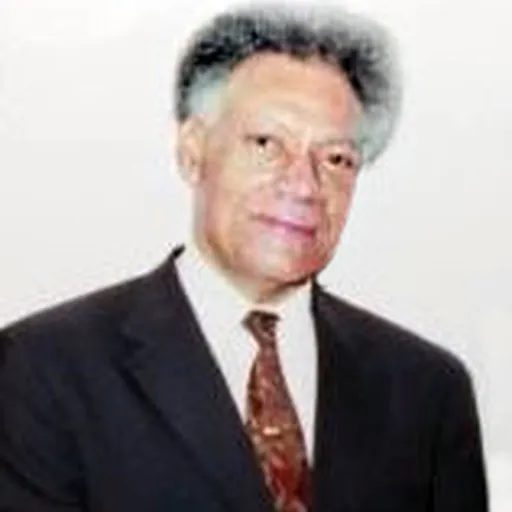
About Ivan van Sertima
Lived 1935 – 2009 (aged 74). Ivan van Sertima was a British anthropologist, historian, linguist, university teacher and journalist, known for Pre-Columbian Africa-Americas contact theories.
Ivan Gladstone Van Sertima (26 January 1935 – 25 May 2009) was a Guyanese-born British associate professor of Africana Studies at Rutgers University in the United States.
He was best known for his Olmec alternative origin speculations, a brand of pre-Columbian contact theory, which he proposed in his book They Came Before Columbus (1976). While his Olmec theory has "spread widely in African American community, both lay and scholarly", it was mostly ignored in Mesoamericanist scholarship, and has been called Afrocentric pseudoarchaeology and pseudohistory to the effect of "robbing native American cultures". ("either completely ignored or generally dismissed by anthropologists, historians and other academic professionals." Haslip-Vierra, de Montellano and Barbour.)
From 1957 to 1959, Van Sertima worked as a Press and Broadcasting Officer in the Guyana Information Services. During the 1960s, he worked for several years in Great Britain as a journalist, doing weekly broadcasts to the Caribbean and Africa. Van Sertima married Maria Nagy in 1964; they adopted two sons, Larry and Michael.
In doing field work in Africa, he compiled a dictionary of Swahili legal terms in 1967. In 1970 Van Sertima immigrated to the United States, where he entered Rutgers University in New Brunswick, New Jersey, for graduate work.
After divorcing his first wife, Van Sertima remarried in 1984, to Jacqueline L. Patten, who had two daughters.
Published work He published his They Came Before Columbus in 1976, as a Rutgers graduate student. The book deals mostly with his arguments for an African origin of Mesoamerican culture in the Western Hemisphere. Published by Random House rather than an academic press, They Came Before Columbus was a best-seller and achieved widespread attention within the African-American community for his claims of prehistoric African contact and diffusion of culture in Central and South America. It was generally "ignored or dismissed" by academic experts at the time and strongly criticised in detail in an academic journal, Current Anthropology, in 1997. He became associate professor of African Studies at Rutgers in the Department of Africana Studies in 1979.
He published several annual compilations, volumes of the journal dealing with various topics of African history. His article "The Lost Sciences of Africa: An Overview" (1983) discusses early African advances in metallurgy, astronomy, mathematics, architecture, engineering, agriculture, navigation, medicine and writing. He posited that higher learning, in Africa as elsewhere, was the preserve of elites in the centres of civilisations, rendering them vulnerable in the event of the destruction of those centres and the loss of such knowledge. Van Sertima also discussed African scientific contributions in an essay for the volume African Renaissance, published in 1999 (he had first published the essay in 1983).
They Came Before Columbus: The African Presence in Ancient America (1976) In this book, Ivan Van Sertima explores his theory that Africans made landfall and had significant influence on the native peoples of Mesoamerica, primarily the Olmec civilization. His work has been rejected as pseudoscience or pseudoarchaeology. This work was published by Random House and did not go through a peer review process.
Van Sertima reached larger audiences through chapters narrated by figures of the past, including Christopher Columbus and the Mali king Abu Bakr II. In doing this, primary source anecdotes are often the evidence cited by Van Sertima combined with inference and exaggeration, though he implies to his readers that the narrative is based in fact. In Chapter 5, called "Among the Quetzalcoatls", Van Sertima narrates the arrival of Abu Bakr II to an Aztec civilization in Mexico in 1311, describing the Mali king as "a true child of the sun burned dark by its rays" in direct and explicit comparison to the Aztec "sun god" Quetzalcoatl, as Van Sertima writes. This interaction is not rooted in historical evidence and Van Sertima does not offer a cited source to back up his narrative. This is one of many examples of Van Sertima's theories that Mesoamerican mythologies are based on Pre-Columbian African contact theories.
Between narrative chapters, Van Sertima develops his main claims about African contact with the Americas in an essay style and includes images of artifacts, which primarily consist of photographs of ceramic heads that Van Sertima says have African features. Van Sertima also includes photos of an African man and woman for comparison, but he does not include pictures of inhabitants of the area where the artifacts were found. Van Sertima focuses specifically on the Olmec colossal heads, saying that the characteristics of the stone faces are "indisputably" African, while Mesoamerican experts such as Richard Diehl disregards this claim, as the statues are stylized and generally accepted as representing native Mesoamericans.
Van Sertima argues that African contact likely happened more than once. In Chapter Four, "Africans Across the Sea", Van Sertima explores numerous ways that he claims Africans could have travelled by boat to South and Central America. Van Sertima writes about shipping technology, saying that even the most ancient of Egyptian ships were sturdy enough to cross the Atlantic on the currents that run from northwest Africa to the Americas. who describe his claims to be ill-founded and false. Van Sertima's Journal of African Civilizations was not considered for inclusion in Journals of the Century. In 1997 academics in an article in the journal Current Anthropology criticised in detail many elements of They Came Before Columbus (1976). Except for a brief mention, the book had not previously been reviewed in an academic journal. The researchers wrote a systematic rebuttal of Van Sertima's claims, stating that Van Sertima's "proposal was without foundation" in claiming African diffusion as responsible for prehistoric Olmec culture (in present-day Mexico). They noted that no "genuine African artifact had been found in a controlled archaeological excavation in the New World." They noted that Olmec stone heads were carved hundreds of years prior to the claimed contact and only superficially appear to be African; the Nubians whom Van Sertima had claimed as their originators do not resemble these "portraits".
In a New York Times 1977 review of Van Sertima's 1976 book They Came Before Columbus, the archaeologist Glyn Daniel labelled Van Sertima's work as "ignorant rubbish", and concluded that the works of Van Sertima, and Barry Fell, whom he was also reviewing, "give us badly argued theories based on fantasies".
In 1981 Dean R. Snow, a professor of anthropology, wrote that Van Sertima "uses the now familiar technique of stringing together bits of carefully selected evidence, each surgically removed from the context that would give it a rational explanation". Snow continued, "The findings of professional archaeologists and physical anthropologists are misrepresented so that they seem to support the [Van Sertima] hypothesis".
In 1981, They Came Before Columbus received the "Clarence L. Holte Literary Prize". Sertima was inducted into the "Rutgers African-American Alumni Hall of Fame" in 2004. His widow, Jacqueline Van Sertima, said she would continue to publish the Journal of African Civilizations and that she planned to publish a book of his poetry.
Don’t just read it —
keep it.
Full-length biographies made to live with: read them, listen on the way to work, watch them tonight.
- E-book
- Audio
- Video
Instant download · yours to keep · every purchase keeps this site free
Important facts
People in Ivan van Sertima's life
Named in this biography and alive at the same time

Related people
Same field, nearest in time



Contemporaries
People whose lives overlapped Ivan van Sertima's



Frequently asked questions
Who was Ivan van Sertima?
British Africanist in New Jersey
When was Ivan van Sertima born?
Ivan van Sertima was born on 26 January 1935 in Guyana.
When did Ivan van Sertima die?
Ivan van Sertima died on 25 May 2009 in Highland Park.
What was Ivan van Sertima's occupation?
Ivan van Sertima was an anthropologist, historian, linguist, university teacher and journalist.
What was Ivan van Sertima known for?
Ivan van Sertima was known for Pre-Columbian Africa-Americas contact theories.
What nationality was Ivan van Sertima?
Ivan van Sertima was British.
Sources & further reading
Cite this page
APA: Biography.guide. (2026). Ivan van Sertima. https://biography.guide/ivan-van-sertima/
MLA: "Ivan van Sertima." Biography.guide, https://biography.guide/ivan-van-sertima/.
Chicago: "Ivan van Sertima." Biography.guide. https://biography.guide/ivan-van-sertima/.
Data last updated: 2026-09-23 · Spot an error? Report a correction.
Portrait: Wikimedia Commons · author & licence
Page generated 2026-09-27 05:05 UTC