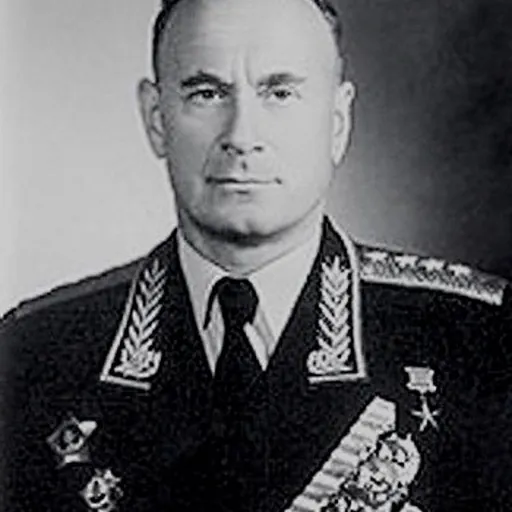
About Ivan Serov
Lived 1905 – 1990 (aged 84). Ivan Serov was a Russian military personnel, politician and intelligence officer.
Ivan Alexandrovich Serov (; 13 August 1905 – 1 July 1990) was a Soviet intelligence officer who served as Chairman of the KGB from March 1954 to December 1958 and Director of the GRU from December 1958 to February 1963. Serov was NKVD Commissar of the Ukrainian SSR from 1939 to 1941 and Deputy Commissar of the NKVD under Lavrentiy Beria from 1941 to 1954.
Serov was active in organising NKVD activities against anti-Soviet forces during the Soviet Invasion of Poland and World War II, including the Katyn massacre. Serov issued the Serov Instructions and helped organise the mass deportations of people from Poland, Baltic states and the Caucasus. Serov helped establish secret police forces in the Eastern Bloc after the war and played an important role in suppressing the Hungarian Revolution of 1956. In 1923, when he was 18 years old, Serov joined the Red Army shortly after the end of the Russian Civil War. In 1926, he became a member of the All-Union Communist Party (Bolsheviks), and in 1928 graduated from the Artillery Officers' School of Leningrad. A major step in his career as a Red Army officer was his attendance in the mid-1930s of Higher Academic Courses in the prestigious Frunze Military Academy. He married during these years and had two children: a son, Vladimir, who became an engineering officer in the USSR Air Force followed by a daughter, Svetlana.
Commissar of Ukraine In 1939, Serov joined the People's Commissariat for Internal Affairs (NKVD), the main security agency and secret police of the Soviet Union. He was appointed to the high-ranking position of NKVD Commissar of the Ukrainian SSR in 1940. As well as performing his duties in this post, Serov was also responsible for the co-ordination of deportation from the Baltic States and Poland.
In 1956, an article in Time magazine accused Serov of being responsible for the death of "hundreds of thousands of Ukrainian peasants" during this period. Serov was also a colleague in Ukraine of Nikita Khrushchev, the local Head of State.
Deputy Commissar of the NKVD In 1941, Serov was promoted to Deputy Commissar of the NKVD as a whole, becoming one of the primary lieutenants of NKVD chief Lavrentiy Beria. In this function, Serov was responsible for the mass deportation of a variety of Caucasian peoples, including the deportation of the Chechens. He issued the so-called Serov Instructions, which detailed procedures for mass deportations from the Baltic States, which was for some time confused with the NKVD Order No. 001223 by historians. He also coordinated the mass expulsion of Crimean Tatars from the Crimean ASSR at the end of World War II. Viktor Suvorov claims that in 1946, Serov had oversight of the execution of Andrey Vlasov and the rest of the command of the Russian Liberation Army, an organisation that had co-operated with the Nazis in World War II. Serov was also there to monitor and spy on Marshal Georgy Zhukov (of whom Stalin was personally suspicious) while acting as his political advisor.
Chairman of the KGB After the death of Joseph Stalin in March 1953, Serov was one of the few senior members of the political police to survive the wave of demotions and forced retirements of Stalinist officials. Serov, who had Beria's trust, betrayed him when he conspired with officers of GRU to avoid his own downfall.
In March 1954, Serov was appointed Chairman of the KGB, making him head of the greater part of the Soviet secret police. Serov organised security for the tours of Nikolai Bulganin and Nikita Khrushchev in the United Kingdom, where he was decried and vilified by the British media as "Ivan the Terrible" and "the Butcher". Afterwards, Serov became the first Chairman of the KGB and was considered a reliable ally of Khrushchev. Serov provided vital support for Khrushchev against the Anti-Party Group in 1957.
Hungary Serov played a key role in the suppression of the Hungarian Revolution of 1956 which attempted to overthrow the Soviet-backed Hungarian People's Republic. Serov was active in Hungary, sending reports to the Kremlin from Budapest, and escorting visiting Soviet Presidium leaders Anastas Mikoyan and Mikhail Suslov via an armoured personnel carrier into Budapest on 24 October, as there was too much shooting in the streets. Serov organised the deportation of Hungarian revolutionaries, including Nagy, and also tried stopping The Workers' Council of Budapest from negotiating for the return of deportees and political rights, using Soviet troops to prevent the council from meeting in the city's Sports Hall.
Awards and decorations Soviet Union
jubilee medals SOURCE:
Foreign
Serov's award of the Gold's Cross of the Virtuti Militari was posthumously deprived in 1995 by the decision of the President of Poland Lech Wałęsa.
Personality In MI5 files about Serov, British agents who had met him called him "something of a ladies' man," good mannered, carefully dressed and a moderate drinker. He displayed a considerable familiarity with detective fiction such as Sherlock Holmes. His sense of humour was somewhat heavy, and his jokes were broadly sarcastic and, on occasion, strongly anti-Semitic.
According to historian Asif Azam Siddiqi, Serov was "almost as feared as his boss, Lavrentii Beria" and was known for his "historic disdain for non-Russians." He was labelled by British media as a "Russian version of Himmler".
In the MI5 reports, Serov was described as "a capable organiser with a cunning mind".
Significance Serov, although generally considered less significant than Beria in modern literature, helped to bring Stalinism to Europe and to Stalinise the Soviet Union. Serov's consolidation of Soviet power in Eastern Europe was helped by his organisation of both the Urząd Bezpieczeństwa (Polish Intelligence Service) in Poland and the Stasi in East Germany.
Cultural references Serov makes a brief appearance at the beginning of Ian Fleming's 1957 James Bond novel From Russia, With Love. Fleming writes that he "was in every respect a bigger man than Beria" and that "he, with Bulganin and Khrushchev, now ruled Russia. One day, he might even stand on the peak, alone." Although his appearance was written out of the film adaptation of the same name, Serov would later coincidentally be portrayed by Die Another Day cast member Mikhail Gorevoy in the 2006 BBC docudrama series Space Race.
Serov also briefly features in the 1950s novel Berlin by the German anti-Nazi writer Theodor Plievier, who lived in the USSR throughout the Hitler years. Plievier says Serov was nicknamed chramoi (which he translates as "Old Cripple Foot", , 'lame', 'limping'), a reference to a supposed deformity (presumably a club foot).
Don’t just read it —
keep it.
Full-length biographies made to live with: read them, listen on the way to work, watch them tonight.
- E-book
- Audio
- Video
Instant download · yours to keep · every purchase keeps this site free
Important facts
People in Ivan Serov's life
Named in this biography and alive at the same time




Related people
Same field, nearest in time


Contemporaries
People whose lives overlapped Ivan Serov's




Frequently asked questions
Who was Ivan Serov?
KGB officer (1905-1990)
When was Ivan Serov born?
Ivan Serov was born on 12 August 1905 in Vologda.
When did Ivan Serov die?
Ivan Serov died on 1 July 1990 in Moscow.
What was Ivan Serov's occupation?
Ivan Serov was a military personnel, politician and intelligence officer.
What nationality was Ivan Serov?
Ivan Serov was Russian.
Sources & further reading
Cite this page
APA: Biography.guide. (2026). Ivan Serov. https://biography.guide/ivan-serov/
MLA: "Ivan Serov." Biography.guide, https://biography.guide/ivan-serov/.
Chicago: "Ivan Serov." Biography.guide. https://biography.guide/ivan-serov/.
Data last updated: 2026-09-20 · Spot an error? Report a correction.
Portrait: Wikimedia Commons · author & licence
Page generated 2026-09-27 04:58 UTC