
About Ivan Bagramyan
Lived 1897 – 1982 (aged 84). Ivan Bagramyan was a Russian politician, military officer and colonel.
Ivan Khristoforovich Bagramyan, born Hovhannes Baghramyan ( – 21 September 1982), was a Soviet military commander of Armenian origin who held the rank of Marshal of the Soviet Union. As commander of the 1st Baltic Front, he orchestrated the offensives which pushed German forces out of the Baltic countries on the Eastern Front of World War II.
Bagramyan was the second non-Slavic military officer, after Latvian Max Reyter, to become a commander of a front. He was among several high-ranking Armenian officers serving in the Soviet Army during the war. Bagramyan's experience in military planning as a chief of staff allowed him to distinguish himself as a capable commander in the early stages of the Soviet counter-offensives against Nazi Germany. He was given his first command of a unit in 1942, and in November 1943 received his most prestigious command as the commander of the 1st Baltic Front.
He did not immediately join the Communist Party after the consolidation of the October Revolution, becoming a member only in 1941, and continues to hold such esteemed status among Armenians and Russians today.
Early life Ivan Khristoforovich Bagramyan was born on in Yelizavetpol, a city then part of the Russian Empire and now part of Azerbaijan. His parents, Mariam and Khachatur Bagramyan, were ethnic Armenians originally from the village of Chardakhlu. Bagramyan's paternal grandfather came from the village of Koti. While Bagramyan's father went to work all day at the local railway station, his mother stayed at home to take care of her seven children. Bagramyan's parents decided to enroll him at a recently opened local two-year school because they could not afford to send him to the local gymnasium.
Graduating in 1912, Bagramyan, whom everyone affectionately called Vanya, followed his father and his brothers in a path in rail work, attending the three-year railway technical institute located in Tiflis. He graduated with honors and was slated to become a railway engineer within a few years when events in World War I changed his life.
World War I
Bagramyan was well aware of the military situation at the Caucasus front during the first months of the world war. In the winter of 1914–15, the Imperial Russian Army was able to withstand and repel the Ottoman offensive aimed at capturing Sarikamish. Bagramyan also began reading harrowing reports in the Russian press of what was taking place against his fellow kinsmen across the border: the Committee of Union and Progress-led government had embarked on a campaign to carry out a genocide of the Ottoman Armenians. He desperately sought to join the military effort but because he was only seventeen and a railway mechanic, he was not subject to conscription. This did not dissuade him from trying, as he later remarked, "My place is at the front."
His opportunity came on 16 September 1915, when he was accepted as a volunteer in the Russian army. He was assigned to the 116th Reserve Battalion and sent to Akhaltsikhe for basic training. With his training complete in December, he joined the 2nd Caucasian Border Regiment of the Russian Caucasus Army, which was sent to dislodge the Ottomans in Persia. Bagramyan participated in battles in Asadabad, Hamedan and Kermanshah, the Russian victories here sending Ottoman forces reeling toward Anatolia.
Learning about the exploits of the men in the outfit, the chief of staff of the regiment, General Pavel Melik-Shahnazarian, advised Bagramyan to return to Tiflis to enroll in the Praporshchik Military Academy. But in order to attend the school, Bagramyan needed to satisfy the academy's requirement of having completed school at a gymnasium. This did not deter him and, after preparing for the courses in Armavir, he passed his exams and began attending the academy on 13 February 1917. He graduated in June 1917
With the creation of the newly established First Republic of Armenia in 1918, Bagramyan enlisted in the newly formed 3rd Regiment.
Interwar years
Three years after the toppling of the Provisional Government by the Bolsheviks in October 1917, the Red Army invaded the southern Caucasus republics of Azerbaijan, Georgia and Armenia. In May 1920, Bagramyan, upset with the country's social and political conditions, participated in the failed May Uprising against the Dashnak-led government of Armenia. He was jailed and sent to work in the fields for several months but was allowed to rejoin the military with the outbreak of the Turkish invasion of Armenia. By December 1920, Armenia was Sovietized and the national army was subsequently disbanded. Bagramyan, however, chose to join the 11th Soviet Army and was appointed a cavalry regiment commander.
As life in Armenia grew relatively more stable under Soviet rule, Bagramyan sought to locate a woman he had met several years earlier, Tamara Hamayakovna. Tamara, who was at this time living in Nakhichevan with her family, had been married to an Armenian officer who had been killed during the Turkish invasion, leaving her with their one-year-old son, Movses. Bagramyan visited her and the two decided to get married at the end of 1922. In addition to their son Movses, who went on to become a painter, they had a daughter, Margarit, who later became a doctor. Tamara remained at Bagramyan's side until her death in 1973.
In 1923, Bagramyan was appointed commander of the Alexandropol Cavalry Regiment, a position he held until 1931. Two years later, Bagramyan graduated from the Leningrad Cavalry School and, in 1934, from the Frunze Military Academy. Grigorenko advised that he appeal the arrest warrant, which Bagramyan reluctantly did. From 1934 to 1936, Bagramyan served as the chief of staff of the 5th Cavalry Division, and from 1938, he worked as a senior instructor and lecturer at the Military Academy of the Soviet General Staff even as Stalin purged the senior Soviet officer corps. While fellow students from the military academy, Andrei Yeremenko and Georgy Zhukov, had seen their careers rise, Bagramyan's had remained stagnant.
In 1940, when General Zhukov was promoted to commander of the Kiev Military District in the Ukrainian SSR, Bagramyan wrote a letter asking to serve under his command. Zhukov agreed, and in December asked for his help writing a paper to be presented to the commanders of the Soviet Military Districts. Bagramyan's paper, "Conducting a Contemporary Offensive Operation," apparently impressed Zhukov, as he promoted Bagramyan to become the head of operations for the Soviet 12th Army based in Ukraine.
World War II
Ukraine In June 1941, Nazi Germany invaded the Soviet Union. Unlike many of the border troops who were caught off guard by the offensive, Bagramyan and his commander, General Mikhail Kirponos, believed an invasion by Germany was inevitable. However, Kirponos chose to ignore Bagramyan's belief that the German offensive would employ the Blitzkrieg-like tactics like those seen in the campaigns in Poland in 1939 and western Europe in 1940. Since the winter of 1939–40, Bagramyan had been busy devising a battle plan that would counter threats from the direction of western Ukraine, which was approved after numerous revisions on 10 May 1940.
On the morning of 22 June, he was tasked with overseeing a transfer of a military convoy to Ternopol. While his column was passing the Soviet airfields near the city of Brody, German air strikes hit the aircraft on the ground. Several hours later, they arrived in Ternopol, having been strafed twice by the planes. Three days after the invasion, the plans for the counter-offensive were implemented, but disorder engulfed the troops, and the counter-attack collapsed. Bagramyan took part in the great tank battles in western Ukraine and the defensive operation around Kiev, in which Kirponos was killed and the entire Front captured by the Germans. He was one of a handful of senior officers who escaped from the encircled Front.
Bagramyan was then appointed chief of staff to Marshal Semyon Timoshenko and along with future Soviet premier Nikita Khrushchev, then a political officer, coordinated the fighting around Rostov.
Khrushchev went on to detail an account where Marshal Semyon Budyonny, sent by the chief of the operations department from Moscow as a representative of Stavka, arrived in Kiev to preside over Bagramyan's court-martial. Bagramyan protested vigorously and said that if his competence was in question, then he should instead be given a field unit to command. To Bagramyan's incredulity, Budyonny went on to attempt to convince him to agree to his execution. Khrushchev remarked that the argument was sparked arbitrarily and had taken place after an "abundant feast with cognac" and that "in those days we didn't take that kind of conversation seriously." According to him, at the time, however, the Soviet military was especially suspicious of the men in its ranks, itself judging that there were "enemies of the people...everywhere, especially the Red Army."
Bagramyan was instrumental in the planning of two Soviet counter-offensives against the Germans, including the major push made by Soviet forces in December during the Battle of Moscow
While Soviet forces were initially successful in recapturing Kharkov, they found themselves trapped by the German Army after the closing of Barvenkovo. On 18 May, Bagramyan asked Timoshenko to alter the plans but Timoshenko along with Stalin refused to approve his request. Soviet losses were heavy as the 6th, 9th and 57th armies (approximately 18–20 divisions) comprising a large portion of the Southwestern Front, were all destroyed and Bagramyan was removed from his post on 28 June by Stavka. According to Khrushchev, Bagramyan was so devastated by the immense loss of men that after the operation was called off: "he burst into tears. His nerves cracked...He was weeping for our army." Held responsible for the failure of the operation and "poor staff work", he was demoted to chief of staff of the Soviet 28th Army. Several days later, he wrote a letter to Stalin asking to "serve at the front at any capacity, however modest." British military historian John Erickson contends that Bagramyan was unfairly scapegoated by Stalin in his attempts to "hunt for [the] culprits" of the mismanagement of operations. Zhukov, with the approval of Stavka, appointed him commander of the 16th Army (2nd formation), (July 1942 – April 1943) replacing its former commander, Konstantin Rokossovsky who had been sent to command the Bryansk Front. The 16th Army transferred its troops to the 5th Army, and its command and staff were moved to the second echelon of the Western Front where the Army took up command of part of the 10th Army's troops, and its defensive positions. On 11 August, however, German forces mounted a surprise offensive on the southern flank of Western Front, splitting the 61st Army from the 16th Army which was not taking part in the Rzhev-Sychevka Offensive operation. The German forces threatened Bagramyan's left flank as he quickly moved his forces to counter their movements and halted them from advancing further on 9 September.
Kursk As the battle of Stalingrad marked the turning point of the war, German forces reorganized for a new offensive in the summer of 1943 to attack the Soviet held Kursk salient in Russia. The German High Command was to deploy veteran units to destroy the salient, including the Ninth Army and the II SS Panzer Corps. Stavka, already informed of the impending offensive, called for an advance toward the German defenses positioned near the town of Kozelsk, which would drive south with the help of the armies of the Central Front. The forces would then proceed to cut off a gap that would effectively surround the Germans and cut it off from reinforcements. This was similar to Operation Uranus, where the Soviet Army encircled and trapped the Sixth Army in Stalingrad.
Bagramyan's 11th Guards Army (the renamed 16th Army) was tasked to take part in the offensive and was given an additional three infantry divisions and two tank corps, a force composed of fifteen divisions. Bagramyan, however, argued to Stavka that its planning was too audacious in the hopes of repeating a successful encirclement like that in Uranus. He claimed that his forces would be overstretched and would have difficulty in attacking the entrenched German positions in Bolkhov. To avoid a repetition of the failure in Kharkov the previous year, he instead asked that the 61st Army from the Bryansk Front aid his 11th Guards in destroying the German forces in Bolkhov, thus eliminating the Ninth Army's protection from the north. Stalin, however, felt it necessary to further wear thin the fighting abilities of the German forces and delayed the offensive.
Ultimately, it was the Germans who took the initiative by launching Operation Citadel on 5 July in the area around Kursk. German losses were initially heavy due to Soviet defensive preparations. Taking advantage of this, on 12 July, Bagramyan's forces commenced their offensive, codenamed Operation Kutuzov, and quickly breached the German defenses, advancing a distance of by 18 July. By 28 July, the operation concluded successfully and he was promoted to the rank of Colonel-General. In the following month, his forces took part in the large-scale tank offensives which routed the German assaults and forced Germany to remain on the defensive for the remainder of the war. enabling them to easily push through entrenched defenses the Germans had spent months preparing. Among the key locations imperative to reach Vitebsk was the small town of Gorodok, which served as a heavily-fortified German communications hub. Despite the strong defenses, Bagramyan was able to utilize his heavy artillery and air support from the Red Air Force in late December to bombard the town and then launched a three-pronged attack, the Gorodok offensive from the ground. With the advance of Soviet forces in the Baltic and Ukraine, German Army Group Center had largely been isolated as Stavka prepared to eliminate the pocket (consisting of Third Panzer, Second, Fourth, and Ninth Armies). Stavka's plan, codenamed Operation Bagration was kept secret from all of the involved Front commanders. Bagramyan himself was only informed in May 1944 of his role in the offensive.
Although Bagramyan found it acceptable to sustain heavy casualties (as did all the commanders of the Red Army), he was disturbed with the immense loss of life sustained by his forces. He attempted to reduce those levels primarily by maintaining the element of surprise in operations. In his preparations for Bagration, he planned for the 43rd Army to move through the more geographically difficult swamps and marshlands to Army Group North's right flank. This maneuver would thus take North by surprise since it expected the Soviet offensive to move through more suitable terrain. He proved correct, as in early June 1944, the 43rd achieved success in its attack. Commander of the 43rd Army, General Afanasy Beloborodov, wrote that during the offensive they apprehended a German general who stated that German forces had been blindsided by the attacking forces. For his achievements, on 7 July he was decorated with the title of Hero of the Soviet Union. Vasilevsky in turn, took it upon his own initiative and gave Bagramyan the go ahead. However, with the loss of 4th Shock Army, Bagramyan was left shortchanged since his promised 39th Army had not only not arrived but was composed of only seven divisions (in comparison to 4th Shock's ten). Feeling that time was being lost, he pressed on with the units he had.
By 9 July, his ground forces had made significant gains in cutting off a vital road that connected Kaunas to Daugavpils. Taking advantage of this, Bagramyan worked with other Front commanders to attack the rear guard of Army Group Center but poor coordination between the units led a stall in the advance. At this time, Bagramyan realized that German forces were most probably not going to easily retreat from the Baltics and so further advances towards Kaunas would be pointless. He proposed to Stavka to launch a full-scale offensive towards Riga but the former rejected his plans, stating that the armies of Second and Third Baltic Fronts would have already pushed Army Group Center to Prussia by the time of the offensive. He attempted to convince them otherwise, citing the numerically deficient forces in the two Fronts, but was rebuffed and ordered to drive towards a road connecting the Lithuanian city of Šiauliai to Riga, resulting in its capture in late July.
With its capture, he persuaded Vasilevsky to allow his forces to move towards Riga, receiving a formal go-ahead by Stavka in a directive on 29 July. On 30 July, his forces finally reached the seaside city of Tukums, near the Bay of Riga,
Bagramyan retired on 25 April 1968, and was transferred to the post of General Inspector in the Group of Inspectors General of the Ministry of Defence of the USSR.
In 1979, another book of Bagramyan titled My Memoirs was published and was based on the first and second volumes. A large portion of the book was dedicated to the Armenian issues including the territories of Western Armenia, massacres of Armenians by the Ottoman Empire and the Armenian Genocide, the Ottoman invasion of Armenia and the Battle of Sardarapat, as well as other topics.
Marshal Bagramyan was awarded numerous Soviet and foreign orders and medals for his service, including two Orders of the Hero of the Soviet Union, seven Orders of Lenin, the Order of the October Revolution, three Orders of the Red Banner, two Orders of Suvorov and the Order of Kutuzov. Among the other commendations he received were the Polish Polonia Restituta twice and the Medal "For the Victory Over Germany". He was buried with full military honors at the Kremlin Wall Necropolis in Moscow.
Honours and awards Bagramyan's ceremonial jacket. Museum in Yerevan, Khorenatsi st., 22
Foreign
Don’t just read it —
keep it.
Full-length biographies made to live with: read them, listen on the way to work, watch them tonight.
- E-book
- Audio
- Video
Instant download · yours to keep · every purchase keeps this site free
Important facts
People in Ivan Bagramyan's life
Named in this biography and alive at the same time




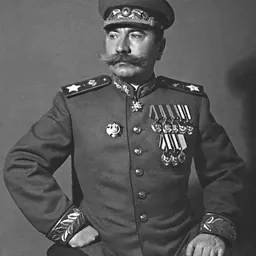
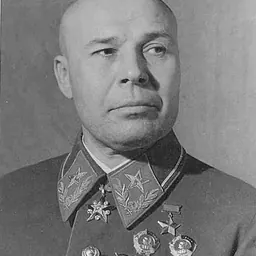
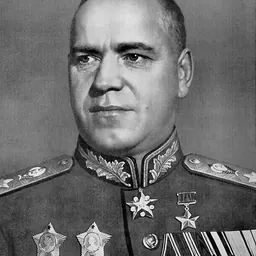
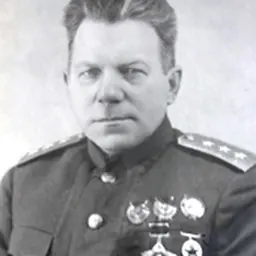
Related people
Same field, nearest in time




Contemporaries
People whose lives overlapped Ivan Bagramyan's


Frequently asked questions
Who was Ivan Bagramyan?
Marshal of the Soviet Union (1897-1982)
When was Ivan Bagramyan born?
Ivan Bagramyan was born on 20 November 1897 in Çardaqlı.
When did Ivan Bagramyan die?
Ivan Bagramyan died on 21 September 1982 in Moscow.
What was Ivan Bagramyan's occupation?
Ivan Bagramyan was a politician, military officer and colonel.
What nationality was Ivan Bagramyan?
Ivan Bagramyan was Russian.
Sources & further reading
Cite this page
APA: Biography.guide. (2026). Ivan Bagramyan. https://biography.guide/ivan-bagramyan/
MLA: "Ivan Bagramyan." Biography.guide, https://biography.guide/ivan-bagramyan/.
Chicago: "Ivan Bagramyan." Biography.guide. https://biography.guide/ivan-bagramyan/.
Data last updated: 2026-09-20 · Spot an error? Report a correction.
Page generated 2026-09-27 05:31 UTC