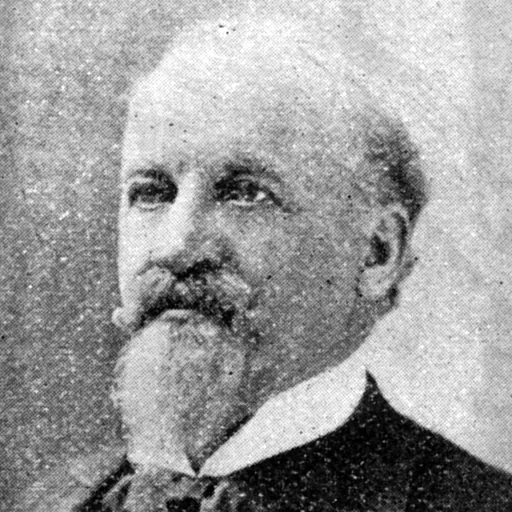
About Isaac P. Gray
Lived 1828 – 1895 (aged 66). Isaac P. Gray was an American diplomat, politician, ambassador, governor and jurist.
Isaac Pusey Gray (October 18, 1828 – February 14, 1895) was the 18th and 20th governor of the U.S. state of Indiana from 1880 to 1881 and from 1885 to 1889. Originally a Republican, he oversaw the forceful passage of the post-American Civil War constitutional amendments while he was a member of the Indiana Senate. He became a Democrat following the corruption of the Administration of Ulysses S. Grant but was regularly stymied by his Democratic adversaries who constantly referred to his tactics while a Republican, earning him the nickname "Sisyphus of the Wabash."
Early life
Family and background Isaac Pusey Gray was born on October 18, 1828, in Chester County, Pennsylvania, the son of John and Hannah Worthington Gray, two Quaker innkeepers. At age eight, his family moved to Urbana, Ohio and in 1842 to New Madison, Ohio. In New Madison, Gray first attended common school and obtained some formal education. After school he became a clerk in a dry-goods store, and later became the owner of the store after purchasing it from his former boss. He married Eliza Jaqua on September 8, 1850, and the couple had four sons. Two of them died in infancy, but the other two grew up to become lawyers.
Gray and his family moved to Union City, Indiana in 1855 where he opened a new store. He soon became involved in local politics and became prominent in his community. He began to study law on his own in his spare time and was admitted to the bar in 1861. He later said that he studied law to further his political career, which was very important in Indiana politics at that time.
When Morgan's Raid into Indiana in July 1863 occurred, Gray was given command of a regiment of the Indiana Legion to help repel the invasion. His unit was disbanded after about a week, once Morgan was forced to flee the state. Gray remained in the militia after the raid, taking a command role in his region, but saw no action. After the war he returned to his law practice.
Governor of Indiana Lieutenant governor In 1876, Gray was nominated to run for Lieutenant Governor of Indiana on the ticket with James D. Williams in hope of gaining the vote of disaffected Republicans. The ploy worked, and they won the election. Despite the success, he was disliked by a large number of Democrats, who recalled his treatment of them in the Senate. When he sought the nomination for governor in the 1880 convention, he was overwhelmingly defeated, but nominated to run again as Lieutenant Governor, this time with Franklin Landers. Only a month later, Governor Williams died and Gray was elevated to his position.
Governor Gray's campaigned focused primarily on the issues of the day, his position on currency and inflation. Gray was elected governor for his own four-year term in 1884. During his term he oversaw the redistricting of the entire state for the Indiana General Assembly elections. He was widely criticized by the minority party for creating gerrymandered districts to weaken their electoral base. All of the redistricting was eventually overturned by the state supreme court.
His term was marked by what came to be called the Black Day of the General Assembly. The assembly was split with Democrats controlling the Senate 31–19, while the House of Representatives was split 52–44–4, with Republicans holding the majority, and Greenbacks holding four seats. In a joint session, it would split the vote 75 Democrat, 71 Republican, with the 4 Greenbacks holding the deciding votes. Knowing that he could probably sway one of the Greenbacks to vote for his bid for the United States Senate, Gray began to attempt to have his name entered as a candidate. Some Democratic leaders were still upset over his actions while he was a Republican, and decided to do whatever it took to prevent him from going any higher in office.
The situation continued to escalate as a superior court ruled that neither Alonzo or Robertson should be seated until situation was resolved. They then forwarded the case to the Indiana Supreme Court who ruled in favor of Robertson. On the morning of February 24, Robertson entered the Senate chamber to take his seat, but as soon as he walked through the door, he was attacked by several Democratic senators who rushed him and beat him to the floor. The Senate leader ordered him removed from the chamber by guards, who then locked him out. The Republicans immediately went wild, attacking their nearest Democrat. The fight continued for several minutes until one Democrat pulled a gun and fired it into the ceiling threatening to start killing Republicans, ending the fight but making the rest of the building aware of it. The brawl soon spread to the House of Representatives and throughout the building as Republicans began to attack Democrats. Unlike the Senate, the rest of the building had a strong Republican majority, and the Democrats were soon overwhelmed. Six-hundred Republicans then beat down the door of the Senate Chamber and dragged out the Democratic senators, threatening to kill them. Gray ordered police and other officials to break up the fight, which ended after nearly a full four hours of fighting.
Barred by the Constitution of Indiana from serving a consecutive term, Gray retired from office and returned to his law practice. He returned to his law practice, and because of all of the situations he found himself in, he gained the derisive nickname "Sisyphus of the Wabash." He was again almost nominated to run for vice president again in 1892, but was defeated again after his opponent ascended the podium to retell the story of his actions in the amendment ratification twenty years earlier. The President of Mexico ordered all the flags flown at half staff in Gray's honor and a full division of the Mexican Army escorted Gray's body back to the border where he was transferred by parcel post to Indianapolis to lie in state. His funeral was held in Union City and was buried in a nearby cemetery.
Electoral history
Don’t just read it —
keep it.
Full-length biographies made to live with: read them, listen on the way to work, watch them tonight.
- E-book
- Audio
- Video
Instant download · yours to keep · every purchase keeps this site free
Important facts
People in Isaac P. Gray's life
Named in this biography and alive at the same time

Related people
Same field, nearest in time



Contemporaries
People whose lives overlapped Isaac P. Gray's




Frequently asked questions
Who was Isaac P. Gray?
American politician (1828-1895)
When was Isaac P. Gray born?
Isaac P. Gray was born on 18 October 1828 in Chester County.
When did Isaac P. Gray die?
Isaac P. Gray died on 14 February 1895 in Mexico City.
What was Isaac P. Gray's occupation?
Isaac P. Gray was a diplomat, politician, ambassador, governor and jurist.
What nationality was Isaac P. Gray?
Isaac P. Gray was American.
Sources & further reading
Cite this page
APA: Biography.guide. (2026). Isaac P. Gray. https://biography.guide/isaac-p-gray/
MLA: "Isaac P. Gray." Biography.guide, https://biography.guide/isaac-p-gray/.
Chicago: "Isaac P. Gray." Biography.guide. https://biography.guide/isaac-p-gray/.
Data last updated: 2026-09-20 · Spot an error? Report a correction.
Portrait: Wikimedia Commons · author & licence
Page generated 2026-09-27 04:58 UTC