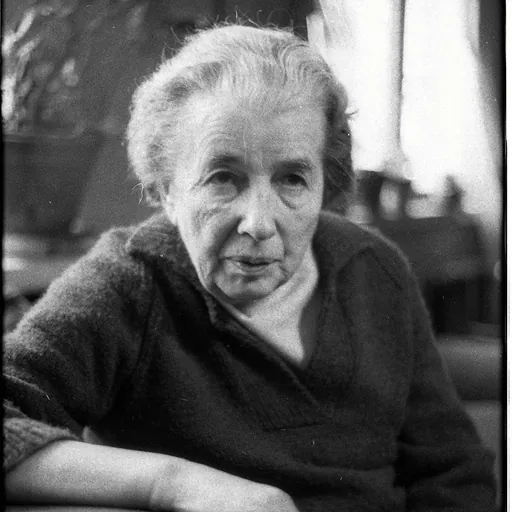
About Irena Białówna
Lived 1900 – 1982 (aged 81). Irena Białówna was a Polish politician, physician and social worker.
Irena Białówna (3 November 1900 – 7 February 1982) was a Polish pediatrician, public health professional, concentration camp survivor, and member of the Polish parliament.
The family home offered hospitality to many Polish people who were working in Russia. Białówna attended Russian secondary school, but also spoke fluent Polish and was familiar with Polish history and literature.
In 1920 she started studying medicine at the University of Voronezh in Central Russia. After a year she moved with her family to Poland to continue her studies at the Medical University of Warsaw. When she was in her fourth year she was president of the students’ paediatric society attached to the children's clinic directed by Professor Mieczysław Michałowicz. She obtained her diploma in 1927.
She rejected a job offered by the university and instead moved to Białystok. She volunteered at the St. Roche's Hospital, worked as a school doctor and co-organized summer camps for children from poverty-stricken families.
During the Invasion of Poland, she served in the Polish Red Cross. In 1941, she was the head of the Children's Department at the hospital at Fabryczna and Warszawska Streets where, together with Anna Ellert, they provided care for Polish, Jewish and Soviet children lost in the war. At that time Białówna also became active in the Union of Armed Struggle of the Home Army under the pseudonym "Bronka".
Białówna was arrested by the Gestapo on March 12, 1942 for the work she did in the underground resistance movement and taken to the Gestapo seat at 15 Sienkiewicza Street. The investigation lasted five months, after which she was interned at the Białystok central prison where she provided medical aid to fellow prisoners and managed to subdue the outbreak of typhus, with which she also became infected. She was transferred to a prison in Kraków, then to the Auschwitz-Birkenau concentration camp, where, together with other doctors, she was dedicated to supporting interned mothers and their children and forged documentation to protect female prisoners.
Thanks to Białówna's influence the inmates received more blankets and a change of mattresses and sheets. She enhanced the stock of medications; she acquired needles and syringes for injections. Thanks to her efforts the block hygiene increased. The figures show the importance of the changes she and her associates introduced, notwithstanding the short supply of the resources: in the winter of 1943/44 the death rate in the block was about 50 per day, whereas in the winter of 1944/45 there were days when no one died, with over 300 patients in the block.
She was moved to the camp in Ravensbrück, then to Gross-Rosen and finally, to Neubrandenburg.
After the war After the liberation of the camp, she was evacuated to Sweden, but returned to Białystok in September 1945. After the war, on her initiative the State Home for Small Children and the Training Center for Social Paediatrics and Obstetrics were created with UNICEF and Swedish funding, as well as paediatric and newborn departments in multiple Białystok hospitals.
She also ran a private practice, treating children from poor families for free, often supporting them monetarily out of her own pocket. Later, she worked, among others as the head of the children's ward of the Provincial Śniadecki Hospital, where the Department and Clinic of Children's Diseases of the Medical University of Bialystok were established. She founded and acted as first president of the Białystok Branch of the Polish Paediatric Society. Personal life and death Białówna died in Białystok on 7 February 1982.
Legacy In 1990 the City Council of Białystok named a street in her honour.
Don’t just read it —
keep it.
Full-length biographies made to live with: read them, listen on the way to work, watch them tonight.
- E-book
- Audio
- Video
Instant download · yours to keep · every purchase keeps this site free
Important facts
People in Irena Białówna's life
Named in this biography and alive at the same time


Related people
Same field, nearest in time






Contemporaries
People whose lives overlapped Irena Białówna's





Frequently asked questions
Who was Irena Białówna?
Polish politician
When was Irena Białówna born?
Irena Białówna was born on 3 November 1900 in Caricyn, USSR.
When did Irena Białówna die?
Irena Białówna died on 7 February 1982 in Białystok, Poland.
What was Irena Białówna's occupation?
Irena Białówna was a politician, physician and social worker.
What nationality was Irena Białówna?
Irena Białówna was Polish.
Sources & further reading
Cite this page
APA: Biography.guide. (2026). Irena Białówna. https://biography.guide/irena-bialowna/
MLA: "Irena Białówna." Biography.guide, https://biography.guide/irena-bialowna/.
Chicago: "Irena Białówna." Biography.guide. https://biography.guide/irena-bialowna/.
Data last updated: 2026-09-22 · Spot an error? Report a correction.
Portrait: Wikimedia Commons · author & licence
Page generated 2026-09-27 05:02 UTC