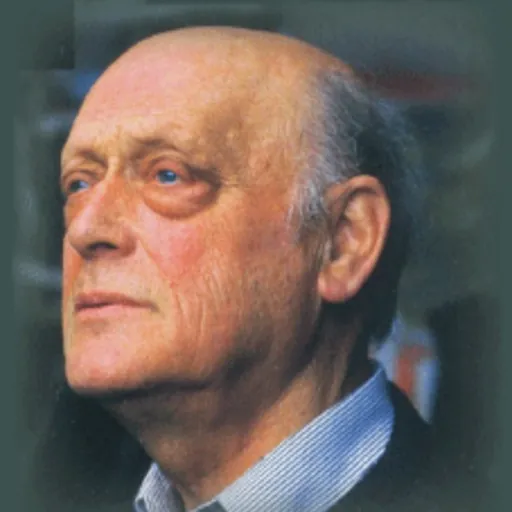
About Ingálvur av Reyni
Lived 1920 – 2005 (aged 84). Ingálvur av Reyni was a Danish painter, postage stamp designer and graphic artist.
Ingálvur av Reyni (18 December 1920 – 26 November 2005) was the most celebrated painter of the Faroe Islands during the last years.
Ingálvur av Reyni was born in Tórshavn. He rebelled through his expressionism against the epic content of his predecessors' art, and has opened up new paths in his painting. His art is characterised by a clear, French colourist tone, and his artistic roots go back to Paul Cézanne and Henri Matisse.
The powerful nature of the Faroes, which makes an immediate visual impact on any painter, is the all-embracing theme in Reyni's art. But he experiences nature from the inside, as structures, tones, and fragments of a universe offering opportunities for graphical treatment of form and movement, light colours and rhythms. The expressions of nature become the basis of an increasingly abstract idiom.
The light fills his landscapes, interiors and figure paintings from the 1940s and 1950s, where he characteristically simplifies the motif in cubist style. The lines and forms of nature contribute to the strict, cubist-inspired composition of the picture, or they are subjected to it. The composition is free of all unnecessary elements, and the work becomes at the same time a picture of both the inner and the outer reality. Increasingly contrasting colours are set against each other, until the culmination at the end of the 1950s with the bold counterplay of complementary colours.
A solo exhibition in Tórshavn in 1961 broke new ground, showing for the first time a directly abstract perception of nature. The paintings had titles such as Kurpali (chaos, disorder) and Sjón í fuglaeyga (view through a bird's eye) This exhibition did not herald an instant conversion to non-figurative art – in the 1960s and well into the 1970s Ingálvur av Reyni treated landscape motifs as never before, although in a highly abstract way, especially the central theme of the village by the sea. His palettes vary from clear, powerful and glowing colours through a delicate greyish, anything but dry spectrum to the deep black register.
A series of works from the 1970s are abstractions of groups of figures and have titles such as girl or people by the sea, as can be seen in a trilogy owned by the art museum. In most recent years Ingálvur av Reyni has chiefly been an abstract painter, if this expression can apply to non-figurative art which is based on nature's own tones and structures. In his strongly painted, usually large and resolute compositions, the work breaks out from the inside. Warm earth tones glow from the deepest layers, sizzle when they touch cold, grey areas, and set light to others. The drama lies in the conflict of the colours and the dynamic movements of the brushstrokes. From time to time the rhythm is further emphasised by scratches made with the handle of the brush in the thick, varnish-like layers of shiny colour. This is tangible painting.
Ingálvur av Reyni was a superb draughtsman. The town with its houses round the harbour, the ships and the boats and the people walking in the streets – especially the older townsfolk – are favourite subjects. He has an impressive ability to capture an expression in a single concentrated stroke. And his many journeys to the cradles of European art have also led to drawings of figures and groups in teeming crowds, or of interiors and street scenes. The drawings show a pronounced artistic sense for sharp characteristics. But even though these drawings in the cases mentioned are more figurative or narrative than the paintings, their themes are still subject to the strict conditions of the line and its enclosing form. On many occasions he has also produced non-figurative drawings.
In 2000 he received the Faroese Cultural Prize (Mentanarheiðursløn Landsins) from the Faroese government.
Reyni died at the age of 84 in 2005 in his hometown Tórshavn.
Gallery of stamps The following Faroese stamps from Postverk Føroya feature Reyni's work:
Don’t just read it —
keep it.
Full-length biographies made to live with: read them, listen on the way to work, watch them tonight.
- E-book
- Audio
- Video
Instant download · yours to keep · every purchase keeps this site free
Important facts
People in Ingálvur av Reyni's life
Named in this biography and alive at the same time

Related people
Same field, nearest in time

Contemporaries
People whose lives overlapped Ingálvur av Reyni's



Frequently asked questions
Who was Ingálvur av Reyni?
Faroese painter (1920-2005)
When was Ingálvur av Reyni born?
Ingálvur av Reyni was born on 18 December 1920 in Tórshavn.
When did Ingálvur av Reyni die?
Ingálvur av Reyni died on 26 November 2005 in Tórshavn.
What was Ingálvur av Reyni's occupation?
Ingálvur av Reyni was a painter, postage stamp designer and graphic artist.
What nationality was Ingálvur av Reyni?
Ingálvur av Reyni was Danish.
Sources & further reading
· Wikipedia: Ingálvur av Reyni
Cite this page
APA: Biography.guide. (2026). Ingálvur av Reyni. https://biography.guide/ingalvur-av-reyni/
MLA: "Ingálvur av Reyni." Biography.guide, https://biography.guide/ingalvur-av-reyni/.
Chicago: "Ingálvur av Reyni." Biography.guide. https://biography.guide/ingalvur-av-reyni/.
Data last updated: 2026-09-22 · Spot an error? Report a correction.
Portrait: Wikimedia Commons · author & licence
Page generated 2026-09-27 05:01 UTC