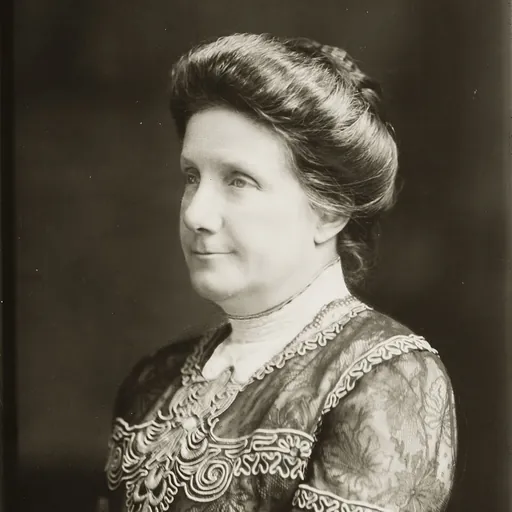
About Infanta María de la Paz of Spain
Lived 1862 – 1946 (aged 84). Infanta María de la Paz of Spain was a Spanish painter.
Infanta María de la Paz of Spain (23 June 1862, Madrid, Spain – 4 December 1946, Munich, Germany) was a Spanish infanta, daughter of Queen Isabella II. She married her cousin Prince Ludwig Ferdinand of Bavaria and lived the rest of her life in Germany, dedicating her time to her family, charity work and writing poetry. She wrote a book of memoirs: Through Four Revolutions: 1862–1933.
Early life Born at the Royal Palace of Madrid on 23 June 1862, Infanta Paz was the third surviving daughter of Queen Isabella II and King Francisco. At age sixteen, Isabella was forced to marry Francisco, her double first cousin. The Queen despised her effeminate husband, and found an outlet for her passionate nature with a string of lovers. The relationship between King Francisco and his reputed children was cold and formal. Isabella II, preoccupied with her turbulent reign and her private life, alternated between periods of great affection towards her children and the distant approach to childhood that was the custom of the time.
According to historians, the true biological father of Infanta Paz was the diplomat and politician Miguel Tenorio de Castilla (1818–1916), who was secretary of Queen Isabella II for several years.
Infanta Paz probably also suspected that Tenorio de Castilla was her natural father. In 1890, in his old age, Tenorio de Castilla settled in a suite on the south wing of Nymphenburg Palace, Paz’s residence. He lived there for twenty-six years until his death on 11 December 1916.
Infanta Paz was baptized by the archbishop of Toledo with the names María de la Paz Juana Amelia Adalberta Francisca de Paula Juana Bautista Isabel Francisca de Asís. Her godmother was her paternal aunt Infanta Amalia of Spain, Princess of Bavaria. In her first years, Infanta Paz was raised alongside her sisters Infantas Pilar and Eulalia in a wing of the Royal Palace of Madrid. In the formal atmosphere of the Spanish court, the little infantas had little contact with their parents.
Queen Isabella II with her three youngest daughters: Eulalia, Paz and Pilar. In 1868, when she was only six years old, Paz and her family were forced to leave Spain by the revolution (the "Glorious Revolution") that cost Queen Isabella II her throne. The royal family was at that time in San Sebastián, and on 30 September 1868, they crossed the border and went to live in exile in France. Isabella II settled in Paris with her children, while King Francisco went to live separately in Épinay. Paz was educated with her sisters Pilar and Eulalia at the Sacré-Coeur, a Catholic school run by nuns. She received her first communion in Rome from Pope Pius IX.
In 1874, Paz’s brother King Alfonso XII was restored to the throne in place of their mother Queen Isabella II. Three years later, Paz returned to Spain with her sisters Pilar and Eulalia. She lived at first in El Escorial with her mother, but later moved to the Alcázar of Seville. When Isabella II returned to live permanently in Paris, Paz and her sisters moved to the Royal Palace of Madrid with their brother King Alfonso XII. The education and care of the three young infantas was placed under the supervision of their eldest sister Infanta Isabel. Paz was particularly close to her sister Pilar, who was only one year older. In 1879, Pilar, who was of delicate health, died suddenly while the sisters were in the small town of Eskoriatza. Paz, who was seventeen at the time, was deeply affected by the death of her sister.
Of Queen Isabella’s five children to survive infancy, Paz was the one who resembled their mother most closely. Paz was short and plain with a small upward nose and a mischievous look in her small eyes. Unlike her sisters Isabel and Eulalia, Paz did not have a strong personality. She was uncomplicated, friendly and accommodating. Romantic and artistic, she was very fond of writing poems and was also a skillful painter. As a child, she studied the history of Spain, and she always remained interested in this subject. In later years, she wrote articles published in the newspaper ABC. She was also musical; she played the harp, and enjoyed songs by Paolo Tosti, as well as the operas of Giuseppe Verdi and Charles Gounod. She was also a devoted Catholic.
Marriage
By the spring of 1880, plans were made to marry Infanta Paz to her first cousin Prince Ludwig Ferdinand of Bavaria. Ludwig Ferdinand’s mother was Infanta Amalia of Spain, a sister of Paz’s father King Francisco, and she was also a first cousin of Queen Isabella. Infanta Amalia wanted to marry her son to Infanta Paz, her goddaughter, and with this in mind, she wrote to her brother and her sister-in-law, who agreed to the project.
Alfonso XII, who had briefly studied at the Ludwig-Maximilians-Universität München with his cousin Prince Ludwig Ferdinand of Bavaria, invited him to Madrid in order to meet Paz. On June 5, 1880, Paz wrote on her diary: "Aunt Amalia of Bavaria (widow of Prince Adalbert) is in Paris with her sons Ludwig and Alphonso and her eldest daughter Isabella. Ludwig is eager to meet me, because he liked my portrait. My brother has invited them all to come to Madrid. The two brothers will arrive in the autumn. I have heard many good things about Ludwig. They say he is serious and polite. He probably believes that I am better looking that I really am because of the portrait. I leave everything in God's hands ... "
When Infanta Paz finally met Ludwig Ferdinand in the autumn of 1880, she found him unattractive and did not wish to marry him. Paz rebuffed the proposed marriage, but Ludwig Ferdinand did not abandon his intentions. In January 1883, Ludwig Ferdinand returned to Spain to ask for Paz's hand in marriage. While walking together in the gardens of La casa de campo on January 22, 1883, he proposed and Paz accepted. She was twenty years old. Among her gifts was the Bavarian sunburst tiara, which remained in the princely family until it was sold at auction in 2013.
Move to Bavaria On their way to Munich, Paz and her husband stopped in Paris and visited King Francisco. who was living in retirement in Épinay. In Bavaria, the couple settled in Nymphenburg Palace outside Munich. Prince Ludwig Ferdinand was not only a cousin of King Ludwig II, but was well liked by him and placed in charge of some the king's financial affairs. In Munich, when Paz met King Ludwig II of Bavaria, they conversed in French, and he gave her a warm welcome. Tragically, Paz's close relationship with the Bavarian ruler ended quickly. King Ludwig II was deposed and died under mysterious circumstances in 1886. He was succeeded by his only brother, Otto, who never truly ruled as king, since he had been declared insane in 1875. Otto's uncle, Prince Luitpold of Bavaria, served as Prince Regent. During the festivities for her arrival at the Bavarian court, Paz met Prince Luitpold, who would serve as Regent of Bavaria until his death in 1912. In Spain, Paz had already met two of Luitpold’s sons: Arnulf and Leopold. The latter was married to Gisela, Archduchess of Austria, daughter of Emperor Francis Joseph; Paz and Gisela became good friends. As with all members of the Bavarian royal family, Paz was related to Luitpold's eldest son Ludwig, who became king of Bavaria in 1913 as Ludwig III. His wife Maria Theresia of Austria-Este was the half-sister of Queen Maria Christina of Spain. Paz also had friends among members of the ducal branch of the Bavarian House of Wittelsbach. Besides following a military career at the highest ranks, he practiced medicine, which he had studied at the Ludwig-Maximilians-Universität München. They surrounded themselves with Spanish artists who visited Bavaria: the composer Tomás Bretón, the violist Pablo Sarasate and the painters Eduardo Rosales and José Moreno Carbonero.
In Munich, Paz dedicated a great deal of her time to charity work. She expanded an asylum for poor children in Neuhausen-Nymphenburg, called Marien-Ludwig-Ferdinand. In 1913, she founded a school in Munich within the grounds of Nymphenburg Palace that came to accommodate 38 students who came from different provinces of Spain. Paz also owned a rural property in Cuenca that she had inherited from her grandmother Queen Maria Cristina and the house of the Dukes of Riánsares in Tarancón, where she used to spend long sojourns enjoying the dry fields of La Mancha. She was buried in the royal crypt in St. Michael's Church in Munich. Her husband survived her by three years.
Author
Infanta Paz wrote the following books: Cuatro revoluciones e intermedios: Setenta años de mi vida. Memorias de la Infanta Paz. Espasa-Calpe, Madrid, 1935. Grand Cross of the Civil Order of Alfonso XII, 16 January 1914
Arms
Ancestry
Don’t just read it —
keep it.
Full-length biographies made to live with: read them, listen on the way to work, watch them tonight.
- E-book
- Audio
- Video
Instant download · yours to keep · every purchase keeps this site free
Important facts
more
María de la Paz de, Infanta de España Borbón, María de la Paz, Infante d'Espagne Marie de la Paz Bourbon, María de la Paz de Borbón, Infanta Maria de la Paz of Spain, Infanta Maria Paz, Maria deFamily & relationships
People in Infanta María de la Paz of Spain's life
Named in this biography and alive at the same time




Related people
Same field, nearest in time
Contemporaries
People whose lives overlapped Infanta María de la Paz of Spain's




Frequently asked questions
Who was Infanta María de la Paz of Spain?
Spanish and Bavarian Royal
When was Infanta María de la Paz of Spain born?
Infanta María de la Paz of Spain was born on 23 June 1862 in Madrid.
When did Infanta María de la Paz of Spain die?
Infanta María de la Paz of Spain died on 4 December 1946 in Munich.
What was Infanta María de la Paz of Spain's occupation?
Infanta María de la Paz of Spain was a painter.
What nationality was Infanta María de la Paz of Spain?
Infanta María de la Paz of Spain was Spanish.
Sources & further reading
· Wikipedia: Infanta María de la Paz of Spain
· DBpedia: Infanta María de la Paz of Spain
Cite this page
APA: Biography.guide. (2026). Infanta María de la Paz of Spain. https://biography.guide/infanta-maria-de-la-paz-of-spain/
MLA: "Infanta María de la Paz of Spain." Biography.guide, https://biography.guide/infanta-maria-de-la-paz-of-spain/.
Chicago: "Infanta María de la Paz of Spain." Biography.guide. https://biography.guide/infanta-maria-de-la-paz-of-spain/.
Data last updated: 2026-09-21 · Spot an error? Report a correction.
Portrait: Wikimedia Commons · author & licence
Page generated 2026-09-27 04:58 UTC