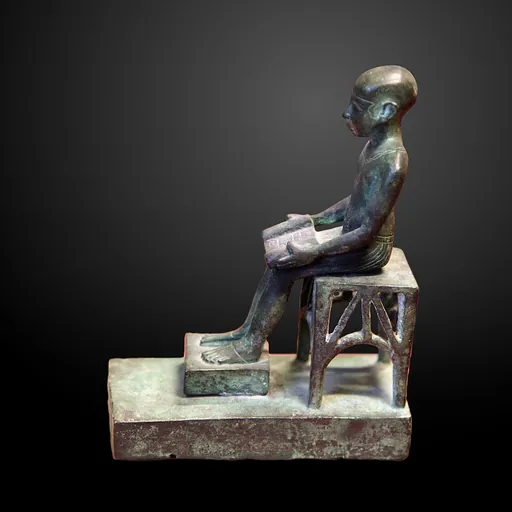
Imhotep
Egyptian architect, physician, astronomer, and god of medicine in ancient Egyptian mythology.
About Imhotep
Lived 2800 BC – 2700 BC. Imhotep was an Egyptian architect, engineer, astronomer, physician, master builder and writer, known for Pyramid of Djoser.
Imhotep (; "(the one who) comes in peace"; ) was an Egyptian chancellor to the King Djoser, possible architect of Djoser's step pyramid, and high priest of the sun god Ra at Heliopolis. Very little is known of Imhotep as a historical figure, but in the 3,000 years following his death, he was gradually glorified and deified.
Traditions from long after Imhotep's death treated him as a great author of wisdom texts and especially as a physician. No extant text from his lifetime mentions these capacities, and none mention his name in the first 1,200 years following his death. The Westcar Papyrus of the Hyksos period, written in classical Middle Egyptian (likely around the 13th Dynasty), contains a story about an official performing a miracle for Djoser, possibly Imhotep. However, this section is badly damaged and no mention of this character's name survived.
Apart from the two short contemporary inscriptions that establish him as chancellor to the Pharaoh, the first surviving text to name Imhotep dates to the time of Amenhotep III . It is addressed to the owner of a tomb and reads:
The wab-priest may give offerings to your ka. The wab-priests may stretch to you their arms with libations on the soil, as it is done for Imhotep with the remains of the water bowl. — Wildung (1977)
The first references to the healing abilities of Imhotep occur from the Thirtieth Dynasty onward, some 2,200 years after his death. The center of his cult was in Memphis. The location of his tomb remains unknown, despite efforts to find it.
Historicity
Imhotep's historicity is confirmed by two contemporary inscriptions made during his lifetime on the base or pedestal of one of Djoser's statues and also by a graffito on the enclosure wall surrounding Sekhemkhet's unfinished step pyramid. The latter inscription suggests that Imhotep outlived Djoser by a few years and went on to serve in the construction of King Sekhemkhet's pyramid, which was abandoned due to this ruler's brief reign. If not a blood relative, he might have been the King's confidant or childhood friend.
Architecture and engineering
Imhotep was one of the chief officials of the Pharaoh Djoser. Concurring with much later legends, Egyptologists credit him with the design and construction of the Pyramid of Djoser, a step pyramid at Saqqara built during the 3rd Dynasty. He may also have been responsible for the first known use of stone columns to support a building. Despite these later attestations, the pharaonic Egyptians themselves never credited Imhotep as the designer of the stepped pyramid, nor with the invention of stone architecture.
Deification God of medicine
Two thousand years after his death, Imhotep's status had risen to that of a god of medicine and healing. Eventually, Imhotep was equated with Thoth, the god of architecture, mathematics, and medicine, and patron of scribes: Imhotep's cult was merged with that of his own former tutelary god.
He was revered in the region of Thebes as the "brother" of Amenhotep, son of Hapu – another deified architect – in the temples dedicated to Thoth. Because of his association with health, the Greeks equated Imhotep with Asklepios, their own god of health who also was a deified mortal.
According to myth, Imhotep's mother was a mortal named Khereduankh, she too being eventually revered as a demi-goddess as the daughter of Banebdjedet. Alternatively, since Imhotep was known as the "Son of Ptah",
A demotic papyrus from the temple of Tebtunis, dating to the 2nd century AD, preserves a long story about Imhotep. The Pharaoh Djoser plays a prominent role in the story, which also mentions Imhotep's family; his father the god Ptah, his mother Khereduankh, and his younger sister Renpetneferet. At one point Djoser desires Renpetneferet, and Imhotep disguises himself and tries to rescue her. The text also refers to the royal tomb of Djoser. Part of the legend includes an anachronistic battle between the Old Kingdom and the Assyrian armies where Imhotep fights an Assyrian sorceress in a duel of magic.
As an instigator of Egyptian culture, Imhotep's idealized image lasted well into the Roman period. In the Ptolemaic period, the Egyptian priest and historian Manetho credited him with inventing the method of a stone-dressed building during Djoser's reign, although he was not the first to actually build with stone. Stonewalling, flooring, lintels, and jambs had appeared sporadically during the Archaic Period, even though it is true that a building the size of the step pyramid made entirely out of stone had never before been constructed. Before Djoser, Kings were buried in mastaba tombs.
Medicine Egyptologist James Peter Allen states that "The Greeks equated him with their own god of medicine, Asklepios, although ironically, there is no evidence that Imhotep himself was a physician."
In his Pulitzer-prize winning “biography” of cancer – The Emperor of All Maladies – Siddhartha Mukherjee cites the oldest identified written diagnosis of cancer to Imhotep. Unfortunately, the therapy Imhotep laconically prescribed for it would be equally recognizable for millennia: “There is none”.
In popular culture
Imhotep's name is shared by the antagonist of the 1932 film The Mummy, along with its 1999 remake and the latter's 2001 sequel.
Don’t just read it —
keep it.
Full-length biographies made to live with: read them, listen on the way to work, watch them tonight.
- E-book
- Audio
- Video
Instant download · yours to keep · every purchase keeps this site free
Important facts
People in Imhotep's life
Named in this biography and alive at the same time
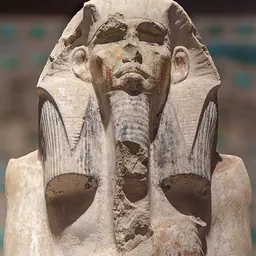
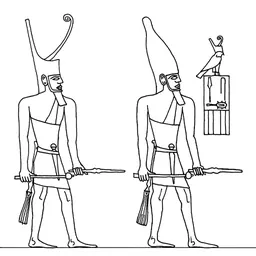
Related people
Same field, nearest in time
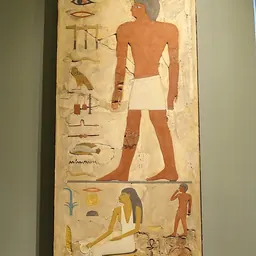


Contemporaries
People whose lives overlapped Imhotep's

Frequently asked questions
Who was Imhotep?
Egyptian architect, physician, astronomer, and god of medicine in ancient Egyptian mythology.
When was Imhotep born?
Imhotep was born in 2800 BC in Memphis.
When did Imhotep die?
Imhotep died in 2700 BC in Ancient Egypt.
What was Imhotep's occupation?
Imhotep was an architect, engineer, astronomer, physician, master builder and writer.
What was Imhotep known for?
Imhotep was known for Pyramid of Djoser.
What nationality was Imhotep?
Imhotep was Egyptian.
Sources & further reading
Cite this page
APA: Biography.guide. (2026). Imhotep. https://biography.guide/imhotep-architect/
MLA: "Imhotep." Biography.guide, https://biography.guide/imhotep-architect/.
Chicago: "Imhotep." Biography.guide. https://biography.guide/imhotep-architect/.
Data last updated: 2026-09-20 · Spot an error? Report a correction.
Portrait: Wikimedia Commons · author & licence
Page generated 2026-09-27 04:58 UTC