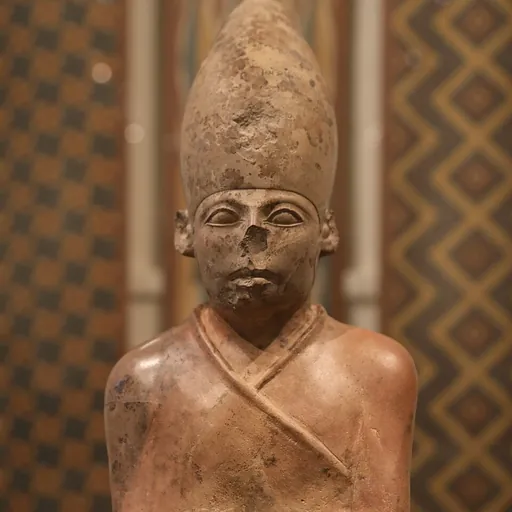
About Khasekhemwy
Lived 2800 BC – 2700 BC. Khasekhemwy was an Egyptian statesperson.
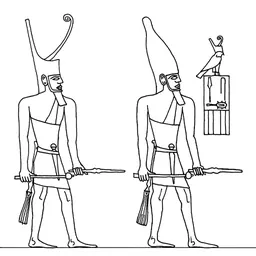
Seal of "Khasekhemwy" with the symbol of unification with the double crown of Upper and Lower Egypt being worn both by Horus and Seth, on a container of state treasury warehouse for the redistribution of agricultural production.
Khasekhemwy ( 2690 BC; , also rendered Kha-sekhemui) was the last Pharaoh of the Second Dynasty of Egypt. Little is known about him, other than that he led several significant military campaigns, reunified Egypt by his 13th year and built the large mudbrick structure known as Shunet El Zebib.
His Horus name can be interpreted as "The Two Powerful Ones Appear", but the name is recorded in many variants, such as Ḥr-Ḫꜥj-sḫm (Horus, he whose power appears), ḫꜥj sḫm.wj ḥtp nṯrwj jm=f (the two powers appear in that the ancestors rest within him) (etc.) He is also known under his later traditioned birth name Bebti (which is also one of the names of the god Horus) and under his Hellenized name Cheneres (by Manetho; derived from Khasekhemwy).
Reign
Length of Reign Khasekhemwy ruled for close to 18 years, with a floruit in the early 27th century BC. The exact date of his reign in Egyptian chronology is unclear but would fall roughly in between 2690–2670 BC.
According to Toby Wilkinson's study of the Palermo Stone in Royal Annals of Ancient Egypt, this near contemporary 5th dynasty document assigns Khasekhemwy a reign of 17.5 or nearly 18 full years. Wilkinson suggests that a reign of 18 "complete or partial years" can be attributed to Khasekhemwy since the Palermo Stone and its associated fragments record Years 3-6 and Years 12-18 of this king and notes that his final year is recorded in the preserved section of the document. Since the cattle count is shown to be regularly biennial during the second dynasty from the Palermo Stone (the year of the 6th, 7th and 8th count is preserved on the document plus full years after these counts respectively), a figure of 18 years is likely correct for Khasekhemwy. (or 18 years 2 months and 23 days from the main fragment of the Palermo Stone)
In addition, Manetho states Khasekhemwy ruled Egypt for thirty years, while the Turin King List states it was only twenty-seven years and a lifespan of forty years. However, both are considered unreliable as they were written long after Khasekhemwy's death whereas the Palermo Stone was carved 200 years after Khasekhemwy's death and is thought to be more accurate.
Events Khasekhemwy is normally placed as the successor of Seth-Peribsen, though some Egyptologists believe that he was the successor of Sekhemib-Perenmaat and that another Pharaoh, Khasekhem, ruled between them. Most scholars, however, believe that Khasekhem and Khasekhemwy are, in fact, the same person. Khasekhem may have changed his name to Khasekhemwy after he defeated Seth-Peribsen and reunited Upper and Lower Egypt following a civil war between the followers of the god Horus led by himself and the followers of the god Seth led by Peribsen . Others believe Khasekhemwy only defeated Seth-Peribsen after returning to Egypt from putting down a revolt in Nubia. Either way, he ended the infighting of the Second dynasty and reunited Egypt by his 12th year on the throne, since the Palermo Stone first refers to him as "the Dual King" by his 13th year.
Khasekhemwy is unique in Egyptian history as having both the symbols of Horus and Seth on his serekh. At the beginning of his reign he adopted the Horus name Khasekhem, "The powerful one has appeared", which clearly showed his allegiance to Horus. Later, however, after defeating Peribsen, he added the symbol of Seth next to Horus and added the epithet to his royal serekh, 20px20px /30px13px30px and accordingly changed his name to the dual form Khasekhemwy, "The two powers have appeared", along with the addition "The two powers are at peace with him". 180px Some Egyptologists believe that this was an attempt to unify the two factions; but after his death, Seth was dropped from the serekh permanently. Khasekhemwy was the earliest Egyptian king known to have built statues of himself.
Khasekhemwy apparently undertook considerable building projects upon the reunification of Egypt. He built in stone at el-Kab, Hierakonpolis, and Abydos. Khasekhemwy built enclosures at Nekhen, at Abydos (a structure known as Shunet ez Zebib), and was buried in the necropolis at Umm el-Qa'ab in Tomb V. He may also have built the Gisr el-Mudir at Saqqara.
An inscription on a stone vase records him “fighting the northern enemy within Nekheb”. This means that Lower Egypt may have invaded and almost taken the capital of Nekhen.
Year-by-year records
The Palermo Stone records the events of the twelfth to final years of Khasekhemwy's reign, and the London Fragment records the events of his third to sixth years of reign.
London Fragment: 3rd year: first occasion of the census of gold [and fields] 4th year: Following of Horus; second occasion of the census [of gold and fields] 5th year: ...of the common people 6th year: Following of Horus; third [occasion of the census of gold and fields]
Palermo stone, main fragment: 12th year: Following of Horus; sixth occasion of the census [of gold and fields] 13th year: Appearance of the Dual King; construction in stone 'The Goddess Endures' 14th year: Following of Horus; seventh occasion of the census of gold and fields 15th year: Creation of the copper statue "High is Khasekhemwy" 16th year: Following of Horus; eighth occasion of the census of gold and fields 17th year: Fourth occasion of reaching the wall; ship-building in Duadjefa year of death: 2 months and 23 days
Family Khasekhemwy's wife was Queen Nimaathap, mother of the King's Children. They were the parents of Djoser and Djoser's wife Hetephernebti. It is also possible that Khasekhemwy's sons were Sekhemkhet, Sanakhte, and Khaba, the three kings succeeding Djoser. Nimaathap was a northern princess who he titled “King bearing mother”.
The king wears the White Crown of Upper Egypt, and is dressed in a long robe. His right fist is drilled so as to attach a separate object, possibly a mace handle or a scepter. The king's name, Khasekhem, is inscribed in front of his feet. It is inscribed within a representation of the palace façade (the serekh), and the falcon god Horus stands on top. This scene seems to record the victory of Khasekhemwy over a northern Egyptian population led by their ruler, Besh. The name Besh may be a variation or nomen of Peribsen, or more probably the name of a Libyan northern tribe near the Fayum. This iconography of the king crushing enemies at his feet would remain a central theme of royal iconography for the next three millennia.
The era of Khasekhemwy's rule is therefore, in a historical context, an important phase in the development of Egypt's statehood. Increasing Egyptian involvement in neighbouring areas and the imposition of political control over territory beyond Egypt's borders, are important indicators of growing self-confidence. The intensity of Egypt's foreign relations in the Early Dynastic period is a complex mixture of ideology and practical economics, illuminating some of the problems and priorities faced by Egypt's early rulers.
Gallery
Don’t just read it —
keep it.
Full-length biographies made to live with: read them, listen on the way to work, watch them tonight.
- E-book
- Audio
- Video
Instant download · yours to keep · every purchase keeps this site free
Important facts
Family & relationships
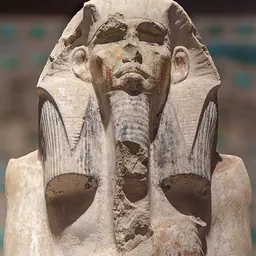
People in Khasekhemwy's life
Named in this biography and alive at the same time

Related people
Same field, nearest in time

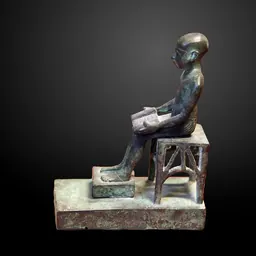
Contemporaries
People whose lives overlapped Khasekhemwy's

Frequently asked questions
Who was Khasekhemwy?
final king of the Second dynasty of Egypt
When was Khasekhemwy born?
Khasekhemwy was born in 2800 BC.
When did Khasekhemwy die?
Khasekhemwy died in 2700 BC.
What was Khasekhemwy's occupation?
Khasekhemwy was a statesperson.
What nationality was Khasekhemwy?
Khasekhemwy was Egyptian.
Sources & further reading
Cite this page
APA: Biography.guide. (2026). Khasekhemwy. https://biography.guide/khasekhemwy/
MLA: "Khasekhemwy." Biography.guide, https://biography.guide/khasekhemwy/.
Chicago: "Khasekhemwy." Biography.guide. https://biography.guide/khasekhemwy/.
Data last updated: 2026-09-23 · Spot an error? Report a correction.
Portrait: Wikimedia Commons · author & licence
Page generated 2026-09-27 05:05 UTC