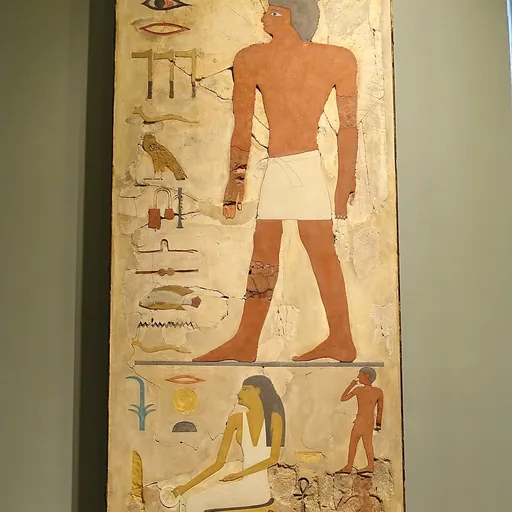
About Nefermaat
Born 2500 BC. Nefermaat was an Egyptian architect, civil servant, vizier and bastet.
Nefermaat I was an ancient Egyptian prince, a son of king Sneferu. He was a vizier possessing the titles of the king's eldest son, royal seal bearer, and prophet of Bastet. His name means "Maat is beautiful" or "With perfect justice".
Biography Nefermaat was the eldest son of Sneferu, the king and founder of the Fourth Dynasty of Egypt and his first wife. He was a half-brother of Khufu. Nefermaat's wife was Itet, also spelled as Atet. Fifteen of Nefermaat's offspring are named in his tomb, sons Hemiunu, Isu, Teta, Khentimeresh and daughters Djefatsen and Isesu are depicted as adults, while sons Itisen, Inkaef, Serfka, Wehemka, Shepseska, Kakhent, Ankhersheretef, Ankherfenedjef, Buneb, Shepsesneb and Nebkhenet and daughter Pageti are shown as children. His son Hemiunu is probably identical with vizier Hemiunu, who was believed to have helped plan the Great Pyramids.
One of Nefermaat's sisters, Nefertkau had a son also called Nefermaat.
Tomb
Nefermaat was buried in mastaba 16 at Meidum. He was one of several relatives of King Sneferu, who was buried in Meidum. The tomb is known for the special technique used for drawing the scenes. Sculptors carved deeply incised images that then were filled with colored paste. This method was labor-intensive because the paste tended to dry, crack, and then fall out. The technique results in vividly colored scenes. This tomb is the only one known to date showing this technique. The fact that later, the plaster cracked and resulted in the loss of the paste, likely led to craftsmen abandoning this type of decoration. A 2015 research paper by Francesco Tiradritti at the Kore University of Enna, published on LiveScience, suggested that the painting could be a nineteenth-century forgery, possibly made by Vassalli.
A 2021 research paper used a biodiversity indicator called the 'Tobias Criteria ' to assess the 'Meidum Geese " to see if these geese match with the species they have been identified as depicting. While Greylag and Greater white-fronted geese were consistent with their respective images, Red-breasted geese was a mismatch according to the analysis. Reasons to account for these differences could be due to either: artistic/cultural license; the depiction being a blend of different animals; or is an accurate depiction of an animal that no longer exists. Of these reasons, the study considered other realistic animal art from the Chapel of Itet (waterfowl, dogs, jackal, leopard, antelope) that are also identifiable to species-level, and suggested it possible the geese painted with red-coloured breast regions may be an unknown extinct goose species. A 2022 study found them to be within the plumage variation range and artistic licence for red-breasted geese.
Don’t just read it —
keep it.
Full-length biographies made to live with: read them, listen on the way to work, watch them tonight.
- E-book
- Audio
- Video
Instant download · yours to keep · every purchase keeps this site free
Important facts
Family & relationships
Related people
Same field, nearest in time


Frequently asked questions
Who was Nefermaat?
ancient Egyptian prince and vizier
When was Nefermaat born?
Nefermaat was born in 2500 BC in Ancient Egypt.
What was Nefermaat's occupation?
Nefermaat was an architect, civil servant, vizier and bastet.
What nationality was Nefermaat?
Nefermaat was Egyptian.
Sources & further reading
Cite this page
APA: Biography.guide. (2026). Nefermaat. https://biography.guide/nefermaat/
MLA: "Nefermaat." Biography.guide, https://biography.guide/nefermaat/.
Chicago: "Nefermaat." Biography.guide. https://biography.guide/nefermaat/.
Data last updated: 2026-09-22 · Spot an error? Report a correction.
Portrait: Wikimedia Commons · author & licence
Page generated 2026-09-27 04:57 UTC